Piazza Dei Signori: Dante's Square
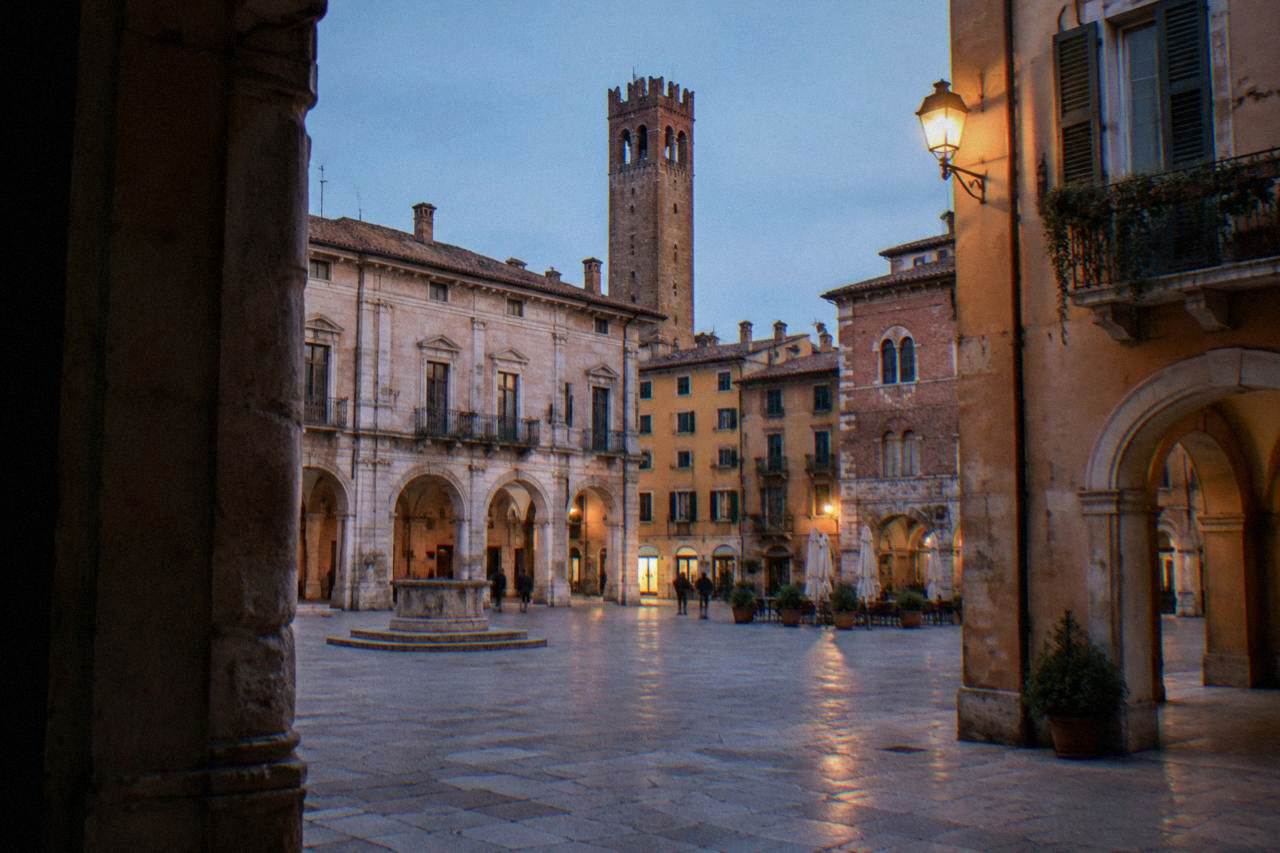
Piazza dei Signori is the monumental administrative square of medieval Verona, one block south of Piazza delle Erbe, free to enter at any hour and best known for the statue of Dante that stands at its centre.
Short answer
Piazza dei Signori is a free, always-open public square in central Verona, a short walk from Piazza delle Erbe, framed by the palaces of the medieval city government and dominated by the statue of Dante.
Piazza dei Signori is the ceremonial heart of medieval Verona, in Veneto, northern Italy: an inland city on the Adige river whose historic centre has been a UNESCO World Heritage Site since it was inscribed in 2000. The square sits one block south of Piazza delle Erbe, the old Roman forum, and it was deliberately built beside that marketplace as the seat of government, the place where the lords who ruled the city held court, pronounced judgement and were buried within a few steps of their power. Today it is free, open at every hour, and it holds the statue of Dante Alighieri that gives the square its everyday Veronese name, Piazza Dante. This page on the Verona Italy Travel Guide covers what stands around the square, how it connects to the rest of the historic centre, and how to plan a visit around it.
What Is Piazza Dei Signori In Verona?
Piazza dei Signori is the former government square of medieval Verona, a free public space open at any hour, one block south of Piazza delle Erbe and a few minutes on foot from the Arena. It is framed by the palaces from which the city was administered, it carries the statue of Dante at its centre, and it leads directly to the Arche Scaligere, the Gothic tombs of the Scala family, beside the church of Santa Maria Antica.
The square was the civic counterpart to the commercial Piazza delle Erbe. Where the older piazza held the market, the seat of the courts and the merchant life of the city, Piazza dei Signori was laid out as a dignified enclosure of government buildings: the palaces of the podesta and the Scala rulers, the courthouse and the council loggia. The Veronese name used today, Piazza Dante, comes from the monument at the centre, raised to Dante Alighieri, who lived in Verona in exile during the years the Scala family sheltered him after his banishment from Florence.
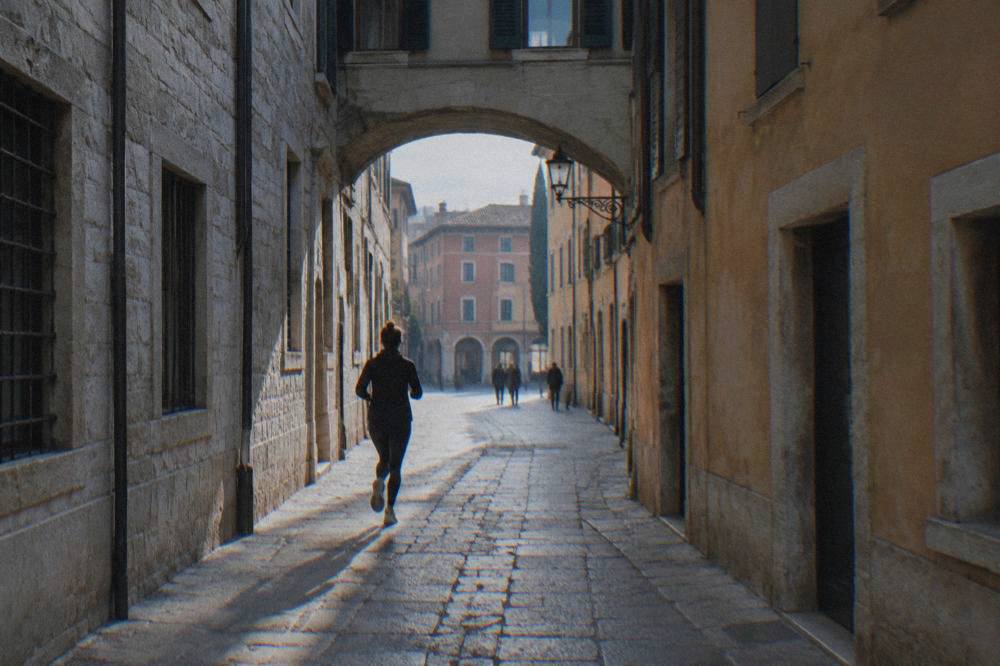
The square rewards slow looking rather than ticketed entry. There is no admission desk, no queue and no closing time: the piazza is an open room of striped stone, arcades and sculpture, and its interest lies in reading the buildings against each other. A visit combines naturally with the market square to the north, the Scala tombs to the west and the lanes that drop towards the Adige, and the whole cluster sits inside the camera-policed ZTL of the historic centre, so it is reached on foot or by bus rather than by car, a point covered in detail on the site's page on the ZTL and parking.
What Can You See Around Piazza Dei Signori?
The square is framed by four principal monuments: the Palazzo del Podesta with its arch, the Palazzo della Ragione behind it, the Loggia del Consiglio on the north side and the Domus Nova on the east, with the Dante monument at the centre and the Arche Scaligere, the fenced Gothic tombs of the Scala family, immediately to the west beside Santa Maria Antica. Every one of these exteriors can be viewed for free.
The Palazzo del Podestà, correctly the Palazzo del Podestà, closes the square's south side and is pierced by a tall arch through which the lane to Santa Maria Antica passes. Behind it rises the great bulk of Palazzo della Ragione, the medieval courthouse of the commune, whose stair and courtyard belong to the civic museum complex. On the north side stands the Loggia del Consiglio, a Renaissance loggia built for the city council, and opposite it the Domus Nova, rebuilt as law courts under Venetian rule. The Dante monument stands on a column base in the centre; the poet is shown in robes, sombre, gazing down the square that carries his name.
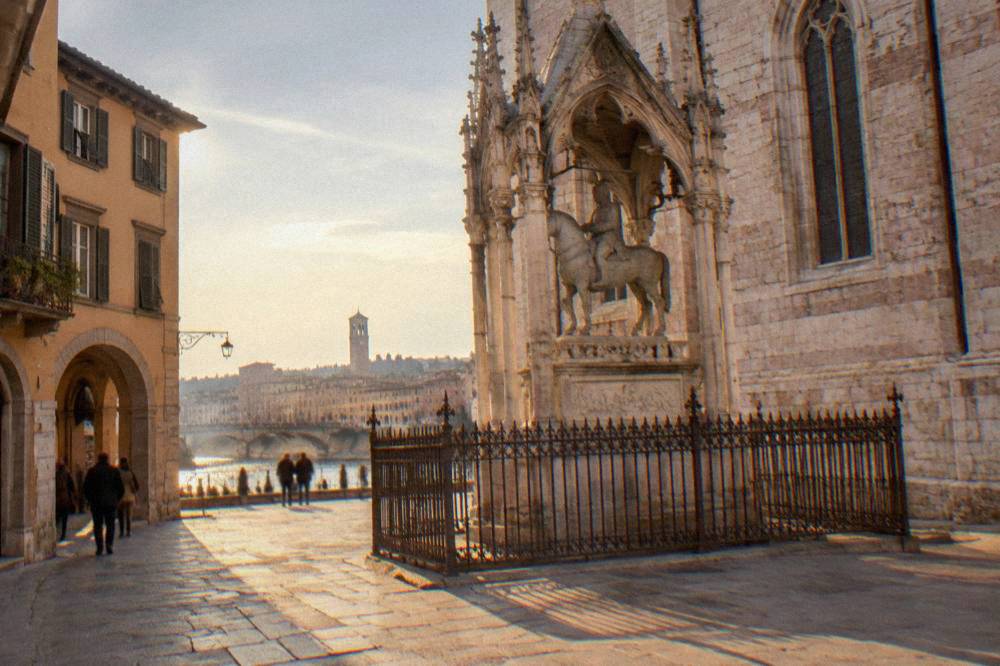
Through the arch and a few steps west lie the Arche Scaligere, the ornate Gothic burial monuments of the Scala family, set in a wrought-iron enclosure against the wall of Santa Maria Antica. The church itself is small and severe, and it is often free or tied to the civic ticket on the same day, with VeronaCard coverage listed by the Comune. The tombs are among the most photographed Gothic objects in northern Italy, and they are the reason a visit to Piazza dei Signori naturally expands into a quarter of an hour or more.
| Element | Where it stands | What it is | Access |
|---|---|---|---|
| Dante monument | Centre of the square | Marble statue of Dante Alighieri on a pedestal | Free, open air |
| Palazzo del Podestà | South side | Medieval palace of the podesta, pierced by an arch | Exterior free |
| Palazzo della Ragione | Behind the south side | Former courthouse of the commune | Exterior free |
| Loggia del Consiglio | North side | Renaissance council loggia | Exterior free |
| Domus Nova | East side | Former law courts under Venice | Exterior free |
| Arche Scaligere | West, beside Santa Maria Antica | Gothic tombs of the Scala family | Viewable through the fencing |
| Statue of Girolamo (hunchback) | Under the arch | Stone figure once used for public proclamations | Free, open air |
An evening visit changes the square entirely, and it is the form of the visit this site's featured tour exists for. The Moonlight Evening Walk covers Piazza dei Signori, the Arena and the river bridges after dark with a local guide; Check availability if that framing appeals. The same square under a midday sun is a crossing point between Piazza delle Erbe and the Scaliger tombs; after dark, emptied of the day's foot traffic, it reads the way its builders intended, as a stage.
Is Piazza Dei Signori Free To Visit In Verona?
Yes, Piazza dei Signori is a free public square, open at every hour with no ticket, no gate and no closing time, like Piazza delle Erbe, Piazza Bra, Ponte Pietra and Porta Borsari in the same historic centre. The sights immediately around it are mixed: the Scala tombs are viewed from outside for free, while the Arena, Juliet's House and the civic museums all charge admission, so the piazza is the free anchor of a walk that can stay free or spread into paid sights.
This distinction matters because two neighbouring Verona landmarks changed their access rules in 2026 and older guides have not caught up. Juliet's courtyard stopped being free on 1 April 2026: the courtyard route now costs 5 euro, the full house and balcony route 12 euro, entry is via the Teatro Nuovo and booking is made online, as the Comune's own notice for the Casa di Giulietta states. The Arena, likewise, is a paid daytime visit, 12 euro full and 9 euro reduced per the Comune di Verona's price list, with a 3 euro rate for visitors aged 18 to 25 and free entry with the VeronaCard.
| Sight | Distance from Piazza dei Signori | Admission | Notes |
|---|---|---|---|
| Piazza dei Signori itself | At the square | Free | Open public space |
| Arche Scaligere | A few steps west | Viewed free through the fence | Interior access varies, check locally |
| Piazza delle Erbe | One block north | Free | Open public space |
| Torre dei Lamberti | About 5 minutes on foot | 6 euro full, reported | Free with VeronaCard, per the tower's own site |
| Casa di Giulietta | Under 10 minutes on foot | 5 euro courtyard, 12 euro house | Online booking since 1 April 2026 |
| Arena di Verona | About 10 minutes on foot | 12 euro full, 9 euro reduced | 3 euro for ages 18 to 25 from EU and reciprocity countries |
| Castelvecchio | About 15 minutes on foot | 9 euro full, reported | Closed Mondays, per the museum site |
For visitors stacking several paid sights, the VeronaCard is the arithmetic worth doing. The card became digital on 1 September 2026, delivered through the "Your Verona" web app, at 33 euro for 24 hours or 38 euro for 48 hours with ATV urban buses included, or 29 and 32 euro without transport, per the Comune di Verona's announcement. It covers the Arena, the civic museums and Juliet's House, though Juliet's House still requires an online booking even for card holders, and it does not include the airport Aerobus.
How Does Piazza Dei Signori Connect To Dante And Romeo And Juliet?
Dante lived in Verona in exile under the protection of the Scala rulers, and the statue at the square's centre was raised to that hospitality; the Romeo and Juliet connection is indirect but real, because the same Scala court that sheltered Dante appears in the play as Prince Escalus, and Juliet's House lies under ten minutes away on foot. The square is therefore the place where Verona's two literary legends, the historical poet and the fictional lovers, sit closest together.
The historical chain runs through the sources. Luigi da Porto, writing in 1531, set the story of the two lovers in Verona and named the warring households after real Veronese factions; Matteo Bandello retold it in 1554 and Arthur Brooke turned it into the poem of 1562 that Shakespeare used. Shakespeare never visited Verona, but he kept the setting and the ruling prince, and the prince's palace stood in exactly this district of medieval administration. The site's longer treatment of the question, why Shakespeare chose Verona for Romeo and Juliet, unpacks the sources in full.
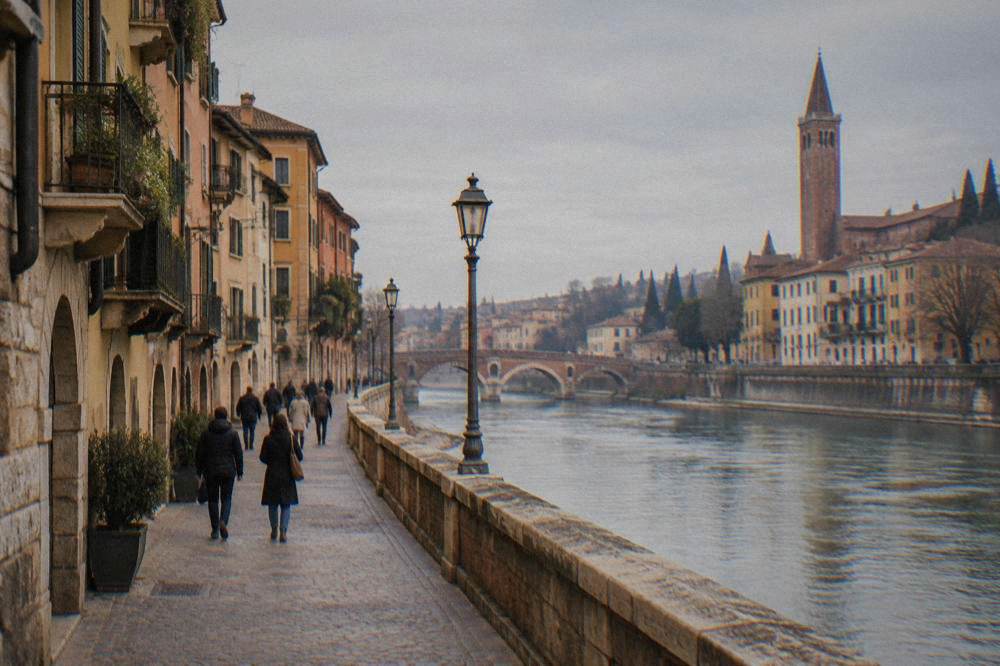
From the square, the walk to the Casa di Giulietta runs north through the lanes behind Piazza delle Erbe. The balcony itself is not original: it was assembled onto the medieval house in 1940 from existing material, as the Comune's tourism pages report, and the question of whether the balcony is real has its own answer page on this site. Since the 2026 change, the fast-track ticket with audio guide is the practical way in; and the courtyard rules are laid out plainly at is Juliet's courtyard free.
When Is The Best Time Of Day To Visit Piazza Dei Signori?
Early morning and the evening give the square its calmest and most photogenic conditions, because Piazza dei Signori is an open public space with no hours and no crowd control, and its foot traffic follows the market rhythm of Piazza delle Erbe one block north.
On climate, the ERA5 reanalysis for Verona, 1991 to 2020, puts July mean daily highs at 29.3 C and January mean daily lows at minus 0.4 C, so midday in high summer is the least comfortable hour and the lit evening the most atmospheric.
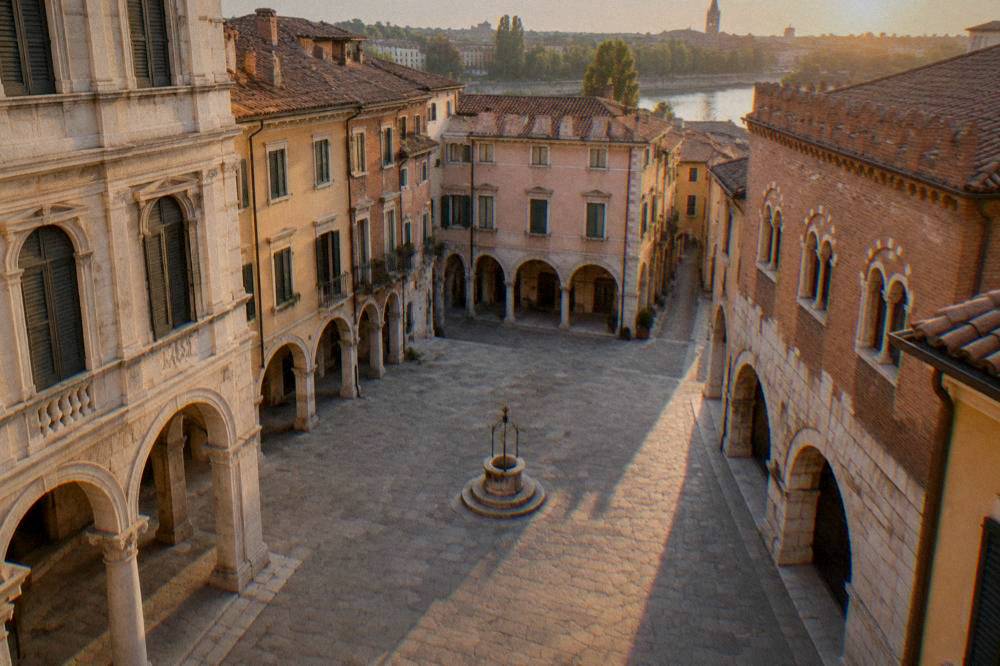
There is no wrong season, only different weather. Spring and autumn sit in the comfortable middle of the table below; November carries the highest rainfall of the year at 118.2 mm in the ERA5 normals, which matters for an open square with little shelter, while winter light on striped stone at 7 to 8 C mean highs is low and flattering for photography. The Arena opera season, which ran 5 June to 12 September in 2026 and is announced for 11 June to 11 September 2027, pushes evening foot traffic across the whole centre, and the square lies on the natural walking line between the Arena and the river.
| Month | Mean daily high (C) | Mean daily low (C) | Rain (mm) |
|---|---|---|---|
| Jan | 7.3 | -0.4 | 52.3 |
| Feb | 9.5 | 0.4 | 58.8 |
| Mar | 14.0 | 3.6 | 67.4 |
| Apr | 17.8 | 7.6 | 93.5 |
| May | 22.3 | 12.2 | 109.7 |
| Jun | 26.6 | 16.5 | 92.3 |
| Jul | 29.3 | 19.1 | 79.4 |
| Aug | 29.1 | 19.4 | 84.1 |
| Sep | 23.7 | 15.1 | 99.7 |
| Oct | 18.1 | 10.5 | 107.2 |
| Nov | 12.3 | 5.3 | 118.2 |
| Dec | 7.8 | 0.8 | 71.1 |
The figures are ERA5 reanalysis values for 1991 to 2020, a modelled grid cell for Verona rather than a weather-station record, and they describe climate normals, not a forecast. For planning around the piazza they point one way: carry an umbrella from late September through November, and pick the evening over the midday in summer.
What Is There To Eat Near Piazza Dei Signori?
The lanes between Piazza dei Signori and Piazza delle Erbe hold the densest concentration of food stops in the historic centre, and the Veronese plates to look for are pastissada de caval, the long-simmered horse stew served with polenta or gnocchi, risotto all'Amarone made with Vialone Nano rice and Valpolicella wine, bollito with peara sauce, and pandoro, the Veronese Christmas yeast cake that originated in the city.
The square sits inside the old market quarter, and its food culture descends directly from that. Veronese cooking runs on the wine hills to the north: Amarone and Valpolicella reds go into the risotto and the stew, Soave and Lessini whites come from east of the city. A guided walk with tastings is the efficient way to sample several of these in one sitting, and the food tour with wine and olive oil tastings runs through the centre's food stops; for visitors who want the plates placed in context rather than found one by one.
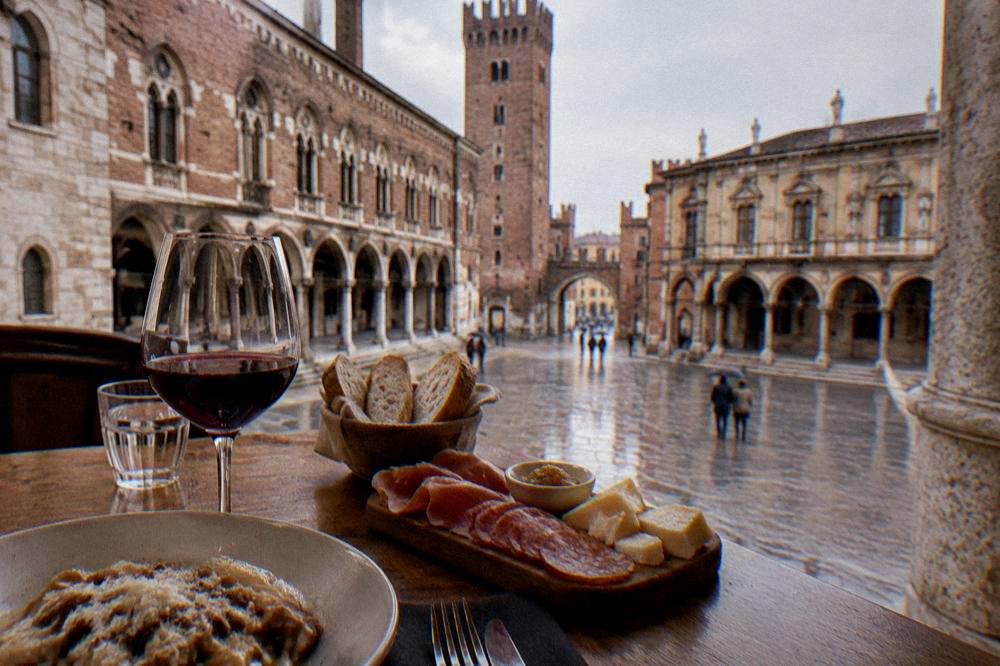
No restaurant is named on this page, and none needs to be: the quarter's osterie change, and the reliable move is to eat one street back from the main squares where the menus list the four dishes above. Lunch service in Verona typically runs from about 12:00 to 14:30 and dinner from about 19:30, so the square at 19:00, in the last light, is the calm half hour before the restaurants fill.
Does Piazza Dei Signori Host Events And Markets?
Piazza dei Signori is a regular venue for Verona's Christmas markets, which ran from 21 November to 28 December in 2025 across Piazza Bra and the adjoining squares including Piazza dei Signori, per the Comune di Verona; official dates for 2026 had not been published, so confirm on the Comune's events pages before planning a festive trip. Outside the market season the square is usually quiet, a contrast to the market stalls and café terraces of Piazza delle Erbe next door.
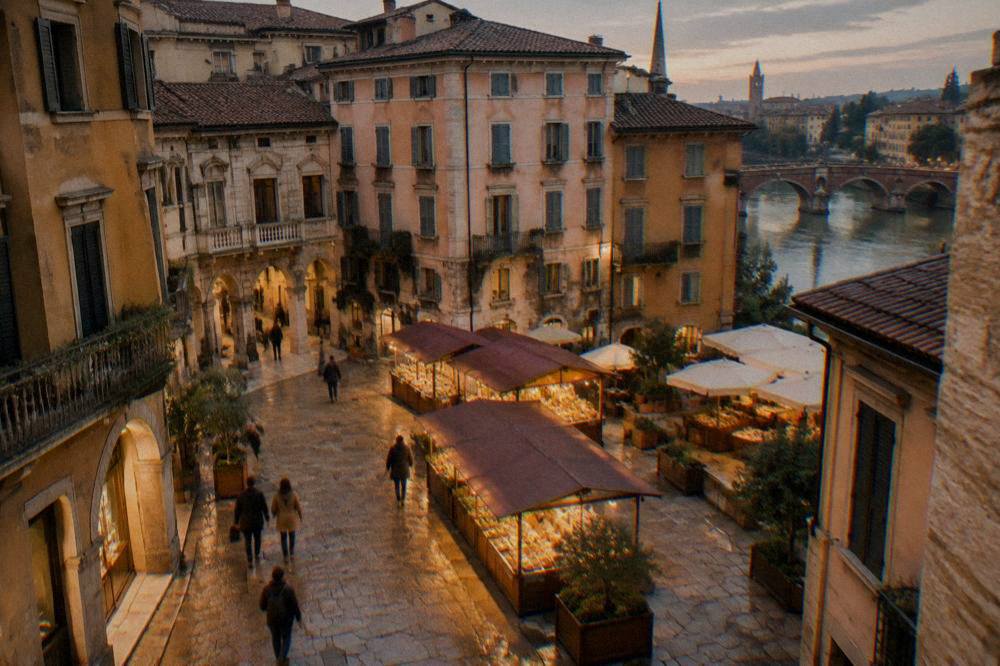
The other recurring Verona events sit within walking distance rather than in the square itself. Tocati, the international festival of street games, filled the Veronetta quarter from 18 to 20 September 2026 and was free to attend; Verona in Love ran 13 to 15 February in 2026; Vinitaly, the wine fair, is announced for 11 to 14 April 2027 and turns the whole city busy. During the opera season the square lies on the route between the Arena and the Adige bridges, which lifts its evening footfall considerably.
| Event | Latest confirmed edition | Where it touches the square | Status for the next edition |
|---|---|---|---|
| Christmas markets | 21 Nov to 28 Dec 2025 | Stalls in Piazza dei Signori and adjoining squares | 2026 dates not published, confirm locally |
| Tocati street games | 18 to 20 Sept 2026, free | Veronetta quarter, across the river | 2027 not announced |
| Verona in Love | 13 to 15 Feb 2026 | Centre-wide, love-themed programme | 2027 not announced |
| Vinitaly wine fair | 11 to 14 April 2027 | Fairground, city hotels and bars full | Announced |
| Arena opera season | 5 June to 12 Sept 2026 | Raises evening footfall across the centre | 11 June to 11 Sept 2027 announced |
Which Day Trips Combine Well With A Visit To Verona?
Verona is an inland city on the Adige, and the classic day trips from its centre run west to the Lake Garda towns, north to the Valpolicella wine hills and east to Soave, Vicenza, Padua and Venice, with drive times from the Arena of about 40 minutes to Sirmione, 25 to Valpolicella, 48 to Vicenza and 85 to Venice, computed over OpenStreetMap routing in free-flow conditions.
None of these is inside Verona, and none is needed for a first visit that centres on Piazza dei Signori and the surrounding quarter.
Sirmione, the peninsula town on Lake Garda, is in Brescia province in Lombardy, not Verona province, and is reached by the ATV line 164 bus in about 55 minutes or by train to Peschiera and bus onward. The Monte Baldo cable car at Malcesine, a round trip of 30 euro or 28 euro booked online per the operator's own fare page, runs roughly from early April to early November, and the Navigazione Laghi full-lake day pass stands at 39.50 euro for an adult in 2026, though the north-south passenger service is reported suspended from 2 November 2026 to 12 March 2027, so confirm sailings before a winter lake plan.
| Destination | Drive time from the Arena | Direction | Main draw |
|---|---|---|---|
| Valpolicella (Sant'Ambrogio) | About 25 min | North | Amarone wineries and hills |
| Bardolino | About 37 min | West | Lake Garda promenade and wine |
| Sirmione | About 40 min | West | Scaliger castle and thermal springs |
| Garda | About 42 min | West | Lakefront town of Garda |
| Soave | About 33 min | East | Walled town and Soave whites |
| Vicenza | About 48 min | East | Palladio's city, a day trip guide of its own |
| Mantua | About 54 min | South | Renaissance lakeside city |
| Padua | About 67 min | East | Frescoed chapels and old university |
| Venice | About 85 min | East | Lagoon city, trains from Porta Nuova |
| Verona Villafranca airport | About 26 min | South | The VRN airport and Aerobus link |
Drive times are computed figures for free-flow traffic and say nothing about summer Saturdays on the lake roads, when a train or bus can be the calmer choice. The site's day-trip pages, beginning with Vicenza and the Lake Garda itinerary, carry the detail for each of these.
For the full range of guided options around the city, from evening walks to food and wine tours, the site's root page on things to do in Verona collects the selection in one place, and the trio below is the shortlist that pairs best with a visit built around this square.
Common Questions About Piazza Dei Signori In Verona
Is Piazza dei Signori free to enter?
Yes. It is an open public square with no gate, ticket or closing time, like Piazza delle Erbe, Piazza Bra, Ponte Pietra and Porta Borsari. The paid sights around it, the Arena, Juliet's House and the civic museums, are separate.
Why is it called Piazza Dante?
Because of the statue of Dante Alighieri at its centre, raised to the poet who lived in Verona in exile under the protection of the Scala rulers. Both names are in use, and street signs may carry either.
What are the Arche Scaligere?
The Gothic burial monuments of the Scala family, set in a fenced enclosure beside the church of Santa Maria Antica, a few steps west of the square through the arch of the Palazzo del Podesta. They can be viewed from outside at any time.
How far is Piazza dei Signori from Juliet's House?
Under ten minutes on foot, north through the lanes behind Piazza delle Erbe. Since 1 April 2026 the Casa di Giulietta courtyard costs 5 euro and the house and balcony route 12 euro, booked online via the Teatro Nuovo entrance.
Can you visit the square in the evening?
Yes, at any hour. The square is unlit museum architecture after dark and lies on the natural evening walking line between the Arena, Piazza delle Erbe and the river, which is why evening walking tours include it.
Does the VeronaCard help here?
Not for the square itself, which is free, but it covers the paid sights around it, including the Arena, the civic museums and Juliet's House, at 33 euro for 24 hours or 38 euro for 48 hours with ATV buses since the card went digital on 1 September 2026. Juliet's House still needs an online booking even with the card.
Piazza dei Signori rewards the visitor who treats it as a room to read rather than a box to tick: stand under the arch, look back at the Dante column, then walk west to the Scala tombs and north to the market square, and the whole structure of medieval Verona, government, market, church and tomb, lies within five minutes in every direction.
Before you go, the pick for this guide:
History and Hidden Gems Walk
★ 5 1,661 reviews · From $39
Check availability →