Can You Do Verona And Venice In One Day?
Yes, Verona and Venice fit in one day thanks to a 1h-1h15 train link, but it is tight: here is what the timetable, the sight hours and the 2026 ticket changes allow.
Yes, Verona and Venice can both be seen in a single day, and the reason is arithmetic rather than optimism. Verona, in Veneto, northern Italy, is an inland city on the Adige river, and the train from its Porta Nuova station to Venice takes 1 hour to 1 hour 15 on high-speed services, per the timetables reported by the operators. That leaves roughly six usable hours in Venice if Verona gets the morning, which is enough for the walk between the two stations and the essentials, but not for a museum. The pairing is common enough that the question is not whether it works but what it costs in depth: two half-days mean choosing three or four sights per city and accepting that the Arena, the Doge's Palace and a gondola yard cannot all fit.
The comparison that usually decides it is laid out in Which Is Nicer Venice Or Verona?, and the honest answer there and here is the same: they are different products, and one compressed day shows the postcard layer of each. What follows is what the timetables, the 2026 ticket rules and the sight hours actually allow.
Can You Do Verona And Venice In One Day?
Yes, one day is enough to see the core of both cities if the train is booked in advance and the plan is Verona in the morning, Venice in the afternoon: Porta Nuova to Venice is 1 hour to 1 hour 15 by high-speed train, so a 07:00 start in Piazza Bra can be standing in front of the Basilica di San Marco by early afternoon. The pairing costs depth, not access. The failure mode is not distance but ambition: anyone who plans the Arena, a Valpolicella lunch, San Marco, the Accademia and a sunset gondola in one day will miss two of them.
What Does The Train Between Verona And Venice Actually Take?
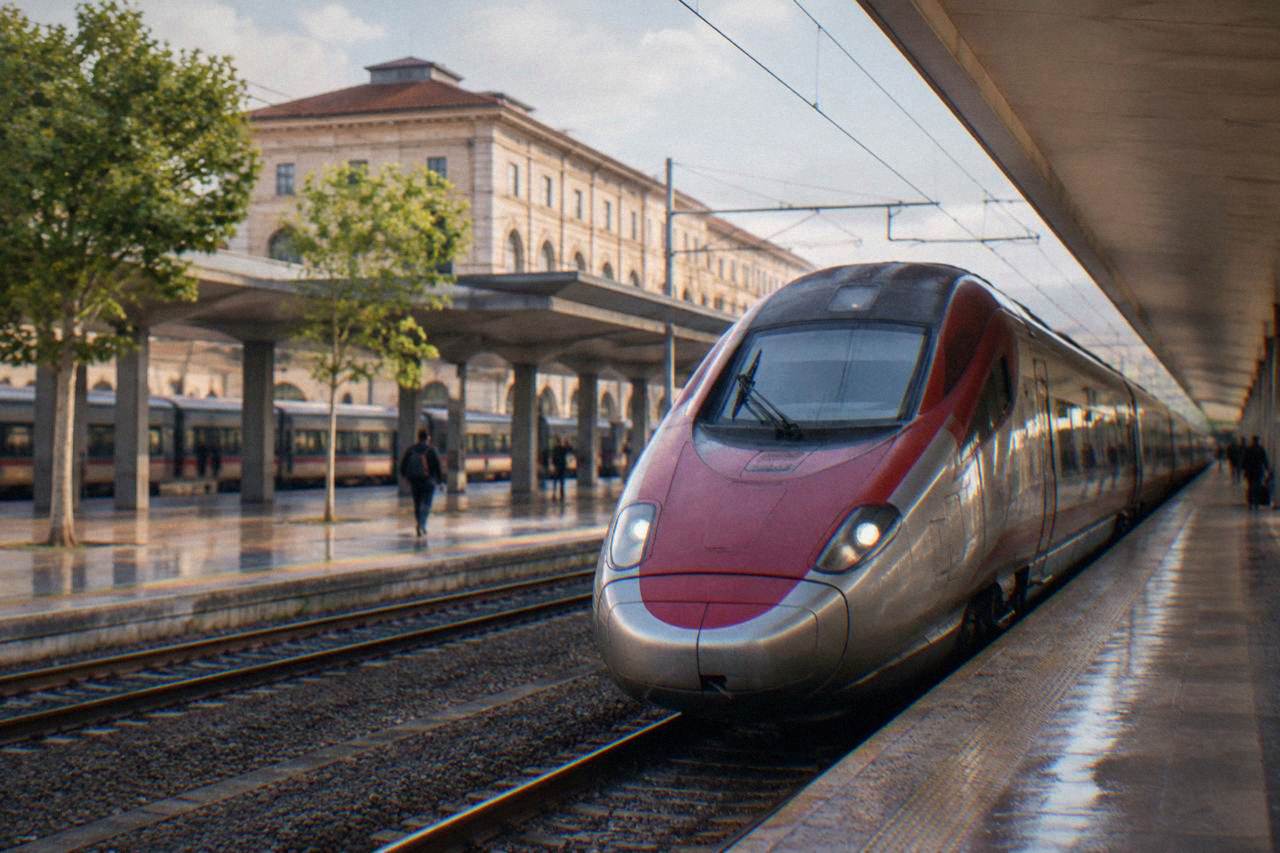
Direct high-speed trains from Verona Porta Nuova to Venice run the route in 1 hour to 1 hour 15, arriving at Venezia Santa Lucia, the station on the lagoon's edge, according to the operators' timetables. From the earlier category of service the same corridor is reported at 58 to 75 minutes. A same-day return is therefore about two and a half hours of rail time in total, before the walks at either end.
Two practical notes shape the day. First, Venice Santa Lucia is the stop to book, not Venezia Mestre: Mestre is on the mainland and adds a local connection. Second, no fare is given for this journey because the pack does not verify one; check the live price on the operator's own booking site, where advance high-speed tickets are normally the cheapest option and seat reservation is compulsory.
The drive, for completeness, is a different animal: about 122 km and 85 minutes of free-flow road time from the Arena to Venice, computed over standard routing, before parking at the edge of the lagoon and taking a vaporetto or people mover in. Rail wins on every count for a day trip.
| Leg | Method | Time | Note |
|---|---|---|---|
| Verona Porta Nuova to Venice Santa Lucia | High-speed train, direct | 1 h to 1 h 15 | Reported by the operators' timetables; reserve a seat |
| Verona centre to Porta Nuova | Walk or urban bus | about 10-20 min | Urban single ticket 1.50 euro, valid 90 minutes |
| Venice Santa Lucia to Piazza San Marco | On foot | about 25-30 min | Or vaporetto down the Grand Canal |
| Arena to Venice, by road | Car | about 85 min, 122 km | Computed free-flow; parking is at the mainland edge |
What Does A Realistic One-Day Split Look Like?
A realistic split gives Verona the morning and Venice the afternoon: Piazza Bra and the Arena exterior first, then Piazza delle Erbe, Juliet's courtyard and the walk to the station, an early-afternoon train, and four hours in Venice for San Marco, the Rialto bridge and the Grand Canal before an evening return. It works because Verona's historic core is compact and walkable, a point this site examines in Is Verona Walkable?
The Verona half needs care around three 2026 rules. The Arena can be visited by day for 12 euro full price, 9 euro reduced, with a 3 euro rate for visitors aged 18 to 25, but it is reported closed on Mondays and to close early on opera evenings, so a one-day itinerary should check its own ticket page before counting on an interior visit. Juliet's House is no longer a free courtyard glance: since 1 April 2026 the courtyard route costs 5 euro and the full house and balcony route 12 euro, booked online, with entry via the Teatro Nuovo. And the VeronaCard became a digital pass on 1 September 2026 at 33 euro for 24 hours with city transport, so it is a marginal buy for a morning-only visit. Everything else covered here is indexed on Verona Italy Travel Guide.
Venice's half should be built around walking, not vaporetto logistics. San Marco, the Rialto bridge and the Grand Canal views between them form a loop from the station that fits four hours at a steady pace. Venice also regulates day visitors with an access fee on certain dates, so confirm the current rules on the city's own access-fee page before travelling. For the full opposite direction, a Venice base with a Verona excursion, the itinerary in One Day In Verona From Venice works the same logic in reverse.
If a second city feels like one city too many, the alternative that keeps the day Italian is the one this site features elsewhere: a half-day in the Valpolicella wine hills, about 25 minutes and 21 km by road from the Arena. The Half-Day Valpolicella and Amarone experience covers vineyard and cellar time with Amarone tasting, and Check availability shows the current dates.
Is It Better To Day-Trip From Verona Or From Venice?
Day-tripping from Verona is the easier direction, because Venice rewards a full day less than Verona does and the morning train lands in Venice before the late-morning crush, while the return leg lets a tired traveller sleep to Verona. Staying in Verona also keeps the lower-cost base, the quieter evenings and a wine region 25 minutes away, and the evening arrival back in Verona leaves time for dinner rather than a vaporeto sprint.
The costs cut both ways. Venice lodging sits at a premium, but a Venice base means the lagoon at dawn, before the day visitors arrive, and a Verona excursion that can start mid-morning. A Verona base means the Arena at night, the Valpolicella or Soave hills on a spare day, and Lake Garda towns such as Sirmione, about 40 minutes by road, on another. The trade is examined city against city in Venice To Verona, and for a longer loop the Northern Italy Itinerary strings both cities with Padua and Vicenza, each under an hour by rail.
What Are The Traps In A One-Day Plan?
The traps are timing rules, not distances: the Arena is reported closed to daytime visitors on Mondays, Juliet's House requires online booking since April 2026, Venice regulates day visitors with an access fee on certain dates, and the last direct return trains set a hard evening deadline in Venice. Each one breaks an itinerary only when it is discovered at the door.
A short list, drawn from the rules for 2026:
| Trap | The rule | What to do |
|---|---|---|
| Arena daytime visit | 12 euro full, reported closed Mondays, early close on show days | Check the Arena's own ticket page for the exact date |
| Juliet's House | 5 euro courtyard, 12 euro house route, online booking, entry via Teatro Nuovo | Book the slot before the trip |
| Wrong Venice station | Trains also stop at Venezia Mestre, on the mainland | Book through to Venezia Santa Lucia |
| Verona ZTL | Historic centre is camera-policed; non-residents get at most four entries a month | Arrive by train, as this plan assumes |
| Return train | Last direct services set the evening deadline | Fix the return departure before the day starts |
The wider question of whether one day sells either city short is answered in How Many Days In Verona Is Enough?, and the short version is that Verona alone repays two full days. What one day does deliver, if the trains cooperate, is the pair of skylines the region is famous for: the Arena's pink stone ring in the morning and the Campanile over the lagoon in the late afternoon.
When Is One Day Not Enough?
One day stops being enough the moment the plan adds a timed interior to Venice: the Doge's Palace and the Basilica's museum pass each swallow an hour or more of queue and visit, and the return train does not wait, so a day that books a Venice slot has to drop the Verona sightseeing down to exteriors and squares. A second day, split as one per city, is the fix this site recommends whenever the trip allows it.
The same logic applies in the other direction for travellers with a spare half-day in Verona: the city's own Things To Do In Verona rundown shows how much the compact centre actually holds, from the Torre dei Lamberti to the Roman theatre across the river. If the afternoon in Verona is free rather than the morning, an evening product often fits where a museum does not: the moonlight walk covers the lit-up Arena, Piazza delle Erbe and the river bridges after dinner, and the gelato class turns a rain window into dessert.
Is The Verona Half Or The Venice Half More Flexible?
The Verona half is the more flexible of the two, because its core sights are open-air and free to walk past: Piazza Bra, Piazza delle Erbe, the Ponte Pietra and the river banks cost nothing and have no booking, while Venice's headline spaces funnel every arrival through the same two or three corridors, so delays there cannot be absorbed. Budget the slack into Venice, not Verona.
That asymmetry is the quiet argument for the morning-in-Verona split. A late start costs Verona a tower climb or a courtyard; the same late start in Venice costs the calm hour at San Marco that makes the whole crossing worthwhile. Build the day with an hour of buffer on the Venice side, fix the return train before leaving Porta Nuova, and the one-day pairing does what the timetable promises.
Common Questions About Verona And Venice In One Day
Can You Do Verona And Venice In One Day?
Yes. The high-speed train from Verona Porta Nuova to Venice takes 1 hour to 1 hour 15, so a morning in Verona and an afternoon in Venice is a workable single day, with exteriors and squares rather than timed museum interiors.
How far is Verona from Venice?
About 122 km by road, roughly 85 minutes of free-flow driving, or 1 hour to 1 hour 15 by direct high-speed train from Porta Nuova to Venezia Santa Lucia.
Is it better to stay in Verona or Venice?
A Verona base is generally the easier and calmer option, with Venice as a day trip; a Venice base trades that for the lagoon at dawn. The trade-offs are compared in this site's guide to the two cities.
Do you need to book Juliet's House in advance for a one-day visit?
Yes. Since 1 April 2026 the courtyard route costs 5 euro and the house and balcony route 12 euro, with online booking and entry via the Teatro Nuovo, so a same-day walk-up is no longer the plan.
Does the Venice access fee apply to day visitors?
Venice applies an access fee to day visitors on certain peak dates; the city's own access-fee page carries the current dates and prices, so check it before travelling.
The question underneath all of these is whether one compressed day is a real visit or a checklist, and the honest answer is that it is a very good first date with two cities at once. For a slower alternative that stays on the Verona side of the rail line, a half-day among the Valpolicella vines replaces the second skyline with the region's other famous export.
A one-day pairing of Verona and Venice is a timetable problem with a known answer: book the early train, keep Verona's half outdoors and free-flowing, give Venice the buffer, and the day holds both skylines.