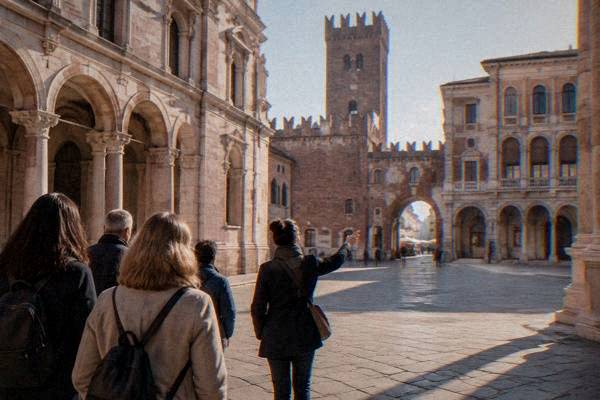
Torre Dei Lamberti: The Climb Over The Rooftops
The Torre dei Lamberti stands between Piazza delle Erbe and Piazza dei Signori in the heart of Verona, in Veneto, and its terrace is one of the few places where the whole UNESCO-listed city, the Adige river bend and the hills beyond open up at once. This guide collects what the city's own listings report about the ticket, the hours and the view.
Short answer
The Torre dei Lamberti is Verona's civic tower between Piazza delle Erbe and Piazza dei Signori. Reported admission is 6 euro full, with free entry for VeronaCard holders; reported summer hours run to about 21:00. Confirm price and hours on the tower's own page before you go.
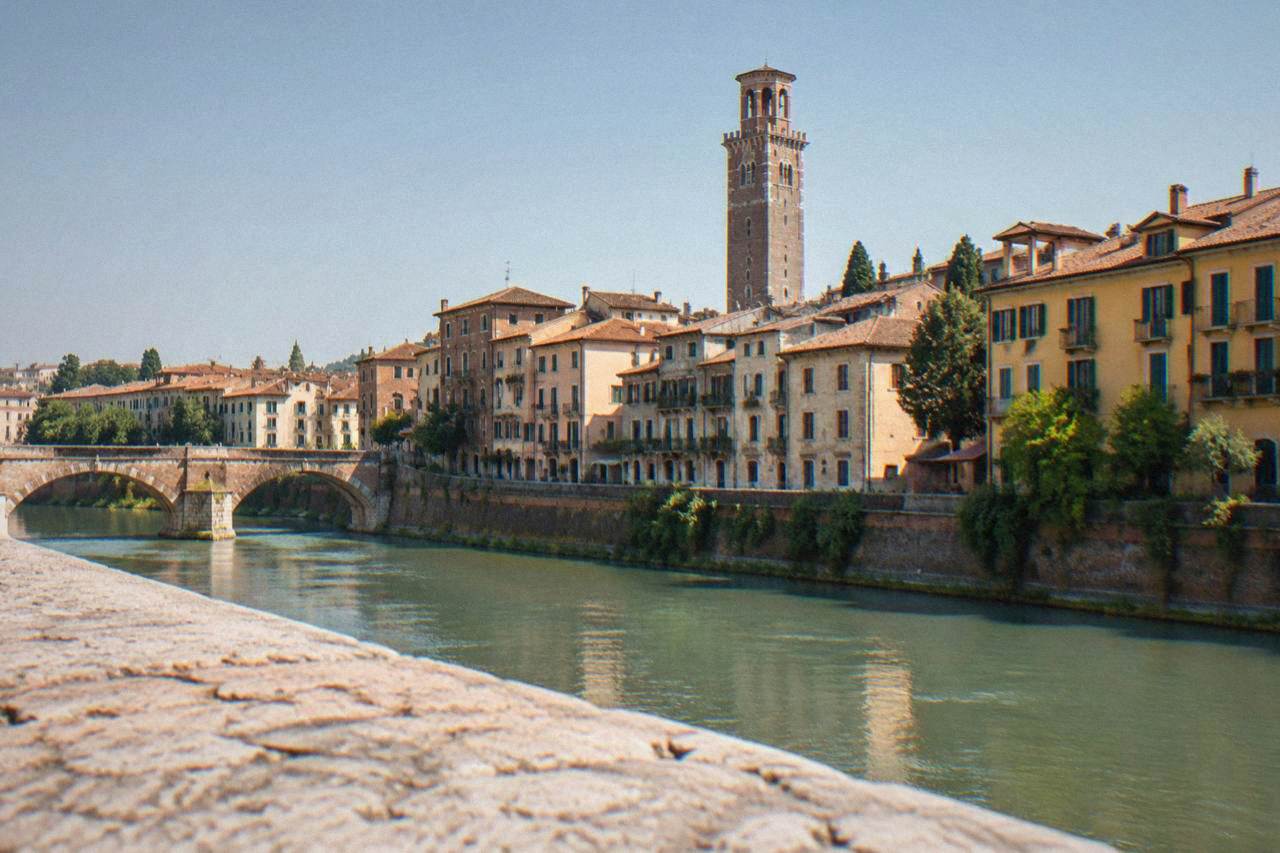
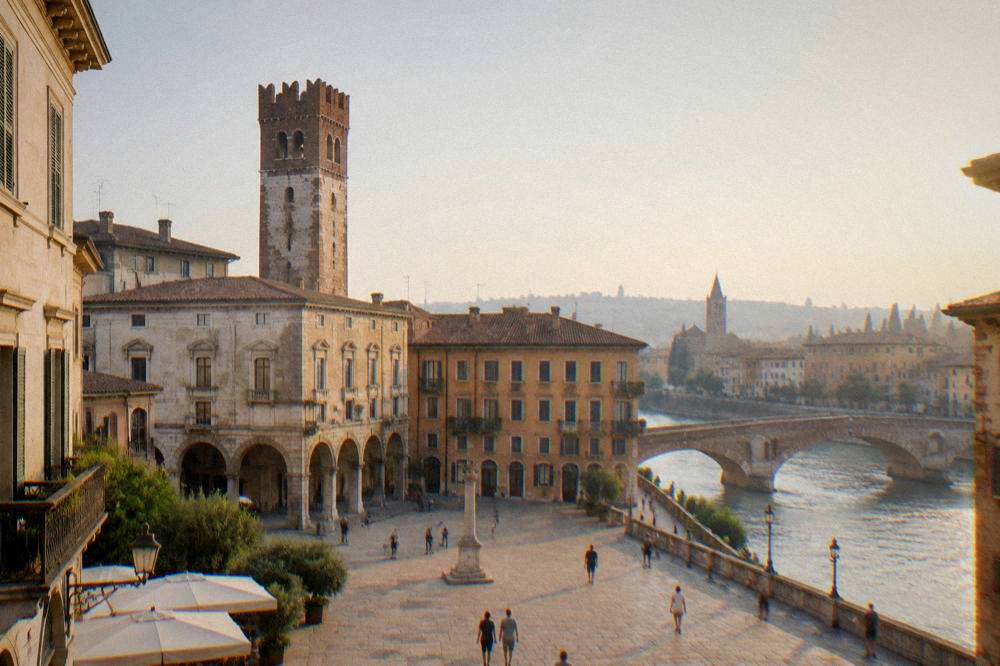
The Torre dei Lamberti rises between Piazza delle Erbe and Piazza dei Signori, the two squares that formed the commercial and political centre of medieval Verona, an inland city on the Adige river in Veneto, northern Italy. It is the tower you see in nearly every rooftop photograph of the historic centre: a shaft of stone and brick with an octagonal belfry near the top, framed by red roofs, church domes and the hills that close the horizon beyond the river. Verona's UNESCO World Heritage inscription, dated 2000, covers exactly this townscape, and the tower's terrace is one of the few points from which you can read the whole of it at once, from the Arena in the south to the Roman Theatre hillside in the north.
This page gathers what the city's own listings report about visiting the tower, the ticket, the hours, the VeronaCard inclusion and what you actually see from the top, and it fits the climb into a sensible day in the city. Where a figure is reported rather than officially confirmed, it says so, and the advice throughout is to check the tower's own page before you set out, because hours shift with the season and with events. For the wider picture of the city, start with the things to do in Verona overview and the Verona walking tour itinerary, which both route through the square at the tower's feet.
What Is The Torre Dei Lamberti In Verona?
The Torre dei Lamberti is Verona's civic tower, a free-standing stone and brick campanile that separates Piazza delle Erbe from Piazza dei Signori in the heart of the historic centre, and it is open to visitors as a viewing terrace. It belongs to the group of civic monuments administered by the city's museums network, alongside the Arena amphitheatre visit and Castelvecchio, and its belfry still carries the bells that mark the hours over the old city.
The tower's role in the city is easy to read from the ground. Piazza delle Erbe, on one side, was the Roman forum and remained the market square; Piazza dei Signori, on the other, held the palaces of government. A tower between the two was a practical instrument: it held the bells that summoned councils, signalled danger and set the rhythm of the trading day. The city's listings present it today simply as a monument and viewpoint, part of the same civic family as the Arena di Verona and Castelvecchio, and that framing matters for planning, because the same ticketing logic and the same VeronaCard apply across the group.
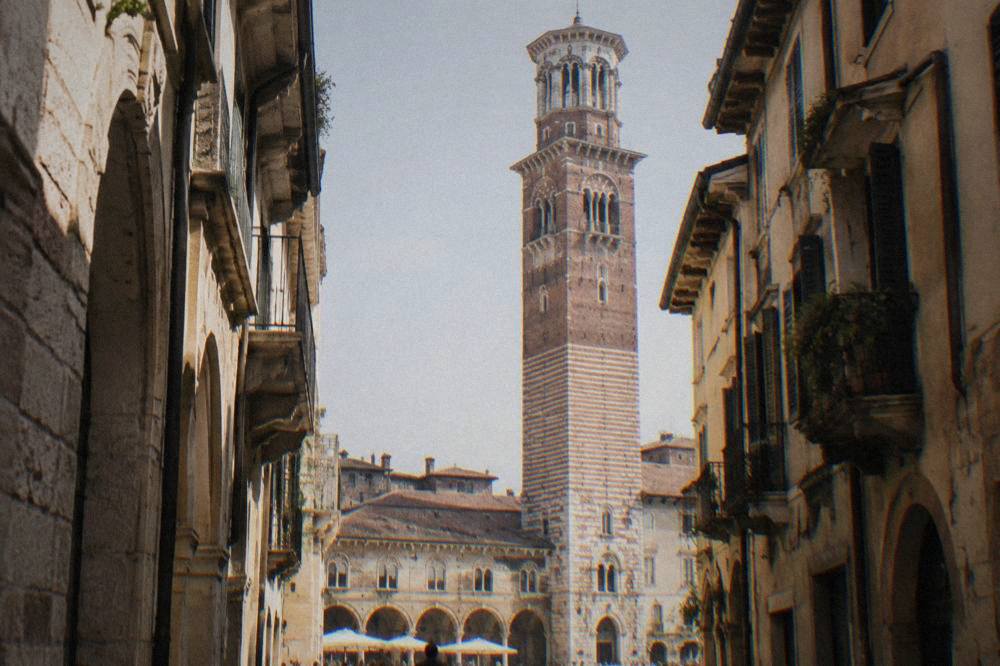
No construction date, architect or restoration history for the tower appears in the available material, so rather than repeat the loose dates that circulate on second-hand travel pages, the honest description is the visible one: a tapering shaft in mixed stone and brick, an upper stage set off by arches, an octagonal lantern and a clock face, and a terrace at the top enclosed to a safe height. The stone changes colour as the shaft rises, which is typical of Italian civic towers patched and raised over centuries, and the bells are still in place in the belfry.
The setting is as much the attraction as the structure. Step out of the tower's entrance and you are in the middle of the Citta Antica, Verona's oldest district, with the market stalls of Piazza delle Erbe a few paces north and the arcaded dignity of Piazza dei Signori immediately south. The Palazzo della Ragione and the Scaliger tombs cluster around the same block, so a visit takes minutes to reach and no detour at all.
| Fact | What the sources say |
|---|---|
| Location | Between Piazza delle Erbe and Piazza dei Signori, historic centre of Verona |
| Type | Civic tower and bell tower, open as a viewing terrace |
| Administration | City civic monuments network, same family as the Arena visit and Castelvecchio |
| Reported full ticket | 6 euro |
| Reported VeronaCard entry | Free |
| Reported summer hours | Open to about 21:00 |
| Status of figures | Reported by live search of official listings; confirm before you go |
How Much Does The Torre Dei Lamberti Cost And When Is It Open?
A full ticket to the Torre dei Lamberti is reported at 6 euro, and the tower is reported free for VeronaCard holders, with summer opening reported to about 21:00, hours that shift through the year and close earlier in the winter months. The figures come from live search of the city's official listings rather than from a permanently published price list, so the rule for planning is to check the tower's own page for the day you intend to climb.
Two practical points follow from the reported hours. First, the evening extension is the useful one: a tower that stays open into the evening lets you time the terrace for the hour when the low sun warms the rooftops and the Arena's lights begin to come on across the city, and that is worth structuring a day around. Second, the hours are seasonal, and the sources describe them only as varying, with the late-August to early-October period reported as daily opening to about 21:00 and last entry shortly before. Outside that window, expect earlier closing and confirm locally.
The ticket itself is modest against the rest of a Verona sightseeing budget. For comparison, the Arena's daytime visit costs 12 euro full with 9 euro reductions, and Juliet's courtyard route has cost 5 euro, or 12 euro with the house, since ticketing began there on 1 April 2026. Those two prices are confirmed in the city's own notices; the tower's 6 euro is a reported figure, and the distinction is kept throughout this guide. If the tower is one stop among several, the arithmetic starts to favour the VeronaCard, which is discussed in the next section.
| Sight in the historic centre | Ticket | Source |
|---|---|---|
| Torre dei Lamberti | 6 euro full, reported; free with VeronaCard, reported | Reported, confirm before you go |
| Arena di Verona daytime visit | 12 euro full, 9 euro reduced, 3 euro ages 18 to 25 | Confirmed by the city's price list |
| Casa di Giulietta | 5 euro courtyard route, 12 euro with house and balcony | Confirmed, online booking since 1 April 2026 |
| Castelvecchio | 9 euro full, 6 euro reduced, 2 euro ages 18 to 25, reported | Reported, closed Monday |
| Piazza delle Erbe, Piazza dei Signori, Porta Borsari | Open access, free | Confirmed |
A pattern worth knowing: several of the city's civic monuments are reported closed on Mondays, the Arena and Castelvecchio among them. The tower's weekly rhythm is not given as a fixed rule in the sources, so treat Monday as a day to double-check rather than assume, and plan the climb for a day when the surrounding sights are open too, since the square itself is worth an unhurried hour either way.
A guided walk is the simplest way to see the tower in context with everything around it. The Small-Group Highlights Walk covers the tower's square together with the Arena and Juliet's House, and it can be booked with free cancellation before the start time: Check availability
Is The Torre Dei Lamberti Included With The VeronaCard?
Yes, the Torre dei Lamberti is reported as free for VeronaCard holders, alongside the Arena visit, Castelvecchio, Juliet's House with an online booking, the Teatro Romano and the city's churches under the Chiese Vive convention. The card became digital on 1 September 2026 and costs 33 euro for 24 hours or 38 euro for 48 hours with ATV urban buses included, or 29 and 32 euro without transport.
The VeronaCard changed shape in 2026, and older guides still describe the paper version. The city's own notice states the new arrangement: from 1 September 2026 the card lives in a web app rather than on plastic or card stock, activates at first use, and comes in two durations and two price levels depending on whether ATV urban buses are bundled. Old paper cards remain valid only to 31 March 2027. The card does not include the Aerobus from the airport, a point the notice is explicit about, and it does not remove the need to book Juliet's House online even for card holders.
| VeronaCard option | With ATV transport | Without transport |
|---|---|---|
| 24 hours | 33 euro | 29 euro |
| 48 hours | 38 euro | 32 euro |
Whether the card pays for a given itinerary is simple arithmetic, not a promise. The confirmed and reported entries it covers, the Arena at 12 euro, Juliet's courtyard at 5 euro or the house route at 12 euro, Castelvecchio reported at 9 euro, and the tower reported at 6 euro, add up quickly for anyone doing the full civic circuit in a day or two. A traveller who plans only the tower and one other sight is better off with single tickets. The city's notice also lists reduced or free church entries through the Chiese Vive convention, covering the Duomo complex, San Zeno, Sant'Anastasia and San Fermo, though no individual church prices are published, so treat those as inclusions to confirm rather than figures to budget.
One booking note specific to the tower: the VeronaCard free entry is a reported inclusion, and the sources describe no separate reservation channel for the tower itself, unlike Juliet's House. In practice that means arriving, showing the card in the web app, and being prepared for a short wait at busy times, with the evening hours reported as the stretch when the terrace is less pressured. Confirm the current arrangement on the day.
What Do You See From The Top Of The Torre Dei Lamberti?
From the Torre dei Lamberti's terrace you look down the length of Piazza delle Erbe and across the whole roofscape of the UNESCO-listed historic centre, with the Arena's ellipse to the south, the Adige river looping around the Citta Antica on three sides, the Roman Theatre hillside and Castel San Pietro to the north, and on clear days the line of the hills and pre-Alps beyond the plain.
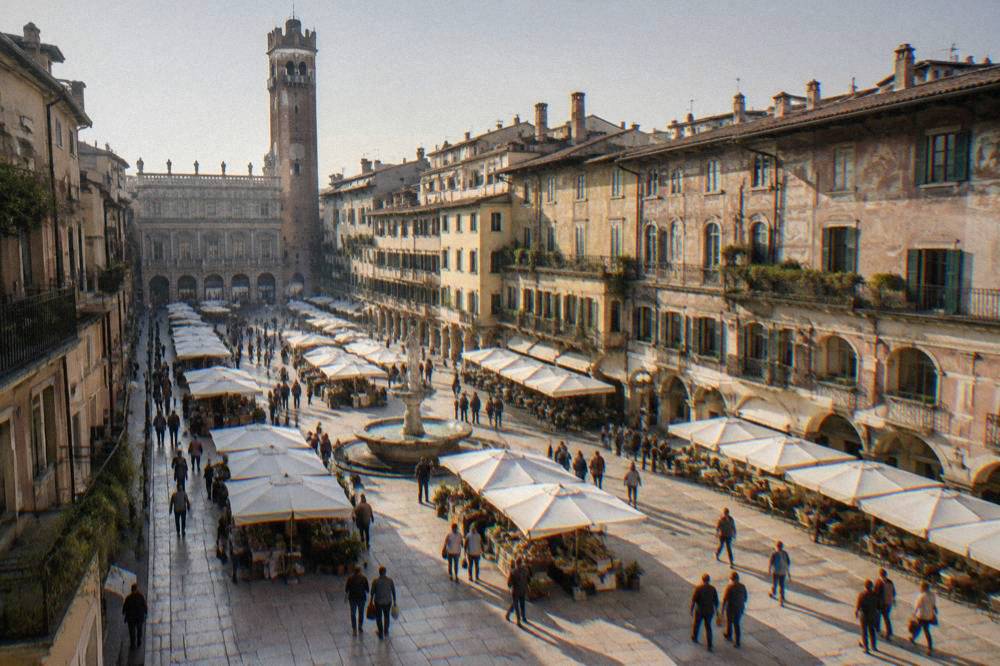
The view rewards a little orientation before you climb. Directly below, the two squares the tower separates read as one continuous civic stage: the market awnings of Piazza delle Erbe to the north, the statue and arcades of Piazza dei Signori to the south, and the smaller dome and tower of the Palazzo della Ragione between them. Turning south, the rooftops run downhill to Piazza Bra and the Arena, whose cavity is visible from above as a pale ring. Turning north and east, the river takes over: the Adige's horseshoe bend wraps the old city, the towers of the Duomo complex and Sant'Anastasia rise in a cluster, and on the far bank the green slope that carries the Teatro Romano climbs to the Castel San Pietro terrace.
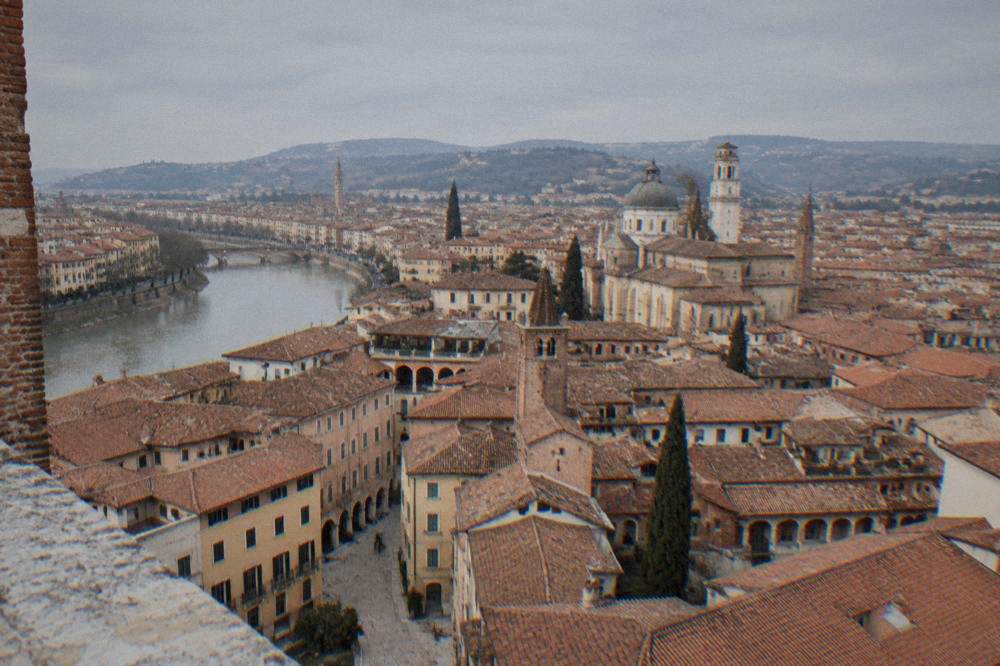
The third direction, west, is the one first-time visitors often miss: beyond the roofs the plain opens toward the Valpolicella hills, the wine country that begins about 25 minutes' drive from the Arena. The tower is the one point in the centre where the geography of the city, river valley, walled core, hills, plain, arranges itself in a single look, which is exactly why it earns its place in an itinerary even beside bigger monuments.
Light matters more than timing luck. The reported evening hours make the last hour of opening the strongest slot in summer: the low sun comes from the west over the Valpolicella hills, catches the facades around Piazza delle Erbe, and puts the river bend in shadow relief. In the middle of the day in July, when the ERA5 reanalysis for Verona, 1991-2020, puts the mean daily high at 29.3 C, the terrace is exposed, so water and a hat belong in the bag. In January, with a mean daily high of 7.3 C, the same exposure is a cold wind funnel, and a layer is the difference between five minutes and a proper half hour.
| Direction from the terrace | What you are looking at |
|---|---|
| North | Piazza delle Erbe rooftops and market square, the Citta Antica |
| South | Roofscape running down to Piazza Bra and the Arena's ellipse |
| East and north-east | The Adige bend, Duomo and Sant'Anastasia towers, Teatro Romano hillside, Castel San Pietro |
| West | The plain and the Valpolicella hills on the horizon |
Photographers should note the enclosure: the terrace is fenced to a safe height, so compositions work over the rail rather than through glass, and the corners of the platform, not the middle, give the cleanest angles down the streets. The full approach to photographing the city, including the tower as a subject from the ground, is covered in the site's photography guide; for the visit itself, the only equipment that matters is time.
How Does The Torre Dei Lamberti Compare With Verona's Other Viewpoints?
Verona has three practical high viewpoints, the Torre dei Lamberti in the centre, the Castel San Pietro terrace across the river, and the climb around the Teatro Romano, and each gives a different picture: the tower looks down on the rooftops and squares, Castel San Pietro looks across the whole city with the tower in the frame, and the river-level crossings give the skyline from below. The tower is the only one in the middle of the historic centre.
The comparison is worth making because the views do not duplicate each other. From the tower you are inside the roofscape; from Castel San Pietro, reached across the Ponte Pietra, the whole walled city is laid out as a single panorama with the Torre dei Lamberti itself as a vertical marker in the middle of it. No published price or hours for Castel San Pietro appear in the available information, so confirm on site what the current access arrangement is; the terrace itself is a public square above the river. The third angle, from the bridges and the riverbank, costs nothing: the Adige crossings, including Ponte Pietra, are open access and free, and the tower photographs well from them at any hour.
| Verona viewpoint | Position | Ticket | Best for |
|---|---|---|---|
| Torre dei Lamberti | Centre, between the two main squares | Reported 6 euro, free with VeronaCard | Looking down on the rooftops and squares |
| Castel San Pietro terrace | Hilltop across the Adige, reached via Ponte Pietra | No published figure in the sources; confirm on site | The whole city in one frame, tower included |
| Ponte Pietra and the riverbank | River level, open access | Free | The skyline and tower from below |
| Giardino Giusti terrace | East of the centre, across the river | No published figure in the sources; confirm on site | Garden setting with a raised view |
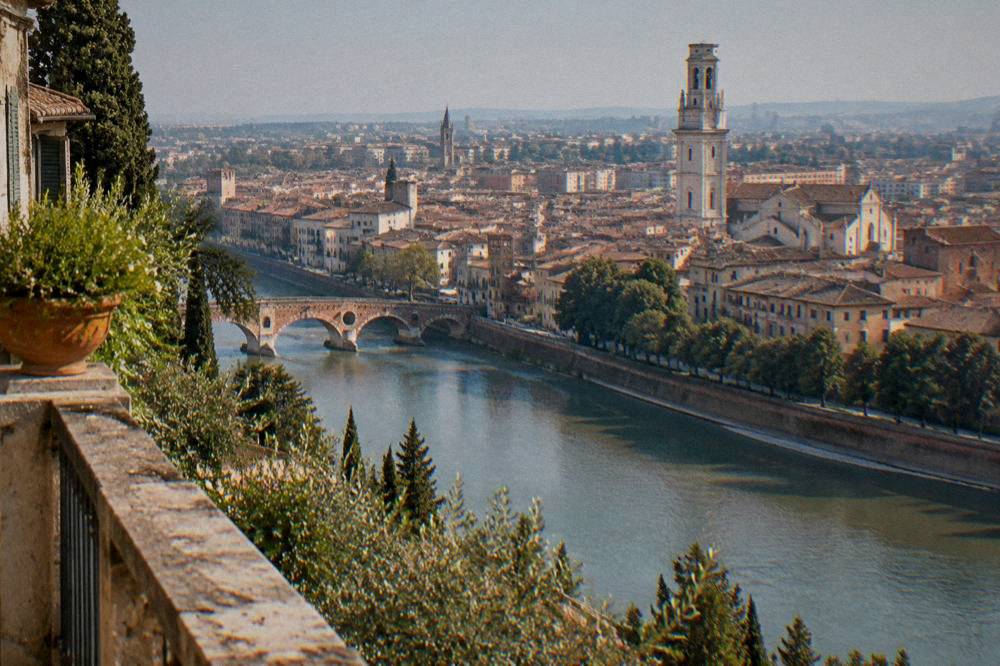
A reasonable plan uses two of them. Climb the tower for the interior view of the city, then cross to Castel San Pietro for the exterior one, ideally with the late-afternoon light between the two. Doing it in reverse also works: the hilltop terrace in the early afternoon, the tower in the reported evening hours. Travellers with a single day in the city can see how both fit alongside the Arena and Juliet's House in the one day in Verona itinerary, which sequences the centre on foot.
Where Is The Torre Dei Lamberti And How Do You Reach It?
The Torre dei Lamberti stands in the pedestrian core of Verona's historic centre, between Piazza delle Erbe and Piazza dei Signori, roughly five minutes on foot from Piazza Bra and the Arena and about ten minutes from Juliet's House, and the whole district around it is closed to through traffic by the camera-enforced ZTL, so nearly everyone arrives on foot or by city bus to the edge of the restricted zone.
The walking distances here are short because the historic centre is compact. From Piazza Bra and the Arena, the route runs up the pedestrian shopping spine and opens directly onto Piazza delle Erbe at the tower's northern corner; the walk is flat, level with the piazza, and takes a matter of minutes. From Verona's Porta Nuova station, the centre is a straight 15 to 20 minute walk, or a short hop on the urban buses, where the single ticket is confirmed at 1.50 euro and valid for 90 minutes. There is no parking question to solve and no reason to solve it: the ZTL around the historic centre allows non-residents at most four entries a month on a booking, in fixed daytime windows, with hotel guests exempt when the hotel registers their plate, so the standard advice is to leave the car outside the zone and walk in.
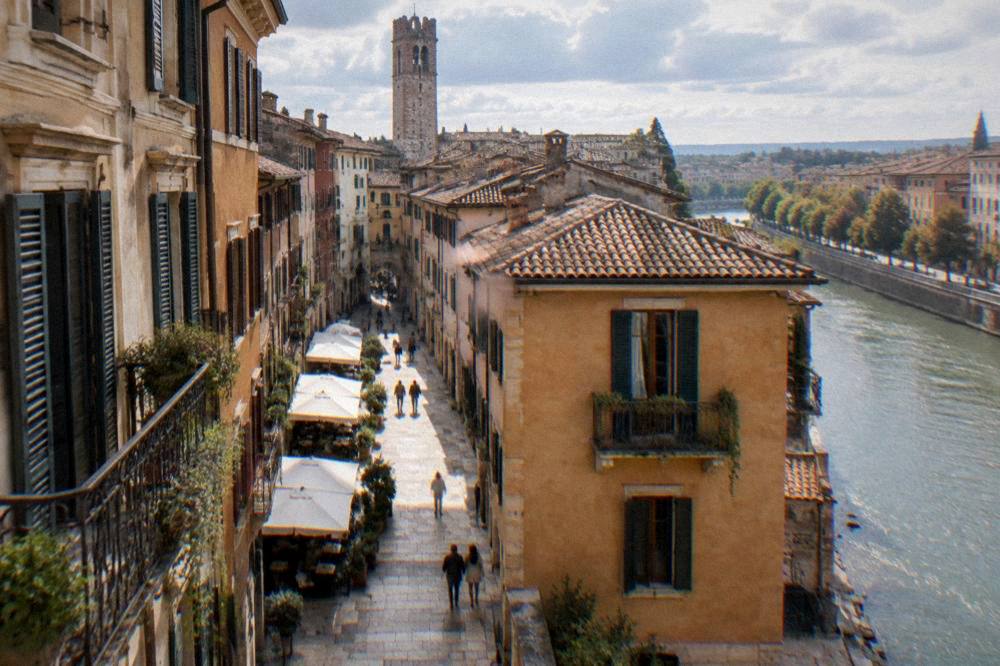
Inside the district, the tower is impossible to lose. Every walking route through the centre, from the Arena to Juliet's House to the Duomo, passes either Piazza delle Erbe or Piazza dei Signori, and the tower is the vertical hinge between them. The free walking tour guide on this site routes the same block, and the paid small-group walks do the same, which reflects a simple fact of the city's geography: this was the forum and the seat of government in the Roman and medieval city, and it remains the natural crossroads.
For orientation at street level, the surrounding block repays attention. The Arche Scaligere, the Scaliger tombs, sit a few paces south beyond Piazza dei Signori; the Palazzo della Ragione fills the block between the squares with its courtyards; and the market of Piazza delle Erbe runs up the tower's northern flank. A visitor with an hour can circle the block, enter the tower, climb, and still have time in both squares.
What Should You Know Before You Climb?
Take the reported figures with a same-day check, carry water in summer, keep the visit short in winter wind, allow for the possibility of a wait at the entrance, and remember that no source available here confirms the internal arrangements of the climb itself, whether steps, lift or a mix, so anyone with mobility constraints should ask at the desk before buying. The tower is a small, well-placed visit, and the difference between a good one and a frustrating one is mostly timing.
On the internal arrangements, honesty is the only policy available. The available material gives a price and hours but says nothing reliable about how the ascent works, and this page will not guess. Ask at the ticket desk, or check the tower's own site before visiting, about the means of ascent and about any accessibility provision; no claim either way belongs on a page that has not confirmed it. The same caution applies to bag rules and opening on event days.
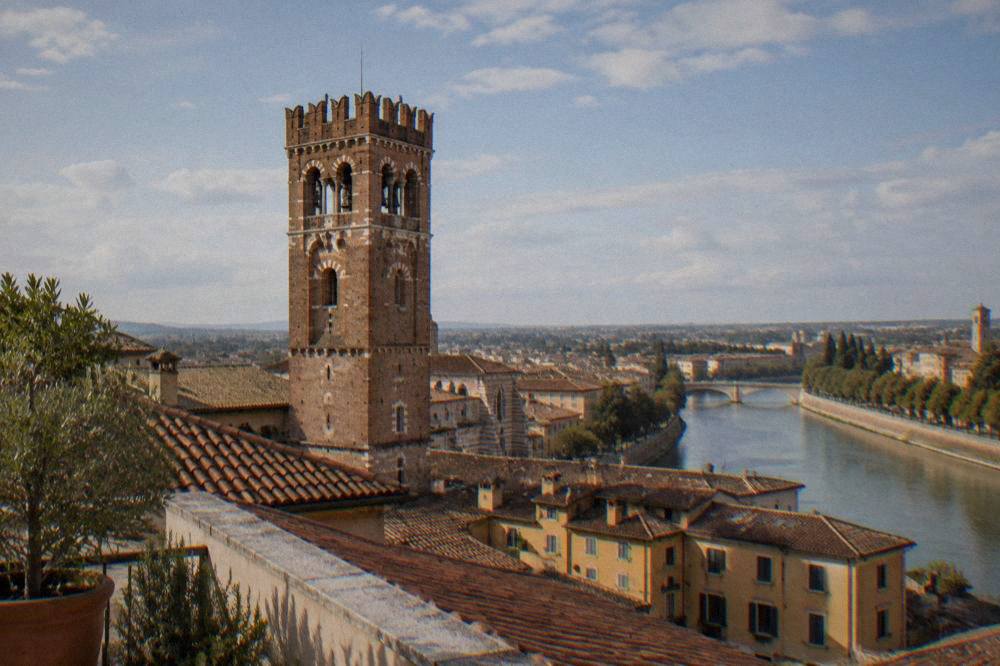
Season shapes the visit more than in an enclosed museum. The ERA5 reanalysis for Verona, 1991-2020, gives the monthly rhythm of the climate: July and August mean daily highs of 29.3 and 29.1 C, January a mean daily low of minus 0.4 C, and the wettest months in May, October and November at roughly 110, 107 and 118 mm of rain. A terrace in those conditions is a summer platform to time for evening and a winter platform to time for midday, and a rain forecast is a reason to reorder the day, since the view is the entire product.
| Month | Mean daily high (C) | Mean daily low (C) | Rain (mm) |
|---|---|---|---|
| January | 7.3 | -0.4 | 52.3 |
| April | 17.8 | 7.6 | 93.5 |
| July | 29.3 | 19.1 | 79.4 |
| October | 18.1 | 10.5 | 107.2 |
The table above is a selection from the monthly normals, ERA5 reanalysis, 1991-2020, a modelled grid rather than a station record, and it is the right kind of number for planning: it compares months, it does not promise a forecast. Combine it with the reported evening hours, and the standing advice of this guide follows: in the warm half of the year, book nothing, climb late; in the cold half, climb at midday and keep it brisk.
How Does The Torre Dei Lamberti Fit Into A Day In Verona?
The tower works best as the hinge of a morning or an evening: pair it with Piazza delle Erbe, Piazza dei Signori and the Arche Scaligere in one continuous loop through the civic heart, then swing down to the Arena and Juliet's House, and return for the reported late opening when the light turns. It needs less than an hour of any itinerary, and its central position means no route through Verona's old city detours to reach it.
A concrete sequence, using the walking geography of the centre: start at Piazza Bra and the Arena's daytime visit, 12 euro full on the city's confirmed price list, then walk up to Piazza delle Erbe and the tower, then south through Piazza dei Signori to the Scaliger tombs, and finish at Juliet's House, where the courtyard route costs 5 euro and the house route 12 euro with online booking required since 1 April 2026. That is a full but feasible day, and the tower slots into the middle of it without adding walking distance. Anyone with a second day adds the far bank, the Teatro Romano hillside and Castel San Pietro, plus a Valpolicella half-day in the hills visible from the terrace.
Guided options cover the same ground with a local's commentary and remove the timing decisions. Beyond the highlights walk already mentioned, an evening walk pairs naturally with the tower's reported late hours, and a food-and-wine walk through the centre turns the squares around the tower into a tasting route. The picks below cover all three angles.
For readers building the visit independently, the summary is short. The tower's reported 6 euro ticket and reported free VeronaCard entry make it one of the cheaper civic visits in a city whose headline sights now all charge. Its reported evening hours make it the sight most improved by patience, and its position between the two great squares makes it the one monument in Verona that no itinerary has to try to include: if you walk the historic centre at all, you will pass its door, and the only decision left is whether the door is open, which is why this guide's last word is the same as its first, check the tower's own page on the day. More on the city around it is on the Verona Italy Travel Guide homepage, and the tower's neighbours, from the Duomo di Verona to Sant'Anastasia, each have their own pages.
Common Questions About The Torre Dei Lamberti
How much does the Torre dei Lamberti cost?
Admission is reported at 6 euro for a full ticket, with free entry reported for VeronaCard holders. The figures come from live search of official listings, so confirm the price on the tower's own page before you go.
Is the Torre dei Lamberti free with the VeronaCard?
Yes, free entry to the tower is reported as one of the card's civic-monument inclusions, alongside the Arena visit, Castelvecchio and Juliet's House, the last of which still requires an online booking even for card holders. The card has been digital since 1 September 2026 and costs 33 euro for 24 hours or 38 euro for 48 hours with ATV transport, or 29 and 32 euro without.
What are the Torre dei Lamberti opening hours?
Hours are reported as seasonal, with the late-summer period opening daily to about 21:00 and last entry shortly before. Earlier closing applies outside that window, and the tower's own page carries the current times, so check it for the day of your visit.
Where is the Torre dei Lamberti in Verona?
The tower stands between Piazza delle Erbe and Piazza dei Signori, in the pedestrian core of the historic centre, a few minutes on foot from Piazza Bra and the Arena and about ten minutes from Juliet's House. The district around it is inside the camera-enforced ZTL, so arrival is on foot or by city bus to the edge of the zone.
Which is better, the Torre dei Lamberti or Castel San Pietro?
They answer different questions. The tower looks down into the roofscape and squares from inside the centre; Castel San Pietro, across the river by Ponte Pietra, frames the whole city in one panorama with the tower itself in the view. A single day can do both, the tower late in the day and the hilltop terrace in the afternoon or vice versa. No published price for the Castel San Pietro access could be confirmed, so check on site.
Can you visit the Torre dei Lamberti in the evening?
Yes, in the reported summer hours that run to about 21:00, the last hour of opening is the strongest slot, when the low western sun lights the rooftops and the city begins to switch on. Hours vary through the year, so check the current times before planning an evening climb.