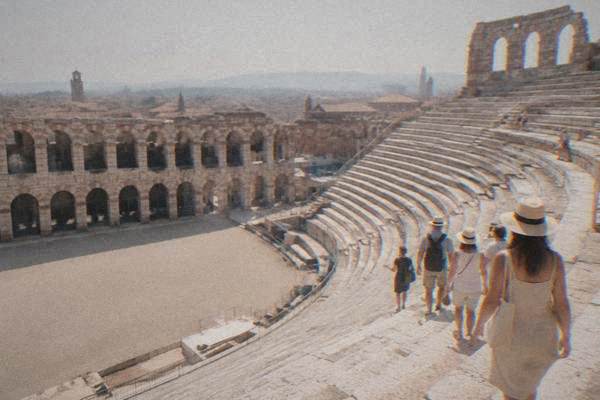
Did Gladiators Fight In The Verona Arena?
Yes, gladiators fought in the Verona Arena: the Arena's own history pages confirm gladiator games and animal hunts in the first-century amphitheatre. Here is what the sources say, and how to visit today.
Verona, in the Veneto region of northern Italy, is an inland city on the Adige river whose rose-pink Roman amphitheatre still dominates Piazza Bra nearly two thousand years after it was built. Visitors standing in its oval cavea often ask the obvious question: did people actually fight and die here, or is that Hollywood shorthand for anything Roman? The short answer is yes, and the sources for it are unusually direct, because the Arena's own institutional pages state it plainly. This page sets out what those sources say about the amphitheatre's gladiator past, what happened to the building after Rome fell, and how it is used and visited today, in a city that is a UNESCO World Heritage Site, inscribed in 2000, and famously not on Lake Garda, whose towns, Sirmione, Bardolino, Garda and Malcesine, are day trips away to the west. Verona was never a lakeside town, and the Arena is the clearest proof of what it was instead: a Roman regional capital with money enough to build for crowds.
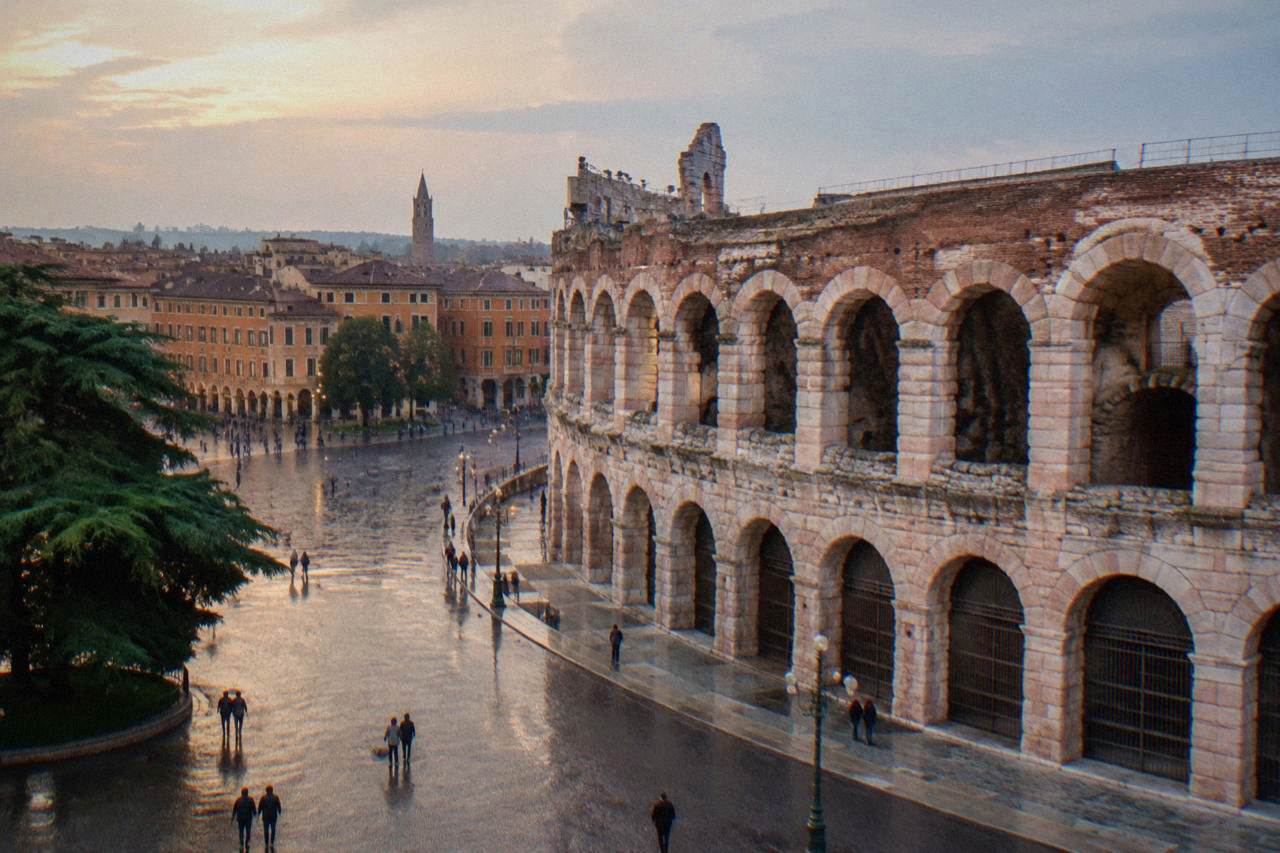
Did Gladiators Fight In The Verona Arena?
Yes, gladiators fought in the Verona Arena. The Arena's own history pages record that the amphitheatre was used for gladiator games and animal hunts, the standard entertainments of a Roman amphitheatre of this scale. The building itself dates to about 30 AD, per the Fondazione Arena and Britannica, which makes it older than the Colosseum in Rome, built around 80 AD, and, as the Arena's site describes it, the third-largest surviving Roman amphitheatre after the Colosseum and Capua.
That single sentence carries the whole answer, but the context around it matters. A first-century city of Verona's standing, a Roman municipium on a major north-south road, would have expected the same spectacle culture as any provincial capital, and an amphitheatre of this size was built for exactly that purpose: combat between trained fighters, and the hunting and killing of imported wild animals. The economics were deliberate. Games were financed by magistrates and wealthy citizens as displays of status, and an amphitheatre seating tens of thousands was a statement that a city had arrived. The Museo Lapidario Maffeiano, Verona's own civic lapidary museum, likewise presents the gladiatorial use of the building as part of its interpretation of the city's Roman monuments, and its inscriptions are among the physical traces that survive from that era.
Two figures anchor the dating. The Arena's site places construction in the first century AD, between the reigns of Augustus and Claudius, with coin evidence pointing to roughly 30 to 42 AD. Britannica and the Arena's own pages agree on the consequence: the Colosseum was inaugurated around 80 AD, so the Verona building is roughly half a century its senior. Nothing about the architect, the exact dimensions or the tier count is sourced for this page, so those details stay off it; for anything beyond what is stated above, the Arena di Verona attraction page gathers the visiting practicalities, and the question is the Verona Arena older than the Colosseum is treated on its own page.
| What the sources say about the Arena | Figure or claim | Who says it |
|---|---|---|
| Construction date | About 30 AD, first century, coin evidence 30 to 42 AD | The Arena's own history pages |
| Age relative to the Colosseum | Older, the Colosseum being about 80 AD | The Arena's site and Britannica |
| Size ranking | Third-largest surviving Roman amphitheatre, after the Colosseum and Capua | The Arena's own site, as a description |
| Original use | Gladiator games and animal hunts | The Arena's own history pages |
| Outer ring | Destroyed by the 1117 earthquake, only the Ala wing remains | The Arena's own history pages |
| Opera capacity | 30,000 effective seats | The Arena's own site |
What Happened To The Gladiator Arena After Rome Fell?
Gladiator shows died with the Roman institutions that staged them, and the Arena of Verona survived by changing use repeatedly: its outer ring collapsed in the earthquake of 1117, leaving only the Ala wing, and from the 16th century onward the seating and structure were repeatedly rebuilt and repurposed. The Arena's own history pages trace those rebuilds from 1568 and the 1580s through the post-war period and a recent restoration campaign.
An earthquake is a blunt editor. The 1117 shock took the outer elliptical ring down almost entirely, and the amphitheatre that visitors see today is the inner cavea wrapped in one surviving wing of the original facade, which is why the building looks open on one side and closed on the other. Anyone expecting the full four-storey envelope of the Colosseum is looking at the wrong monument; Verona's version lost that outer skin nine hundred years ago and kept everything that mattered for putting an audience in rows. After that, the structure passed through centuries of use and disuse before opera arrived and fixed its modern identity. A recent Art Bonus restoration programme, reported at 14 million euros, addressed sealing, systems and lighting.
The gladiator connection did not vanish entirely from the record. Stone inscriptions and sculpture tied to games and fighters ended up in the city's civic collections, which is one reason the Museo Lapidario Maffeiano exists at all. And the memory of spectacle shaped the building's afterlife: executions, tournaments, theatre and eventually opera all reused a space engineered for mass viewing. How the amphitheatre ended up as an opera house is its own story, covered on the Verona opera festival guide, and the practical question of where to sit is handled on the Arena di Verona seating guide.
Those picks share one thread with this page's subject: each includes or accompanies access to the Arena, so the amphitheatre you have just read about is the one you walk into.
Can You Visit The Verona Arena By Day?
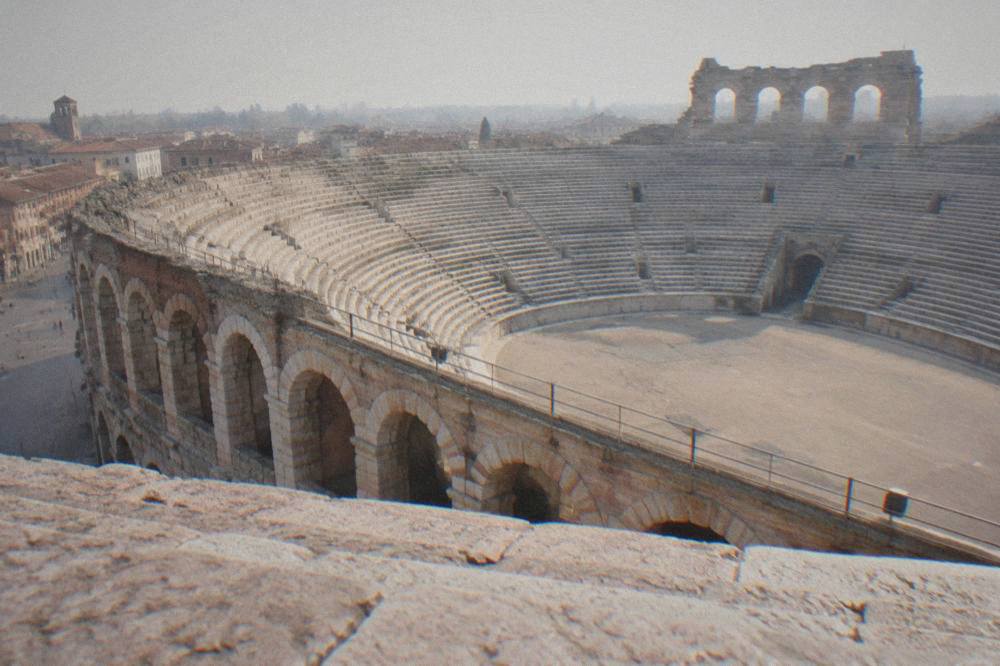
Yes, the Arena can be visited by day and not only for opera. The daytime amphitheatre visit costs 12 euro full, 9 euro reduced for groups of 15 or more, over-65s and other concessions, and 3 euro for visitors aged 18 to 25 from EU and reciprocity countries, per the Comune di Verona's own price list, which also sets 1 euro on the first Sunday of the month from November to March. Children under 18 enter free, as do VeronaCard holders.
The hours come from the Arena's own site and are reported, not stamped in stone: Tuesday to Sunday, about 9:00 to 19:00, closed Mondays, with earlier closing on show days and last entry 30 minutes before closing. Anyone planning a visit on a performance date should check the current calendar on the Arena's own ticket page before booking, because on those evenings the monument shuts early to be turned around for the show. The reduced rows deserve a second look, since the categories do not overlap: the 9 euro band covers groups and seniors, the 3 euro band is an age-specific rate, and the 1 euro first-Sunday rule applies only across the winter months. The Comune's price list also exempts disabled visitors with a companion, alongside the under-18 and card-holder entries. More of these guides are collected on Verona Italy Travel Guide.
| Arena daytime visit, 2026 | Price |
|---|---|
| Full ticket | 12 EUR |
| Reduced (groups of 15+, over 65, concessions) | 9 EUR |
| Ages 18 to 25 (EU and reciprocity countries) | 3 EUR |
| First Sunday of the month, November to March | 1 EUR |
| Under 18 | Free |
| VeronaCard holders | Free |
For visitors who would rather not queue at the gate, the Verona: City Card with Arena Priority Entrance pairs the amphitheatre with the city's other sights, and its live listing carries the current price and availability: Check availability.
How Is The Gladiator Arena Used Today?
The Arena of Verona is now an opera house above all: the 2026 Arena Opera Festival, its 103rd edition, ran 5 June to 12 September, and the 104th edition is announced for 11 June to 11 September 2027, per the Arena's own site. Its stated capacity for opera is 30,000 effective seats, and stone-step seats start in the EUR 30s, with exact sector prices on the Arena's own ticket pages.
The festival's repertoire in 2026 included a new production of La Traviata, Aida in two stagings, Nabucco, La Boheme and Turandot, all staged on the same sand-covered floor where animal hunts once ran. The 2027 programme has not yet been published, so no titles can be listed for it here; the dates are the only firm fact. The practical rules are reported on the Arena's terms and FAQ pages: gates open about two hours before the start, visitors are asked to arrive at least an hour early, and performances begin around 21:00 to 21:30 in June, earlier later in the season. Small backpacks, a cushion and an umbrella are permitted subject to security checks, which matters on the bare stone of the gradinata. Rain never cancels a performance before its scheduled start; a show may be delayed up to 150 minutes or suspended, and there is no refund once it has started. On the question of dress, no strict rule against shorts was found on the official pages, so the terms and conditions are the place to confirm before an evening on the stone steps.
Whether an opera night justifies the ticket is a fair question, and it has its own page in is the opera in Verona worth it. What can be said here is structural: a building engineered for 30,000 spectators and open to the sky is the reason Verona's opera experience is unlike any indoor theatre's, and that engineering is the gladiators' direct legacy. For a fuller orientation of the city that grew around the amphitheatre, the editorial desk's things to do in Verona page is the root guide, and the question of how long to stay is answered in how many days in Verona is enough.
Common Questions About The Verona Arena
Did gladiators really fight in the Verona Arena?
Yes. The Arena's own history pages state that the amphitheatre, built about 30 AD, was used for gladiator games and animal hunts, the standard spectacles of a large Roman amphitheatre.
Is the Verona Arena older than the Colosseum?
Yes, per the Arena's own site and Britannica: Verona's amphitheatre dates to about 30 AD and the Colosseum to about 80 AD, roughly half a century later.
Can you see the Arena without going to the opera?
Yes. The amphitheatre is open to daytime visitors for 12 euro full, 9 euro reduced and 3 euro for ages 18 to 25 from EU and reciprocity countries, per the Comune di Verona's price list, with hours reported as Tuesday to Sunday and closure on Mondays.
How much of the original Arena survives?
The inner seating bowl survives, but the outer ring collapsed in the earthquake of 1117 and only one wing, the Ala, remains of the original facade, per the Arena's own history pages.
What is the Arena used for now?
Primarily opera. The 2026 Arena Opera Festival, the 103rd edition, ran 5 June to 12 September, and the 104th edition is announced for 11 June to 11 September 2027.
The gladiators are gone, the outer ring fell nine centuries ago, and the audience now pays to hear Verdi rather than to watch combat, but the building they all share is the same oval of pink stone in Piazza Bra, and its own institutional pages are the clearest record of what happened inside it.