Is The Verona Arena Older Than The Colosseum?
Yes, the Verona Arena in Verona, Veneto, was built around 30 AD, roughly fifty years before Rome's Colosseum. Here is what the sources say about both amphitheatres.
Verona, the inland city on the Adige river in Veneto, northern Italy, holds a Roman amphitheatre at Piazza Bra whose age puts it ahead of the most famous amphitheatre of them all. The Arena di Verona was built in the first century, around 30 AD, according to the Fondazione Arena's own historical pages, while Rome's Colosseum was completed around 80 AD. The gap is roughly half a century, and it surprises people who assume the capital's building must be the earlier one. This page sets out what the sources actually say about both buildings, what survives of each, and what the Arena's age means for a visit today, from its daytime ticket prices to the opera season that fills its stone tiers each summer.
Is The Verona Arena Older Than The Colosseum?
Yes. The Arena di Verona in Verona, Veneto, was built around 30 AD in the first century, per the Fondazione Arena's own historical pages and Britannica, while the Colosseum in Rome was completed around 80 AD. That makes Verona's amphitheatre roughly fifty years the senior, and the same sources describe it as the third-largest Roman amphitheatre still standing, after the Colosseum and the one at Capua. Both datings are reported by the institutions concerned, so the ordering, not the exact year, is the reliable part.
The Arena's own foundation history pages give the construction window as the first century AD, between the reigns of Augustus and Claudius, with coin evidence pointing to the years 30 to 42 AD. Britannica's entry on the Verona Arena repeats the same first-century dating. The Colosseum's completion around 80 AD under Titus is one of the best-established dates in Roman building history. Neither figure is contested in the sources, and no scholar quoted on those pages argues for a later Verona start date.
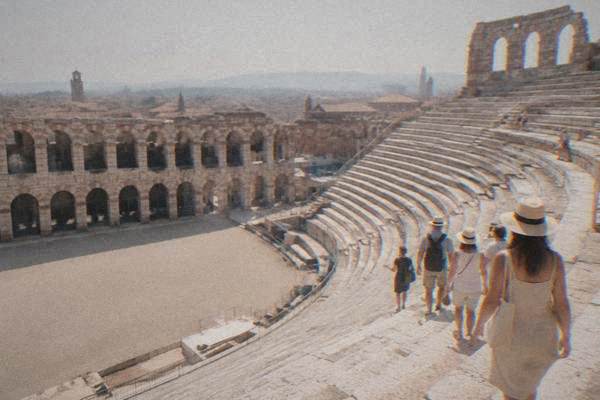
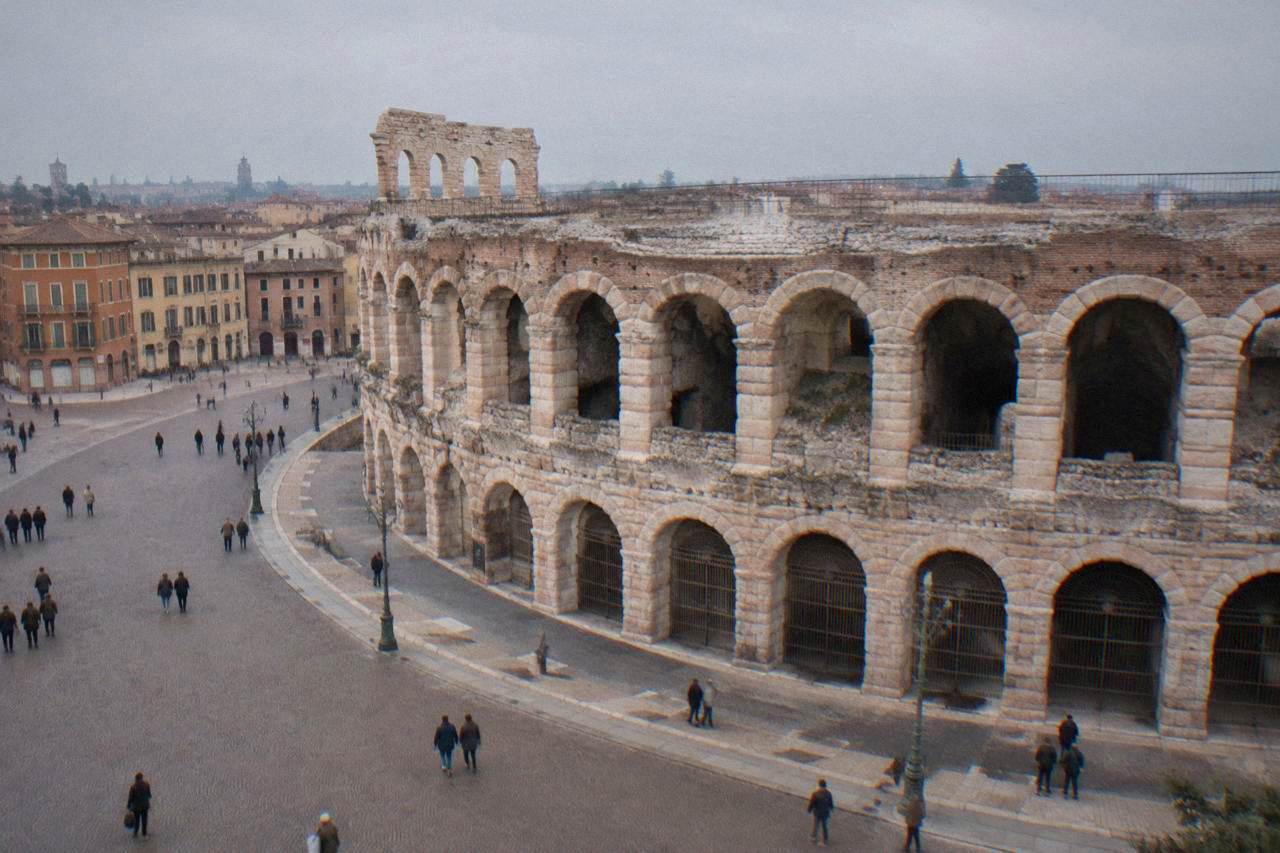
What the comparison does not tell you is which building looks more complete. That is where the two part company, and it is the reason the Arena's age is easy to miss on a casual walk around Piazza Bra. The outer ring that once wrapped Verona's amphitheatre is gone, so the building you see today is the inner shell, still perfectly usable, still holding performances every summer.
When Was Each Amphitheatre Built?
The Verona Arena went up around 30 AD, coin-dated to between 30 and 42 AD per the Fondazione Arena's history pages, placing it in the reigns of Augustus and Claudius. The Colosseum in Rome was finished around 80 AD. Verona's building therefore belongs to the earlier generation of imperial amphitheatres, the experimental period before Rome committed to its own vast version, and both dates are as reported by the sources concerned.
The dating for Verona rests on coins found in the structure, a standard archaeological method for Roman public buildings. The Fondazione Arena presents the result plainly: a first-century amphitheatre, built before the Flavian dynasty commissioned the Colosseum. Britannica carries the same dating and adds the ranking claim, describing the Verona building as the third-largest surviving Roman amphitheatre after the Colosseum and Capua.
| Amphitheatre | City | Reported construction date | Source basis |
|---|---|---|---|
| Arena di Verona | Verona, Veneto | About 30 AD, coin evidence 30 to 42 AD | Fondazione Arena history pages, Britannica |
| Colosseum | Rome | Completed about 80 AD | Standard Roman building history |
| Amphitheatre of Capua | Santa Maria Capua Vetere, Campania | First century BC, earlier than both | Ranked ahead of Verona in size by the same sources |
The gap matters for how each building was used in its early decades. Gladiator games and animal hunts were the Arena's original purpose, the same spectacles the Colosseum was later built to host at a far larger scale. Verona, a Roman city of real standing on the road between Milan and Aquileia, got its amphitheatre while such buildings were still spreading through the empire's provincial capitals.
A related question people ask alongside the age one is scale: the Arena's stated capacity for opera today is 30,000 effective seats, per the Fondazione Arena, and how many people the Arena di Verona can seat has its own fuller answer elsewhere on this site.
For a visit focused on the building itself, the Arena Priority Access Tour pairs entry with a local guide who covers exactly this Roman history, and Check availability on the operator's live listing before travel dates firm up. The same tour kind suits anyone whose interest in the Arena starts with its age rather than its opera calendar.
What Survives Of Each Building Today?
Most of the Verona Arena survives, but not its outer ring, which collapsed in the earthquake of 1117, leaving only a short wing, the Ala, standing, per the Fondazione Arena's history pages. The Colosseum keeps substantially more of its outer facade, including the famous three-storey arcaded wall on one side. Verona's building, by contrast, is intact as a working performance venue, restored in stages from 1568 onward and in continuous operatic use each summer.
The 1117 earthquake is the single event that shaped the Arena's modern silhouette. Before it, the building wore a complete elliptical outer ring like the Colosseum's. After it, only the Ala section remained, and the seating cavea was rebuilt in stages, with major works recorded from 1568, again per the Arena's own historical account. Post-war restoration and a recent Art Bonus programme worth 14 million euros have since addressed sealing, systems and lighting.
The Colosseum's story runs the other way: more facade, less function. It stands as a monument and archaeological site, visited in the millions, but it does not host a summer opera festival inside its walls. Verona's amphitheatre does, and has done since the opera festival's early editions, which is the practical payoff of a building that kept its cavea usable. The 2026 season, the 103rd, ran 5 June to 12 September, and the 104th is announced for 11 June to 11 September 2027, per arena.it.
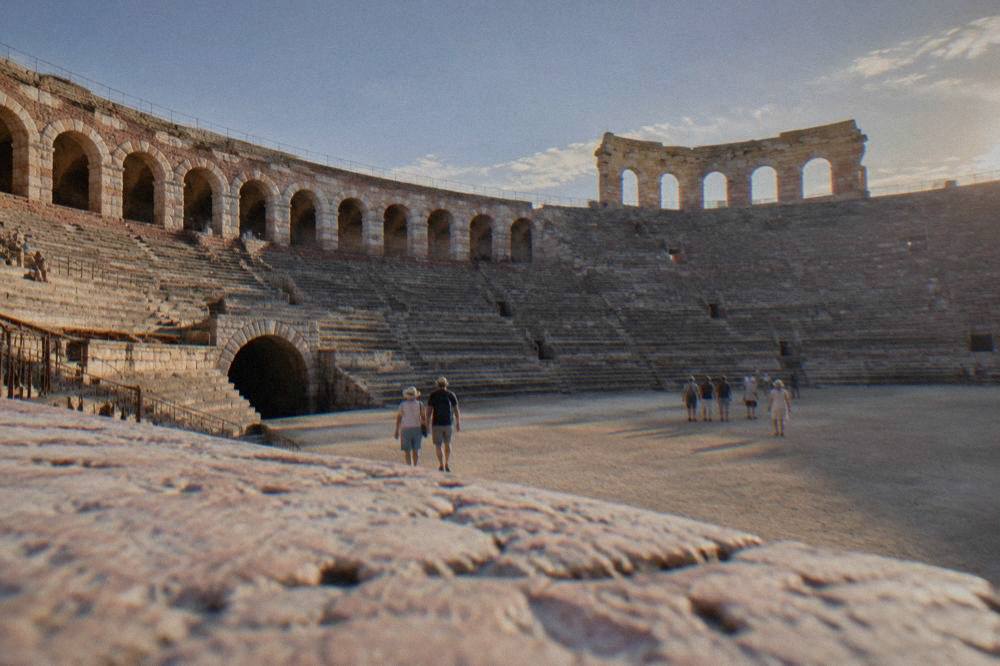
That working life is why the age question is not purely academic. A building from around 30 AD that still sells tickets for nightly performances is a different experience from one preserved as a ruin, and the opera festival in Verona has its own guide on this site for anyone planning around a performance night, including how opera in Verona compares on value.
Which Is Bigger, The Arena Or The Colosseum?
The Colosseum is bigger. The Verona Arena is described by the Fondazione Arena and Britannica as the third-largest surviving Roman amphitheatre, ranked after the Colosseum itself and the amphitheatre at Capua, with an opera capacity stated at 30,000 effective seats. No dimensions for the Verona building's length, width or tier count appear in the sources, so the ranking claim, with its attribution, is the only size comparison this page can make.
Size rankings among surviving amphitheatres are exactly the kind of claim that needs an institution behind it, and here two independent ones agree. The Fondazione Arena's own pages make the third-largest claim, and Britannica repeats it. What neither source does, in the material available, is publish a dimension table for Verona that would let a reader verify the ranking with a tape measure, so this page reports the ranking and leaves the arithmetic alone.
| Claim | What the sources say | Attribution |
|---|---|---|
| Relative size | Third-largest surviving Roman amphitheatre, after the Colosseum and Capua | Fondazione Arena, Britannica |
| Opera capacity | 30,000 effective seats | Fondazione Arena |
| Original use | Gladiator games and animal hunts | Fondazione Arena, Museo Lapidario Maffeiano |
| Outer ring | Destroyed by the 1117 earthquake, the Ala wing remains | Fondazione Arena history pages |
How Does The Arena's Age Change A Visit Today?
It barely changes the ticket, and it changes the atmosphere completely. The daytime visit costs 12 euro full, 9 euro reduced for groups of 15 or more, over-65s and other concessions, and 3 euro for visitors aged 18 to 25 from EU and reciprocity countries, per the Comune di Verona's price list, with 1 euro entry on the first Sunday of the month from November to March. What the age adds is standing inside a structure from around 30 AD that still hosts a summer opera season in its stone tiers.
The Comune's price list, on the local police authority's civic museums page, carries those daytime figures for the amphitheatre visit, and the card trap to avoid is the assumption that the Arena exists only for opera. It does not: it is a daytime sight with a standard admission, open to visitors who never return for an evening performance. Reported hours from the Arena's own site are Tuesday to Sunday, about 9:00 to 19:00, closed Monday, with earlier closing on show days and last entry 30 minutes before, so anyone planning around a festival date should confirm the day's hours before setting out.
The 2026 traps this site keeps flagging all apply within a few hundred metres of the building. Juliet's House, a short walk away, has charged for the courtyard itself since 1 April 2026, 5 euro for the courtyard route and 12 euro with the house and balcony, booked online. The VeronaCard, digital since 1 September 2026 at 33 euro for 24 hours or 38 for 48 with ATV transport, includes civic museums but readers should confirm current inclusions on the Comune's VeronaCard notice before relying on it, and it does not cover the Aerobus from the airport.
| Arena daytime visit | Price | Notes |
|---|---|---|
| Full ticket | 12 euro | Per the Comune di Verona price list |
| Reduced | 9 euro | Groups of 15 or more, over-65s, concessions |
| Ages 18 to 25 | 3 euro | EU and reciprocity countries |
| First Sunday, Nov to Mar | 1 euro | Per the same price list |
| Reported hours | Tue to Sun, about 9:00 to 19:00 | Closed Monday, early close on show days, confirm on the Arena's own site |
For a first Verona day built around the amphitheatre, this site's one day in Verona itinerary sequences the Arena with Piazza Bra, Piazza delle Erbe and the river crossings, and the broader Arena di Verona guide covers the building's visiting practicals in full. Whether Verona is worth visiting on its own account has its own answer page, but a first-century amphitheatre in working order is a large part of the case.
Combining the amphitheatre with the views across the city from the hills above the Adige is a natural pairing for anyone whose day has a Roman core, and the tour above folds the Arena visit together with the cable car and optional Juliet's House tickets. Pair it with the picks below if the day has room for more.
For more on the city the Arena sits in, the Verona Italy Travel Guide homepage gathers the site's coverage of Verona, from the Romeo and Juliet sites to the Valpolicella hills a short drive north.
Common Questions About The Verona Arena And The Colosseum
Is The Verona Arena Older Than The Colosseum?
Yes. The Arena di Verona was built around 30 AD, per the Fondazione Arena's history pages and Britannica, while the Colosseum was completed around 80 AD, making Verona's amphitheatre roughly fifty years older.
Which is bigger, the Verona Arena or the Colosseum?
The Colosseum. The Verona Arena is described by the Fondazione Arena and Britannica as the third-largest surviving Roman amphitheatre, after the Colosseum and the one at Capua, with a stated opera capacity of 30,000 effective seats.
Why does the Verona Arena look smaller than the Colosseum?
The earthquake of 1117 destroyed its outer ring, leaving only the Ala wing standing, per the Arena's own history pages. The inner shell and seating survive and remain in use for performances.
Did gladiators fight in the Verona Arena?
Yes, gladiator games and animal hunts were the building's original use, per the Fondazione Arena and the Museo Lapidario Maffeiano, the same spectacles the Colosseum later hosted at a larger scale.
Can you visit the Verona Arena without going to the opera?
Yes. The amphitheatre visit costs 12 euro full, 9 euro reduced and 3 euro for ages 18 to 25 from EU and reciprocity countries, per the Comune di Verona's price list, with reported daytime hours of Tuesday to Sunday, about 9:00 to 19:00, closed Monday, so confirm hours on the Arena's own site before a visit.