Which Is Nicer, Florence Or Verona?
An honest, source-based comparison of Verona and Florence: arena tickets, walkability, wine hills, day trips and which traveller each city suits better.
Verona and Florence are two of northern and central Italy's most visited cities, and the question of which is nicer has no objective answer: the sources here cover Verona in depth and say almost nothing about Florence beyond geography. What the sources do support is a framing. Verona, in Veneto on the Adige river, is a UNESCO World Heritage city inscribed in 2000, built around a first-century Roman amphitheatre, the Romeo and Juliet legend and the Valpolicella wine hills, with Lake Garda's towns 22 to 39 km west as day trips. Florence is Tuscany's Renaissance capital, and this site's facts file carries no sight list, price or hour for it, so this comparison reports Verona's figures and leaves Florence's to its own sources.
Which Is Nicer, Florence Or Verona?
Neither city can be called nicer on the evidence here: this site's sources document Verona only, so the honest answer is that Verona suits travellers who want a compact, walkable Roman-and-Shakespeare city with opera, wine hills and Lake Garda day trips, while Florence suits those whose priority is Renaissance art and architecture. The choice turns on days available, interest in opera and Roman ruins, and whether wine country or an art capital is the goal.
That framing is not a dodge; it is what the facts allow. Verona's ticketing is described in detail: the Arena di Verona can be visited by day for 12 euro full price, 9 euro reduced, with visitors aged 18 to 25 paying 3 euro, per the Comune di Verona's own civic ticket list. Juliet's House has been ticketed since 1 April 2026, at 5 euro for the courtyard route and 12 euro for the house and balcony, booked online with entry via Teatro Nuovo. The VeronaCard became a digital card on 1 September 2026 at 33 euro for 24 hours or 38 euro for 48 hours with ATV urban transport included, or 29 and 32 euro without.
Florence's equivalent figures are not in this site's sources, and a number that is not in the sources does not go on the page. Readers weighing Florence should check that city's official ticketing pages directly. For Verona's side of the ledger, the overview of things to do in Verona on this site carries the full sight-by-sight detail, and the question of how many days in Verona is enough has its own answer page.
What Kind Of Trip Does Each City Suit?
Verona suits a two-to-three-day stay built around a Roman amphitheatre, an opera festival that ran 5 June to 12 September in 2026, Valpolicella wine country about 25 minutes away by road and Lake Garda day trips; Florence suits a stay centred on Renaissance painting, sculpture and architecture. A traveller's interests decide the answer faster than any ranking could.
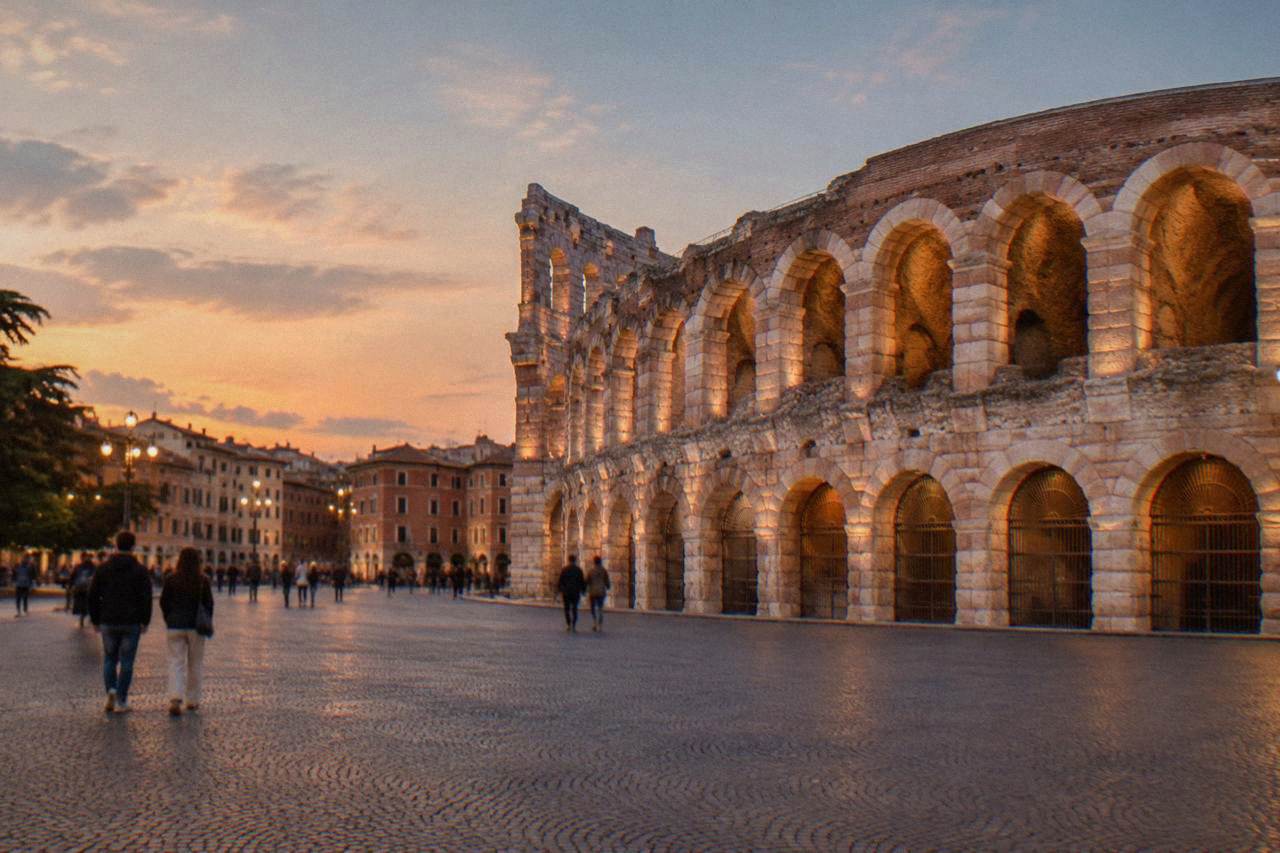
Verona's calendar is unusually shaped for a city its size. The Arena Opera Festival, the 103rd edition of which ran 5 June to 12 September 2026, stages opera inside the first-century amphitheatre, with stone-step seats starting in the EUR 30s per the Arena's own rates page, and the 104th edition announced for 11 June to 11 September 2027. Outside the season the Arena is a daytime monument visit, reported open Tuesday to Sunday and closed Monday, with early closing on show days: confirm the day's hours on the Arena's own ticket page before going.
Around the festival sits a walkable historic centre. The answer on whether Verona is walkable covers the distances in detail: Piazza Bra, Piazza delle Erbe, the Casa di Giulietta, Ponte Pietra and Castelvecchio all sit inside the bend of the Adige, a compact core that keeps car use optional. Florence, by contrast, is not documented on this site beyond the fact that it lies in Tuscany, well south of Verona; its galleries, queues and opening hours belong to its own official sources, and the honest comparison leaves them there.
What Does Verona Cost To Visit?
Verona's headline entry costs are 12 euro for the Arena by day, 5 euro for Juliet's courtyard or 12 euro with the house since 1 April 2026, 6 euro reported for the Torre dei Lamberti, and a digital VeronaCard at 33 euro for 24 hours or 38 euro for 48 hours with ATV buses from 1 September 2026. The city also charges a tourist tax, collected by the accommodation, capped at four nights per person per month.
Those are the figures, and they matter for anyone budgeting a trip. The Comune di Verona's price list gives the Arena's reduced ticket at 9 euro for groups of 15 or more, over-65s and other concessions, with 3 euro for visitors aged 18 to 25 from EU and reciprocity countries, and free entry for under-18s. The VeronaCard, per the Comune's own notice, covers civic museums and the churches under the Chiese Vive convention; it does not include the Aerobus airport service, and Juliet's House still requires an online booking even for card holders, so plan that visit in advance. More of these guides are collected on Verona Italy Travel Guide.
| Verona sight | Ticket (full) | Notes from the sources |
|---|---|---|
| Arena di Verona (day visit) | 12 EUR | 9 EUR reduced, 3 EUR ages 18-25, per the Comune di Verona's price list |
| Casa di Giulietta, courtyard route | 5 EUR | Since 1 April 2026, online booking, entry via Teatro Nuovo |
| Casa di Giulietta, house and balcony | 12 EUR | Includes the courtyard route |
| VeronaCard 24h / 48h with transport | 33 / 38 EUR | Digital from 1 September 2026, per the Comune's notice |
| Torre dei Lamberti | 6 EUR | Reported price; free with VeronaCard, check torredeilamberti.it before going |
The tourist tax applies per person per night and stops after four nights in a month, whatever the accommodation; the accommodation collects it and any rate question goes to the property at booking. Florence's museum and card prices are not in this site's sources, so no comparison table of the two cities' costs can be built honestly. A wine-country half day is the other line item worth planning: the related tour on this page, a guided chateau visit with Amarone tasting in Valpolicella, covers the hills about 25 minutes and 21 km by road from the centre, and Valpolicella is something Florence's surrounds do not offer in the same form.
Can You See Both Florence And Verona On One Trip?
Yes, and the sources support pairing them by train through Bologna, though this site's facts carry no Verona-Florence journey time, so check Trenitalia or Italo for the actual connection. Verona's Porta Nuova station has reported direct high-speed trains to Venice Mestre in 58 to 75 minutes, to Milano Centrale in 1 hour 15 to 1 hour 50 and to Rome in about 3 to 3 hours 30, which shows how well the city sits on the north-south rail spine.
The practical pattern many travellers use is a rail itinerary: arrive in Venice or Milan, stop in Verona two or three days, then continue south. The guide to travelling from Florence to Verona on this site covers the route in detail. What Verona adds to such a trip is distinct: a Roman amphitheatre you can walk inside by day and hear opera in at night, a UNESCO-listed historic centre on a river bend, and wine hills 25 minutes away. For what the city is actually famous for, the answer page on Verona's fame lists the Arena, Juliet and the Valpolicella connection.
Florence adds the Renaissance, and that is a claim this site's sources simply do not document beyond its region. Travellers who want both should let the calendar decide the order: an opera night in the Arena means Verona between June and September, while gallery cities run year-round.
Who Should Pick Verona Over Florence?
Pick Verona for opera in a Roman arena, a walkable UNESCO-listed centre, Valpolicella and Soave wine country within about 35 minutes by road, and Lake Garda towns 22 to 39 km west; pick Florence when Renaissance art is the single purpose of the trip. A short break favours Verona's compactness, a first art pilgrimage favours Florence.
The day-trip radius is where Verona is unusually strong, and every drive time below is computed over OSM routing at free flow. Lake Garda is not in Verona: the city is inland on the Adige, and the lake is a day trip west.
| Day trip from Verona | Drive time | Distance by road |
|---|---|---|
| Valpolicella (Sant'Ambrogio) | about 25 minutes | 21 km |
| Soave | about 33 minutes | 33 km |
| Vicenza | about 48 minutes | 65 km |
| Mantua | about 54 minutes | 59 km |
| Padua | about 67 minutes | 93 km |
| Sirmione, Lake Garda | about 40 minutes | west of the city |
| Venice | about 85 minutes | 122 km |
Trains extend the list: Venice is a reported 1 hour to 1 hour 15 from Porta Nuova, which is why the question of doing Verona and Venice in one day comes up so often. The lake deserves its own decision too, and the Verona or Lake Garda stay comparison covers it. The Monte Baldo cable car at Malcesine, about 84 minutes' drive away, runs a 30 euro adult round trip, 28 euro online, in its April-to-November season, and the Navigazione Laghi full-lake day pass is 39.50 euro for an adult in 2026, with the north-south passenger service reported suspended from 2 November 2026 to 12 March 2027.
Weather is another honest differentiator within the year, though only for Verona's side: the ERA5 reanalysis for Verona, 1991-2020, gives a July mean high of 29.3 C and a January mean low of -0.4 C, with November the wettest month at 118.2 mm. Florence's climate normals are not in this site's sources. On the broader Venice-versus-Verona question there is a separate Venice or Verona comparison, and the Bologna or Verona question has its own page, since the answer changes with each rival city.
Common Questions About Verona Or Florence
Which Is Nicer, Florence Or Verona?
There is no sourced answer that ranks one above the other. Verona suits travellers who want a Roman amphitheatre with summer opera, a compact walkable centre, wine hills and Lake Garda day trips; Florence suits travellers whose trip is about Renaissance art. This site documents Verona's figures only, so check Florence's official pages for its side.
Is Verona cheaper than Florence?
Verona's entry costs are 12 euro for the Arena by day, 5 euro for Juliet's courtyard or 12 euro with the house, and a digital VeronaCard at 33 or 38 euro with transport. Florence's prices are not in this site's sources, so no honest cost comparison can be made.
How many days does Verona need?
Two days cover the Arena, Juliet's House, Piazza delle Erbe, Ponte Pietra and Castelvecchio with time for a wine half day; three allow a Lake Garda day trip on top. The drive times are about 25 minutes to Valpolicella and about 40 minutes to Sirmione.
Can you visit Verona and Florence in the same trip?
Yes, by train via Bologna, though this site's sources carry no Verona-Florence journey time. Porta Nuova has reported direct high-speed trains to Venice Mestre in 58 to 75 minutes and to Milan in 1 hour 15 to 1 hour 50, showing how Verona sits on the main north-south rail line.
Is Verona good without a car?
Yes: the historic centre is walkable, the urban bus single is 1.50 euro for 90 minutes per ATV's fare page, the Aerobus from Verona Villafranca airport is reported at 7 euro, and Lake Garda is reachable by train to Peschiera or ATV bus line 164, reported at about 55 minutes to Sirmione.
The choice, in the end, is a traveller's own: the Verona Italy Travel Guide carries the detail for Verona's side of it, and Florence's official sources carry the rest.