Verona Weather By Month: Temperatures, Rain And Fog
Verona sits inland on the Adige in the Veneto plain, and its climate is continental northern Italian: cold damp winters, hot humid summers and a rainfall peak in late autumn. Here is what the ERA5 climate normals say, month by month.
Short answer
Verona's climate is continental: January averages a mean of 3.1 C with highs of 7.3 C, July averages a mean of 24.5 C with highs of 29.3 C, and November is the wettest month at 118 mm of rain. Spring and early autumn are the mild, in-between seasons, and the Arena opera season runs through the warm months.
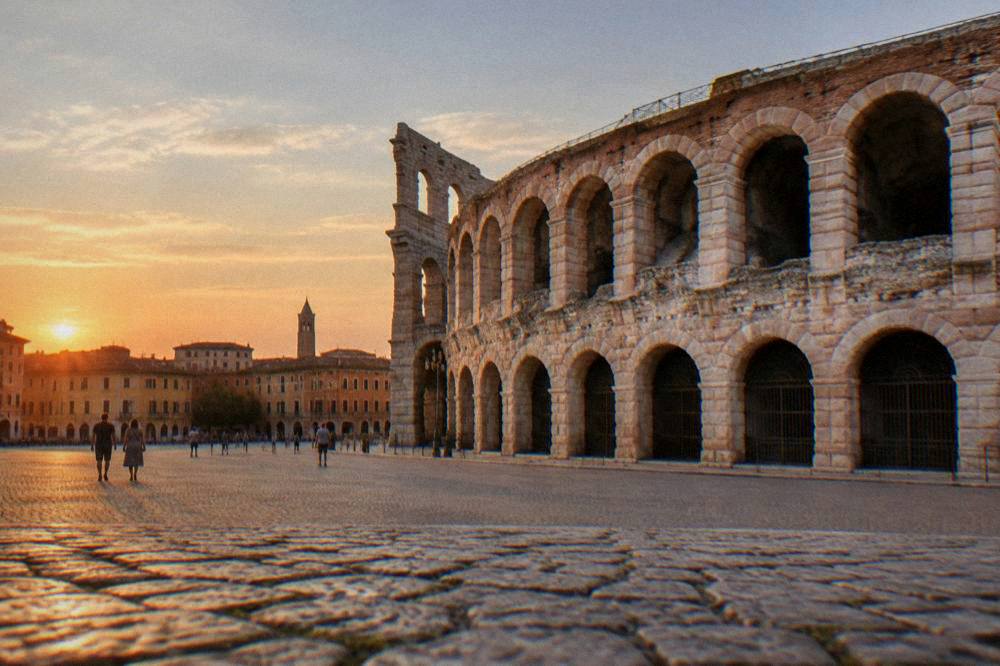
Verona is an inland city on the Adige river in the Veneto, northern Italy, and its weather behaves like the continental Po Valley city it is: sub-zero nights in January, mean daily highs near 29 C in July, and a long damp tail to the year that peaks in November. The figures on this page come from the ERA5 reanalysis, 1991-2020, a modelled grid cell near Verona at about 66 m elevation, not a weather-station record. They describe averages, and any given week can sit well above or below them. What they are genuinely useful for is planning: which month suits an outdoor itinerary, when an umbrella earns its place in the bag, and what the warm months mean for an opera night at the Arena, the season of which ran 5 June to 12 September in 2026 and is announced for 11 June to 11 September in 2027.
For a sense of how the weather shapes a visit, the Verona Italy Travel Guide covers the full range of seasonal itineraries, from Verona In Winter to the warm-month classics on the things to do in Verona page.
What Is The Weather Like In Verona Through The Year?
Verona has a humid continental climate with four distinct seasons: cold winters with mean January temperatures of 3.1 C, warm springs, hot and humid summers with July mean highs of 29.3 C, and mild autumns that turn wet, with November bringing 118 mm of rain in the ERA5 1991-2020 normals. Rain falls in every month of the year, so there is no reliably dry season. The city is inland, roughly 22 to 39 km from the Lake Garda towns, and the lake does not moderate its temperatures the way it does Sirmione's or Bardolino's own microclimates.
| Month | Mean High C | Mean Low C | Rain mm |
|---|---|---|---|
| Jan | 7.3 | -0.4 | 52.3 |
| Feb | 9.5 | 0.4 | 58.8 |
| Mar | 14.0 | 3.6 | 67.4 |
| Apr | 17.8 | 7.6 | 93.5 |
| May | 22.3 | 12.2 | 109.7 |
| Jun | 26.6 | 16.5 | 92.3 |
| Jul | 29.3 | 19.1 | 79.4 |
| Aug | 29.1 | 19.4 | 84.1 |
| Sep | 23.7 | 15.1 | 99.7 |
| Oct | 18.1 | 10.5 | 107.2 |
| Nov | 12.3 | 5.3 | 118.2 |
| Dec | 7.8 | 0.8 | 71.1 |
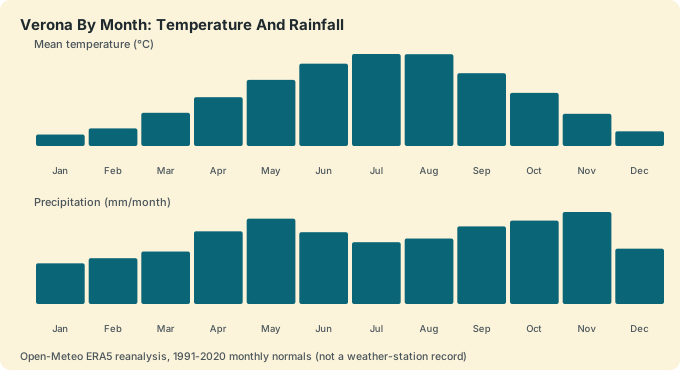
Two patterns in that table are worth fixing in mind before anything else. The first is the summer plateau: July and August mean highs sit within 0.2 C of each other, and mean lows stay near 19 C, which is what makes warm evenings at the Arena plausible across the whole opera season. The second is the autumn ramp: rainfall climbs steadily from August through September and October to a November peak of 118.2 mm, then falls back. January, at 52.3 mm, is the month with the least rain in the normals.
Winter deserves a separate word because averages hide it poorly. A January mean low of -0.4 C means freezing nights are routine, not rare, and the same damp air that produces November's rain produces low cloud and grey days through the cold months. Snow is possible in any winter month, but this page prints no snow-day count because the climate source gives temperature and precipitation only.
Which Months Are Warmest In Verona?
July has a mean daily high of 29.3 C and a mean low of 19.1 C in the ERA5 1991-2020 normals, with August at 29.1 C and 19.4 C, while June follows at 26.6 C. The heat is humid rather than dry, as the mean lows show: nights that barely drop below 19 C leave little cooling relief between one warm day and the next.
| Warm-Season Month | Mean High C | Mean Low C | What It Means For A Visit |
|---|---|---|---|
| Jun | 26.6 | 16.5 | Warm days, mild evenings, opera season under way |
| Jul | 29.3 | 19.1 | Hot and humid, late opera starts, daytime shade planning |
| Aug | 29.1 | 19.4 | Heat like July, damp evenings possible |
| Sep | 23.7 | 15.1 | Warm days, cooler nights, rain rising |
Practically, the warm months reward an early-start schedule. The stone squares, Piazza Bra and Piazza delle Erbe, hold heat in the afternoon, and the sensible pattern is a morning walk, a long shaded lunch, and an evening out. That is also the shape of the Arena opera night: the 2026 season ran 5 June to 12 September, with performances reported to begin around 21:00 to 21:30 in June and earlier later in the season, gates opening about two hours before. A cushion and a small umbrella are permitted subject to security checks, which matters because the summer months still carry substantial rain each in the normals, and rain never cancels an Arena show before its scheduled start: a performance may be delayed or suspended, with no refund once it has started.
For travellers who like the warmth but want structure, a small-group highlights walk moves the city's core sights into a single guided block, and the operator's live listing shows what each departure covers.
Which Months Are Coolest And Driest In Verona?
January is the coolest and least rainy month in the normals, with a mean low of -0.4 C, a mean high of 7.3 C and 52.3 mm of rain, while December and February sit close behind at mean highs of 7.8 C and 9.5 C. Winter in Verona is damp cold rather than alpine cold: rain and low cloud are more common than snow, and the February mean low of 0.4 C sits a fraction above freezing.
| Cold-Season Month | Mean High C | Mean Low C | Rain mm |
|---|---|---|---|
| Dec | 7.8 | 0.8 | 71.1 |
| Jan | 7.3 | -0.4 | 52.3 |
| Feb | 9.5 | 0.4 | 58.8 |
The cold months have real compensations. Daytime entry to the Arena costs 12 euro full and 9 euro reduced, and the civic price list marks the first Sunday of the month from November to March at 1 euro, which makes a winter Sunday an economical day for the amphitheatre. Juliet's House has been ticketed since 1 April 2026, 5 euro for the courtyard route and 12 euro for the house and balcony with online booking, so its indoor route works well on a grey day. The Verona In Winter guide and the Verona In The Rain itinerary both build on this season's realities.
When Does It Rain Most In Verona?
November is the wettest month in the ERA5 1991-2020 normals at 118.2 mm, followed by May at 109.7 mm and October at 107.2 mm, while January is the least rainy at 52.3 mm. Rain falls in every single month of the Verona year, so the question is never whether to pack for rain at all, only how much of the trip it is likely to touch.
| Rank | Month | Rain mm | Notes |
|---|---|---|---|
| 1 | Nov | 118.2 | Peak of the autumn ramp |
| 2 | May | 109.7 | Spring's wettest month, often as thunderstorms |
| 3 | Oct | 107.2 | Mild but increasingly damp |
| 4 | Sep | 99.7 | Late in the opera season |
| 5 | Apr | 93.5 | Showery, fast-changing |
May's position near the top of the rainfall table surprises travellers who assume spring is dry. The pattern behind it is convective: warm days building into afternoon showers. September and October rain tends to arrive in longer, steadier fronts. The Verona In Spring and Verona In Autumn guides take these differences into account in their itineraries.
What About Fog In Verona?
Verona's damp, cold months are its fog and low-cloud season: the same humidity that produces 118 mm of November rain feeds grey, low-visibility mornings in November, December and January, when mean lows sit at or below freezing and mean highs struggle to reach 8 to 12 C. The ERA5 climate normals used on this page give temperature and precipitation only, and the seasonal pattern is consistent across the whole Po Valley plain.
Fog in practice means two things for a visit. One, morning sightseeing in the cold months can start under flat grey light that only lifts toward midday, which pushes photographers toward late-afternoon hours, and the Verona Photography Spots perspective changes entirely between seasons. Two, fog is a road condition: anyone driving to or from the Lake Garda towns or the Valpolicella hills in winter should allow extra time on the plain. The drive times computed for this site, Sirmione about 40 minutes and Bardolino about 37 from the Arena in free-flow conditions, assume clear roads.
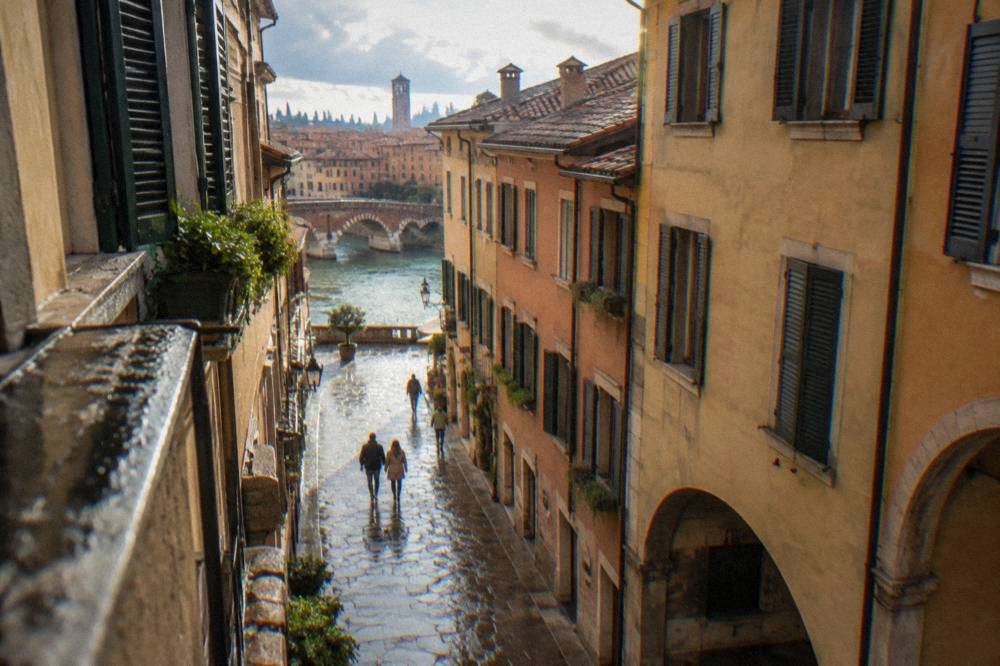
The trade for the gloom is atmosphere. Low cloud over the Adige, empty squares and the Christmas-market season, which in past years has run from late November to late December with no official 2026 dates published yet, give the cold months a character the summer crowds never see. The Verona Christmas Markets guide keeps track of what is confirmed.
What Should You Pack For Verona Weather?
Pack for Verona as a two-outfit city: breathable layers and sun protection for June to August, when mean highs sit near 29 C, and a real coat, scarf and waterproof for November to February, when mean lows fall below 3 C and monthly rain runs 52 to 118 mm. The in-between months, April, May, September and October, need both a warm layer and rain gear, because warm afternoons and cool evenings sit in the same day.
| Season | Months | Mean High Range C | Packing Core |
|---|---|---|---|
| Winter | Dec to Feb | 7.3 to 9.5 | Warm coat, scarf, waterproof shoes, umbrella |
| Spring | Mar to May | 14.0 to 22.3 | Layers, light jacket, compact umbrella |
| Summer | Jun to Aug | 26.6 to 29.3 | Breathable clothing, sun hat, water bottle, evening layer |
| Autumn | Sep to Nov | 12.3 to 23.7 | Layered clothing, waterproof, warmer jacket by November |
Footwear matters more than the averages suggest. Verona's historic centre is stone and cobble, wet stone in autumn is slick, and the Arena's unnumbered stone-step seating in the low-cost sectors is exactly what it sounds like, so shoes with grip serve both a rainy October piazza and an August opera night. A cushion for the stone steps is permitted, per the Arena's own terms.
How Does The Weather Affect The Arena Opera Season?
The Arena opera season sits entirely inside Verona's warm months: the 2026 edition, the 103rd, ran 5 June to 12 September, and the 2027 edition, the 104th, is announced for 11 June to 11 September, months in which ERA5 mean highs range from 23.7 C up to 29.3 C, with mean lows of 15 to 19 C. An opera evening is a warm-evening experience with a real chance of a shower, since those months carry substantial rain in the normals.
The Arena's reported rain rules are the detail worth knowing before booking. Rain never cancels a performance before its scheduled start, a show may be delayed or suspended mid-performance, and there is no refund once it has started, with partial protections for an early suspension. Gates open about two hours before curtain, and visitors are asked to arrive at least an hour early, so the whole evening is outdoors for several hours. A small umbrella is permitted subject to security checks. No strict dress code against shorts was found on the official pages, so the practical answer is to check the current terms on the Arena's own site before travel. Ticket pricing has one safe formulation here: stone-step seats start in the EUR 30s, with the full sector detail on the Arena's own ticket pages. The Verona Opera Festival and Arena Di Verona Seating guides carry the full picture.
How Does Verona Weather Compare With Lake Garda?
Verona is an inland city and its climate is the plain's climate, while the Lake Garda towns 22 to 39 km west sit at the foot of the mountains with the lake's own influence, so summer day trips from Verona to Sirmione, Bardolino or Malcesine trade a hot inland afternoon for a shoreline one. This page's climate table covers Verona's grid cell only, so no separate lake temperature or wind figure appears in it.
The practical seasonal notes are about transport and altitude rather than temperature. The Monte Baldo cable car from Malcesine runs a season of roughly early April to early November, with a round trip at 30 euro for an adult, 28 online, per its own fares page, so a mountain excursion is a warm-season plan and the summit is colder than the shore below. The Navigazione Laghi full-lake day pass is 39.50 euro for an adult at 2026 fares, but the north-south passenger service is reported suspended from 2 November 2026 to 12 March 2027, which reshapes any cold-season ferry plan. Drive times from the Arena, about 40 minutes to Sirmione and about 84 to Malcesine, are computed over free-flow roads. The Lake Garda and Sirmione guides carry the full day-trip detail.
What Is The Best Month To Visit Verona For Good Weather?
The months with the best balance of warmth and manageable rain in the ERA5 normals are June and September: June averages a mean high of 26.6 C with 92.3 mm of rain, and September 23.7 C, both warm enough for evening plans without the July and August mean highs near 29 C. April and October are the cooler alternatives, at 17.8 C and 18.1 C mean highs, with rain of 93.5 and 107.2 mm respectively.
| Month | Mean High C | Rain mm | Verdict For Planning |
|---|---|---|---|
| Apr | 17.8 | 93.5 | Mild, showery, low-season calm |
| May | 22.3 | 109.7 | Warm but one of the wettest months |
| Jun | 26.6 | 92.3 | Warm evenings, opera under way, good balance |
| Sep | 23.7 | 99.7 | Warm days, cooler nights, season closing |
| Oct | 18.1 | 107.2 | Mild and increasingly damp |
No month is a guaranteed winner, and the numbers argue against over-planning around them. June and September shorten the odds on pleasant evenings; May pays for its warmth with 109.7 mm of rain; and the cold months trade comfort for empty squares and the 1-euro first-Sunday Arena entry from November to March. The Best Time To Visit Verona guide weighs those same trade-offs against crowds and events rather than temperature alone, and Verona In One Day shows how little weather matters when the itinerary is compact, since the city's sights cluster within a short walk of each other.
Does Verona Weather Ever Disrupt Travel Plans?
Yes, in three specific ways: winter fog and freezing nights affect driving on the plain around Verona, the November-to-January damp makes for slick cobblestones in the historic centre, and summer thunderstorms, the mechanism behind May's 109.7 mm in the normals, can arrive fast in the warm months, with the Arena's own terms providing for rain delays of up to 150 minutes rather than cancellations. None of these typically stops a trip, but each one rewards a plan with slack in it.
Train travel is the weather-proof option, and Verona Porta Nuova connects to Venice Mestre in 58 to 75 minutes and to Milano Centrale in 1 hour 15 to 1 hour 50 on direct services, times only; fares are on the operators' own sites. The Aerobus line 199 from Verona Villafranca airport is a reported 7 euro and about 15 minutes, with the schedule on the operator's pages to confirm before travel. For anyone driving in, the historic centre is a camera-policed ZTL limited to at most four entries a month for non-residents, with hotel guests free if the hotel registers the plate, so a wet day is not the moment to be circling the centre looking for a space. The Verona ZTL And Parking and Getting Around Verona guides cover the details.
How Do You Plan A Rainy Day In Verona?
A rainy day in Verona is an indoor day with unusual depth: the Arena's daytime visit, Juliet's House with its 5 euro courtyard route and 12 euro house route booked online, Castelvecchio and the Torre dei Lamberti all run through the year, and the city's food side, from risotto all'Amarone to a pasta class, is entirely weather-proof. With rain in every month of the normals, a wet-day plan is not pessimism, it is ordinary Verona planning.
The full wet-weather itinerary lives at Verona In The Rain, and the food anchor is What To Eat In Verona. A cooking class is the most weather-immune plan in the city, since the whole point is a kitchen. A guided food walk does the same for the covered and indoor stops, as does an evening tour when the rain has often cleared.
Common Questions About Verona Weather
What is the weather like in Verona in July?
In the ERA5 1991-2020 normals, July has a mean daily high of 29.3 C, a mean low of 19.1 C and 79.4 mm of rain. It is hot, humid and the month of warm evenings at the Arena, with a real chance of showers.
Does it snow in Verona?
It can: January's mean low is -0.4 C, so freezing nights are routine in winter. The climate source used on this page gives temperature and precipitation only, so no snow-day count is printed.
What is the rainiest month in Verona?
November, at 118.2 mm in the ERA5 1991-2020 normals, ahead of May at 109.7 mm and October at 107.2 mm.
Is Verona hot in the summer?
Yes. July and August mean highs are 29.3 C and 29.1 C, with mean lows near 19 C, which makes the heat humid with little overnight relief.
Is Verona cold in winter?
Winter is damp cold: December, January and February mean highs run 7.3 to 9.5 C and mean lows sit at or just below freezing, with rain and low cloud more common than snow.
When is the best weather for the Arena opera in Verona?
The season runs through the warm months: 5 June to 12 September in 2026, 11 June to 11 September in 2027. June and September mean highs of 26.6 C and 23.7 C are the milder evenings; July and August are the warmest, around 29 C.
The Short Version Of Verona Weather
In one line from the ERA5 1991-2020 normals: Verona runs cold and damp from December to February, mild and showery in spring, hot and humid in July and August, and increasingly wet from September to a November peak of 118.2 mm. June and September offer the best warmth-to-rain balance, and no month is dry.
Winter is cold and damp, with mean lows at or below freezing from December through February. Summer is hot and humid, with July and August mean highs near 29 C and evenings warm enough to sit outdoors at the Arena. Spring and autumn are the swing seasons: May is warm but one of the three wettest months, and October slides from mild into November's rainfall peak. Rain falls somewhere in the normals every single month, so a compact umbrella belongs in the bag from January to December, and the months that reward a booking most, June and September, are exactly the ones that flank the opera season. The Where To Stay In Verona guide picks up from here, since a well-placed base shortens every walk between the sights, whatever the sky is doing.