Is Verona, Italy Worth Visiting?
An honest, source-based answer to whether Verona is worth visiting: the Arena, Juliet's House, food, wine and Lake Garda day trips, with 2026 prices and practical facts.
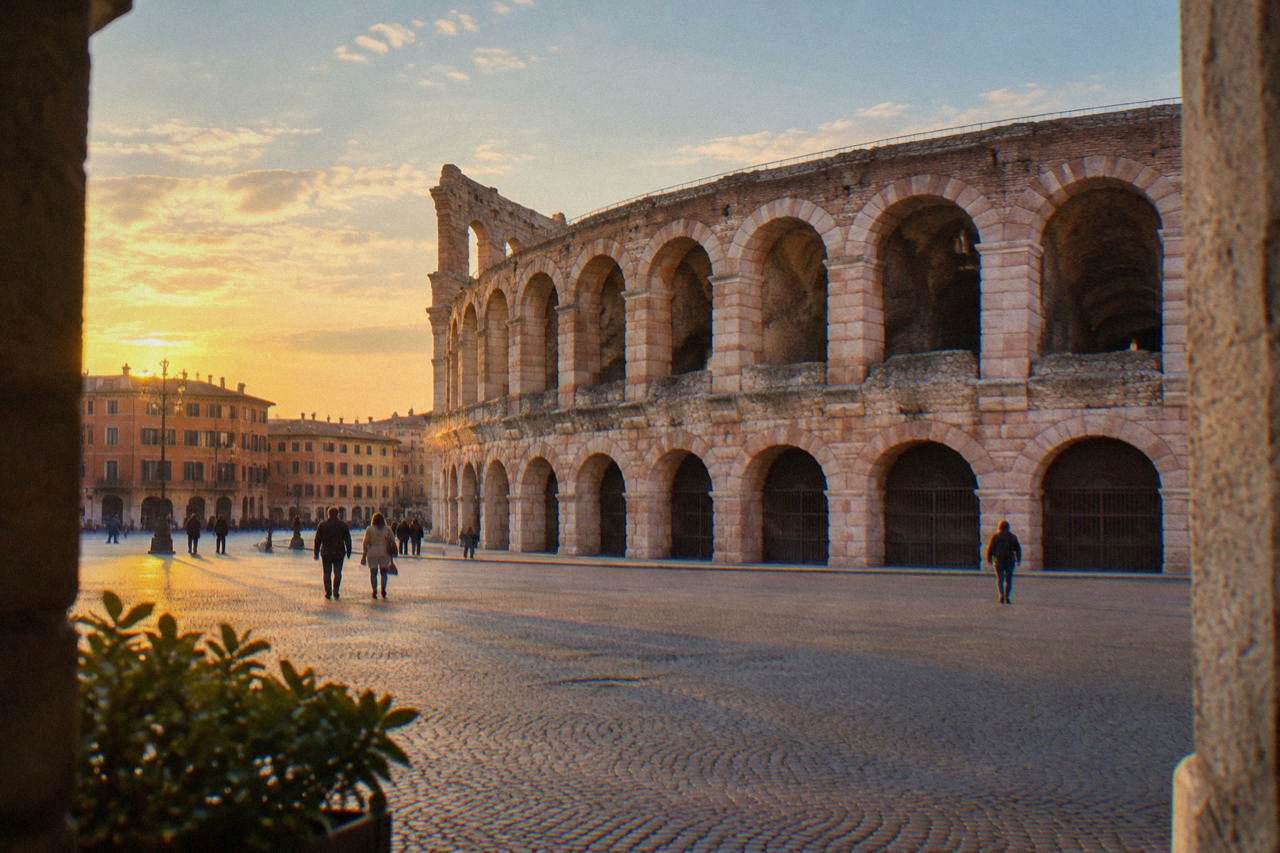
Verona, in Veneto, northern Italy, is an inland city on the Adige river built around a first-century Roman amphitheatre, and the honest answer to whether it deserves a place on an Italian itinerary is yes, for reasons that survive close inspection. The old centre has been a UNESCO World Heritage Site since 2000, the Arena hosts one of Europe's large summer opera seasons, and the Valpolicella wine hills begin about 25 minutes' drive from Piazza Bra. Lake Garda, which Verona is often wrongly said to sit on, is a separate day trip 22 to 39 km to the west, which is close enough to be a genuine asset rather than a distraction.
This page lays out what the primary sources say about the city's sights, prices, food and day trips, so the verdict rests on verifiable facts rather than brochure language. It draws on the Comune di Verona's own ticket pages, the Arena's official site and the ERA5 climate reanalysis, and it flags which details changed in 2026, because three of them matter to anyone planning a visit right now.
Is Verona, Italy Worth Visiting?
Yes: Verona is worth visiting for a compact, walkable historic centre anchored by a Roman amphitheatre you can enter by day for 12 euro, a UNESCO World Heritage listing inscribed in 2000, a summer opera season inside that same Arena, the Romeo and Juliet sites, and Valpolicella wine country about 25 minutes away by road, with Lake Garda's towns reachable as day trips from 37 to 84 minutes out. It suits travellers who want a small northern Italian city with layers of Roman, medieval and Renaissance history rather than a beach or a resort base.
That verdict comes with one correction that colours everything else: Verona is not on Lake Garda. The lake towns, Sirmione, Bardolino, Garda and Malcesine, sit 22 to 39 km west, and Sirmione is actually in Brescia province, Lombardy. Anyone picturing a lakeside city should read the answer to is it better to stay in Verona or Lake Garda before booking, because the two offer genuinely different trips.
What Verona offers instead of a lakefront is density. The Arena, Piazza Bra, Piazza delle Erbe, the Torre dei Lamberti, Castelvecchio, Juliet's House and the Ponte Pietra all sit within a bending loop of the Adige that takes twenty minutes to cross on foot at its widest. The city's famous landmarks cluster so tightly that the real planning question is not transport but ticketing, and three ticketing facts changed in 2026.
What Changed In Verona In 2026?
Three things changed in 2026 that a visitor should know: the Arena's daytime visit costs 12 euro full and 9 euro reduced, Juliet's courtyard stopped being free on 1 April 2026 and now costs 5 euro, or 12 euro with the house and balcony, booked online with entry via Teatro Nuovo, and the VeronaCard became a digital card on 1 September 2026 at 33 euro for 24 hours or 38 euro for 48 hours with city buses included. None of these changes makes the city less worth seeing, but all three make old guidebooks unreliable.
The Arena price list comes from the Comune di Verona's own pages: 12 euro full, 9 euro reduced for groups of 15 or more, over-65s and other concessions, and 3 euro for visitors aged 18 to 25 from EU and reciprocity countries, with free entry for under-18s and VeronaCard holders. Reported opening hours are Tuesday to Sunday, closed Monday, with early closing on opera show days, so check the Arena's own calendar before planning a daytime visit. The Comune di Verona's VeronaCard notice states the card covers civic museums and the Chiese Vive churches but not the airport Aerobus, and VeronaCard holders still need to book Juliet's House online.
These changes are small money in the context of a trip, but they reshaped the visiting rhythm. Juliet's House now runs on timed online booking, which shortens the courtyard crush that older reviews complain about, and the digital VeronaCard rewards anyone planning a dense museum day. For a full sight-by-sight breakdown, the site's things to do in Verona page carries the details.
Is Verona Worth Visiting Without The Opera?
Yes: the opera is one reason to visit, not the reason, because the Arena is a daytime sight in its own right, the 2026 season ran 5 June to 12 September rather than a short summer burst, and stone-step opera seats are reported to start in the 30-euro range, so a visit outside the season loses the performances but keeps the amphitheatre, the UNESCO old centre and the food and wine scene intact. Spring and autumn visitors miss nothing structural.
The Arena's own site attributes an origin around 30 AD and a current opera capacity of 30,000 seats, and the 2027 season is announced for 11 June to 11 September. Opera nights reshape the city: gates open about two hours before a 21:00 or 21:30 start, and the daytime visit closes early. Travellers weighing an opera night against other plans can read the site's detailed answer to is the opera in Verona worth it, and the amphitheatre's age question is covered separately in is the Verona Arena older than the Colosseum.
Away from the Arena, the city's appeal is quieter. Piazza delle Erbe's market square, the Scaliger tombs, the Ponte Pietra's Roman arches and the climb to Castel San Pietro fill days without a single ticket queue, and the walking routes across the centre are short enough that footwear matters more than transport. The Romeo and Juliet layer is partly modern stagecraft, since the balcony was added in 1940 and Shakespeare never visited, but the courtyard's bronze Juliet, placed in 1972, has made the site a destination in its own right, as covered in is Juliet's balcony real in Verona.
A Themed Way To See The Old Centre
Standard walking tours cover the highlights; a themed one reframes them. The Dark Historical Verona Walking Tour digs into the city's grimmer episodes, plagues, executions and the rougher edges of Scaliger rule, and its evening slots pair well with an afternoon of churches and piazzas. Check availability
Is Verona Worth It For Food And Wine?
Yes: Verona sits between two of Italy's named wine zones, Valpolicella to the north and Soave to the east, and its kitchen has documented local dishes including risotto all'Amarone, pastissada de caval, bollito with pearà sauce and gnocchi, so the food case stands on the city's own traditions rather than on generic Italian dining. The wine hills are about 25 minutes from the Arena by road.
Amarone della Valpolicella, the area's appassimento red made from dried Corvina, Corvinone and Rondinella grapes, is the region's flagship, and a tasting can be done two ways: inside the city, where several operators pour local wines with panoramic views over the rooftops, or out in the hills, where vineyard visits show the drying lofts the wine depends on. The guided options on this site, from short city tastings to half-day Valpolicella trips with transport, are listed with live prices on each tour page. Everything else covered here is indexed on Verona Italy Travel Guide.
Food tours work the same way, walking the centre through osterias and market squares, and cooking classes have become one of Verona's stronger formats because the local repertoire, fresh pasta, tiramisu and gelato, is teachable in a single sitting. Between them they cover what the traditional Veronese dishes page breaks down dish by dish.
When Is Verona Worth Visiting?
Verona is worth visiting from April to June and September to October, when the ERA5 reanalysis for 1991-2020 puts mean highs at 17.8 to 26.6 C in spring and 23.7 to 18.1 C in autumn against July and August highs of 29.3 and 29.1 C, with November the wettest month at 118.2 mm of rain, so the shoulder seasons trade a little warmth for thinner crowds and lower rainfall than late autumn. Opera fans should target 11 June to 11 September 2027.
| Month | Mean high (C) | Mean low (C) | Rain (mm) |
|---|---|---|---|
| January | 7.3 | -0.4 | 52.3 |
| April | 17.8 | 7.6 | 93.5 |
| July | 29.3 | 19.1 | 79.4 |
| September | 23.7 | 15.1 | 99.7 |
| November | 12.3 | 5.3 | 118.2 |
These are ERA5 reanalysis values for 1991-2020, a modelled grid cell rather than a weather-station record, but they frame the trade-offs honestly. Winter brings the Christmas market season, whose 2026 dates the Comune had not published at the time of the site's research, plus cold, damp weather with January means around 3.1 C. Summer brings the opera and heat in equal measure. The site's best time to visit discussion covers how the seasons change the itinerary.
Is Verona A Good Base For Day Trips?
Yes: Verona works as a base because Lake Garda's towns are 37 to 84 minutes away by road, Venice is an 85-minute drive or a 58 to 75 minute direct train from Porta Nuova, and Valpolicella, Soave, Vicenza, Mantua and Padua all sit inside about an hour, giving the city a day-trip range few Italian cities of its size match. The lake itself, not the city, is the destination for a waterside day.
| Day trip from Verona | Drive time from the Arena | Notes |
|---|---|---|
| Valpolicella (Sant'Ambrogio) | about 25 min | wine hills, tastings |
| Soave | about 33 min | walled town, white-wine zone |
| Vicenza | about 48 min | train also serves the city |
| Mantua | about 54 min | regional train connections |
| Padua | about 67 min | on the Venice rail line |
| Bardolino | about 37 min | Lake Garda shore |
| Sirmione | about 40 min | in Brescia province, Lombardy |
| Garda | about 42 min | the town of Garda, not Riva del Garda |
| Malcesine | about 84 min | Monte Baldo cable car nearby |
| Venice | about 85 min | train 58 to 75 min direct |
Drive times are computed over OpenSM routing in free-flow conditions, so add margin in summer traffic. Two lake details from the sources: the Navigazione Laghi full-lake day pass lists 39.50 euro for an adult in 2026, and the north-south passenger ferry service is reported suspended from 2 November 2026 to 12 March 2027, so winter lake day trips lean on buses and the year-round Maderno-Torri car ferry. The distance question is answered in full at how far is Verona from Lake Garda.
What Are The Honest Downsides?
Verona's downsides are real but bounded: the historic centre is a camera-policed limited-traffic zone where non-residents get at most four entries a month, a tourist tax applies per person per night capped at four nights a month, the city's climate runs hot in July and August and damp in November, and the main sights close on Mondays or early on opera nights, so a poorly timed two-day visit can collide with closures. None of these is hidden; all are documented by the Comune.
The ZTL rules come from the Comune di Verona: entries on weekdays run 10:00 to 18:00 and 20:00 to 23:00, with weekend windows from 10:00 to 13:30, and hotel guests drive in free if the hotel registers their plate, a concession short-term rentals do not get. Monday closures hit the Arena, Castelvecchio and the Teatro Romano, per their reported hours, and church opening times vary, so confirm locally. The tourist tax's exact rate depends on the accommodation category, so ask at booking. None of this argues against visiting; it argues for reading a how many days in Verona is enough planner before locking dates.
Common Questions About Visiting Verona
Is Verona, Italy worth visiting?
Yes. The city combines a Roman amphitheatre visitable by day, a UNESCO-listed old centre, the Romeo and Juliet sites, strong local food and wine traditions, and a day-trip range that includes Lake Garda's towns, Venice, Mantua and Padua. The compact size makes it practical even for a short stay.
Is Verona too touristy to enjoy?
The centre is busy around Piazza Bra, Via Mazzini and Juliet's House, and general advisories flag pickpocketing in those crowded spots. But the 2026 online booking at Juliet's House spreads arrivals, and districts such as Veronetta and San Zeno sit minutes from the crush with far thinner footfall, so the density is avoidable with basic planning.
Can you see Verona and Venice in one day?
It is possible because the train from Verona Porta Nuova takes 58 to 75 minutes direct to Venice Mestre, but it compresses both cities hard. The site's dedicated answer at can you do Verona and Venice in one day weighs the trade-off in detail.
Is Verona expensive?
Core sight prices are modest: the Arena by day is 12 euro, Juliet's courtyard route is 5 euro, and the digital VeronaCard is 33 euro for 24 hours with buses. The tourist tax adds a per-night cost capped at four nights. Restaurant and hotel prices were not sourced for this page, so check current rates when booking.
Do you need a car in Verona?
No. The centre is walkable, the urban bus single is 1.50 euro for 90 minutes per ATV's fare page, trains reach Venice, Milan and Rome from Porta Nuova, and the historic centre's ZTL restricts driving anyway. A car only earns its keep for slow touring of the Valpolicella and Soave hills.
Is one day enough for Verona?
One day covers the Arena, Piazza delle Erbe, Juliet's House and one viewpoint. Two days add Castelvecchio, San Zeno or a wine tasting, and three allow a Lake Garda day trip. The how many days guide on this site breaks the options down.
The verdict stands on the sources: a UNESCO-listed, Roman-rooted, wine-country city an hour from Venice, with 2026 prices that are published and modest, deserves the two or three days a northern Italy route can give it.