Verona Cathedral: Titian, Cloister And Sant'elena
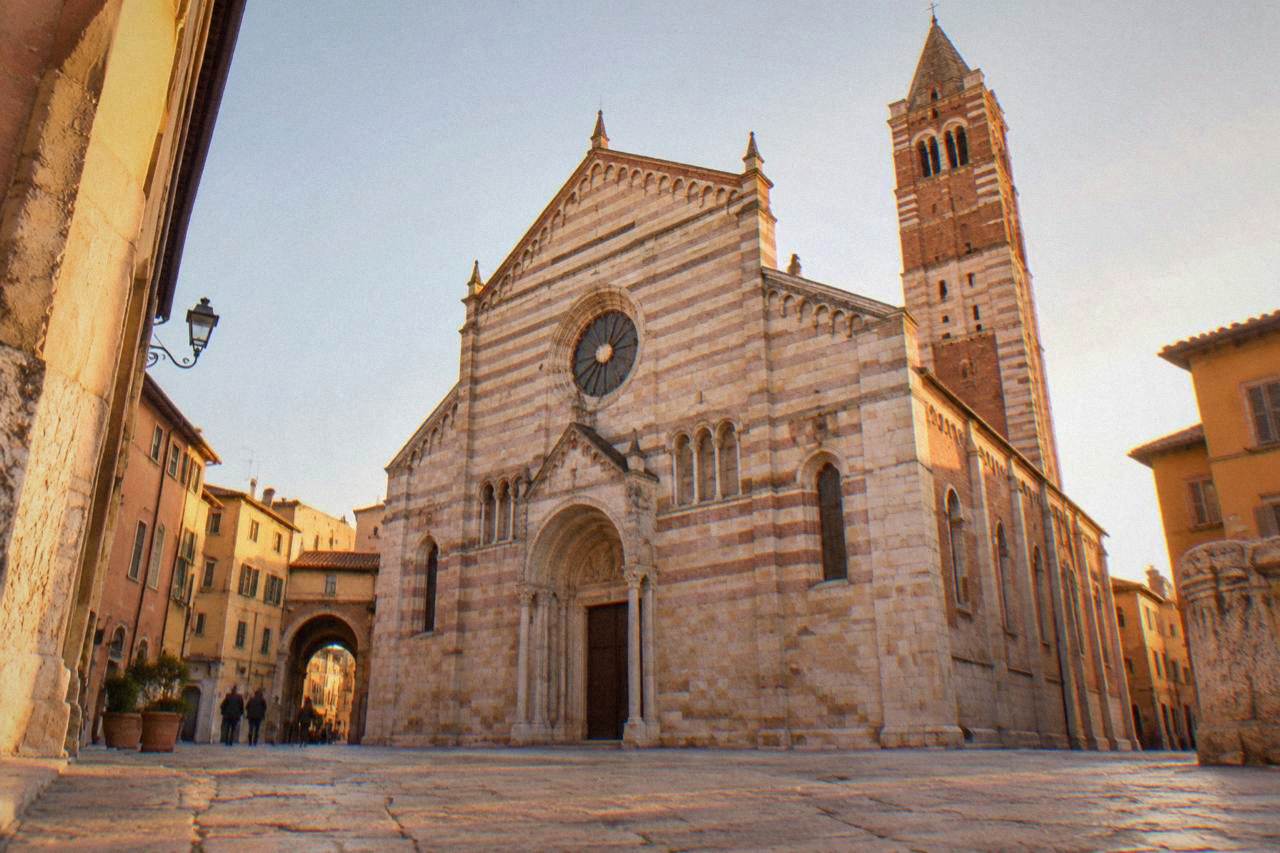
Verona Cathedral, the Cattedrale Santa Maria Matricolare, stands on the edge of the historic centre of Verona in Veneto, a short walk from Piazza delle Erbe and the Adige river.
Short answer
Verona Cathedral is the city's cathedral church, reported to be covered by the VeronaCard under the Chiese Vive circuit together with the cloister and the early Christian complex. Admission prices and hours were not captured from official sources, so confirm at the door or with the card before you go.
Verona Cathedral, formally the Cattedrale Santa Maria Matricolare, is the principal church of Verona, an inland city on the Adige river in Veneto, northern Italy. The church gives its name to the whole cathedral quarter on the edge of the historic centre, a cluster that includes the cloister, the baptistery known as Sant'Elena and the remains of earlier churches beneath the present building. The complex sits within the UNESCO World Heritage perimeter inscribed in 2000, a short walk uphill from Piazza delle Erbe and the Casa di Giulietta. This page gathers what official and reported sources say about the complex, its artworks, its coverage under the VeronaCard, and how to plan a visit, without inventing a single hour or price that the sources do not state.
The useful starting point is a blunt one: church admission in Verona is exactly the kind of topic where guidebooks and forum posts disagree, because ticketing changed with the VeronaCard system. The Comune di Verona's VeronaCard notice states the card became digital on 1 September 2026, at 33 euro for 24 hours and 38 euro for 48 hours with ATV urban transport included, or 29 and 32 euro without transport. The same notice and the card's own listings report that the Duomo complex, San Zeno, Sant'Anastasia and San Fermo are covered by the card under the Chiese Vive convention. What no official page captured for this guide is a standalone door price or a fixed opening hour for the cathedral, so this page prints none, and the honest instruction is to confirm at the entrance or on the card's listing before setting out.
What Is The Verona Cathedral Complex?
The Verona Cathedral complex is the cathedral church of Verona, Santa Maria Matricolare, together with its Romanesque cloister, the early Christian baptistery of Sant'Elena and the archaeological layers of earlier churches beneath and beside the present building, all within the UNESCO-inscribed historic centre. The complex is reported to be covered by the VeronaCard under the Chiese Vive circuit. No standalone ticket price or opening hours were captured from official sources, so confirm locally before a visit.
The cathedral is the mother church of the diocese, and the building a visitor sees today is the result of a rebuilding after the 1117 earthquake that devastated Verona and destroyed the outer ring of the Arena. That earthquake date is one of the few securely sourced chronological anchors in the city's history, and it explains why so much of central Verona, including the cathedral quarter, took its present Romanesque shape in the decades that followed. No architect's name and no precise construction dates for the cathedral were captured from the sources used here, and this page does not supply them.
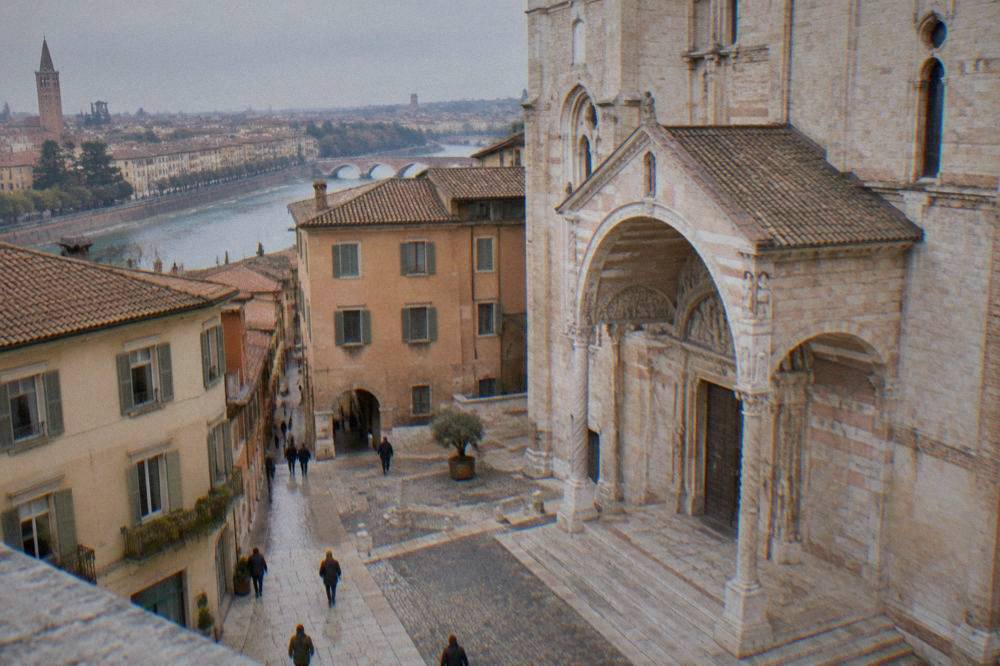
The complex works as a sequence rather than a single room. A visitor normally passes the striped marble facade with its deep porch, enters the nave, then reaches the cloister on the north side, and from there the steps down into the baptistery of Sant'Elena, where floor mosaics and the base of an earlier structure survive. The archaeological layer below is the part first-time visitors read about least and remember longest: the footprint of an early Christian church is visible in the excavated area, which makes the site a readable sequence of Verona's church history in one place.
What the experience is not is a single grand hall like some Italian cathedrals built on an open square. The cathedral sits in a tight quarter of narrow streets, canon's houses and small courtyards, and the approach on foot from Piazza delle Erbe is part of the visit. The section of the historic centre around it is quiet compared with the streets around the Arena and Juliet's House, which for many itineraries is exactly the point of walking this way.
For travellers who want the cathedral placed in the context of the whole city rather than visited cold, a guided walk is the natural format. The Verona walking tour itineraries on this site cover the cathedral quarter among the city's highlights, and the small-group version can be checked directly:
What To See Inside Verona Cathedral?
Inside Verona Cathedral the reported highlights are Titian's Assumption of the Virgin above the high altar, the Romanesque cloister with its paired columns, the early Christian mosaics in the baptistery of Sant'Elena, and the excavated remains of earlier churches beneath the complex. Artwork attributions and dates beyond these were not captured from official sources, so treat any further detail as something to confirm on the interpretive panels during a visit.
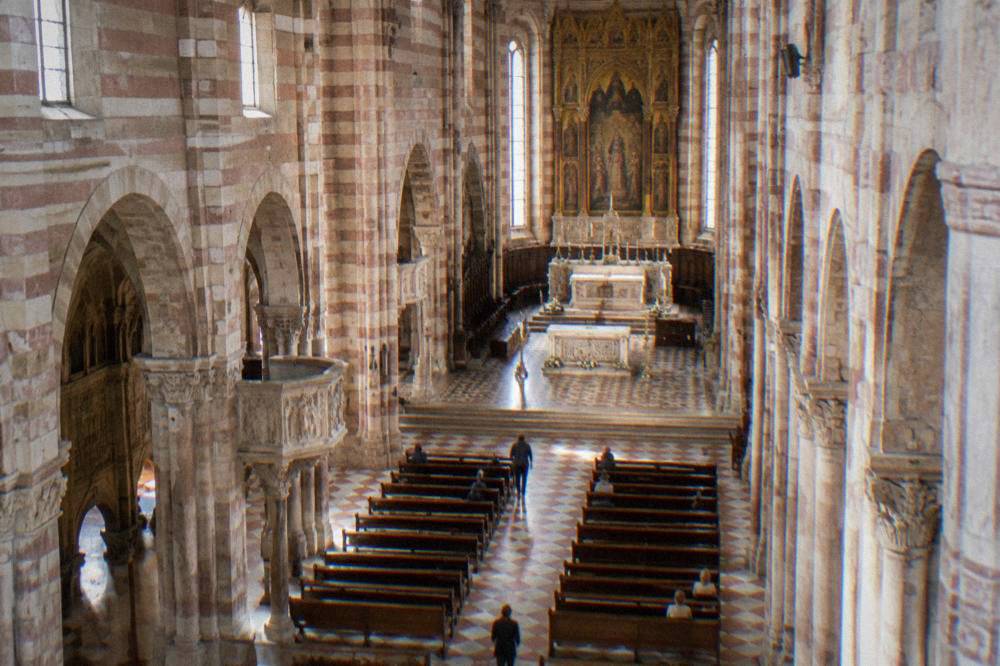
The Titian altarpiece is the single most frequently named artwork in the complex. The Assumption of the Virgin hangs above the main altar, and it is the painting around which the whole nave is oriented. Sources describing the interior name it consistently, though the detailed art-historical commentary that fills guidebooks is not reproduced here, because this page prints only what the captured sources support. The rest of the nave rewards slow looking: the striped stone banding of the interior walls, the sculpted portal figures, and the unusual double column arrangement of the cloister, where each pair of shafts is carved differently.
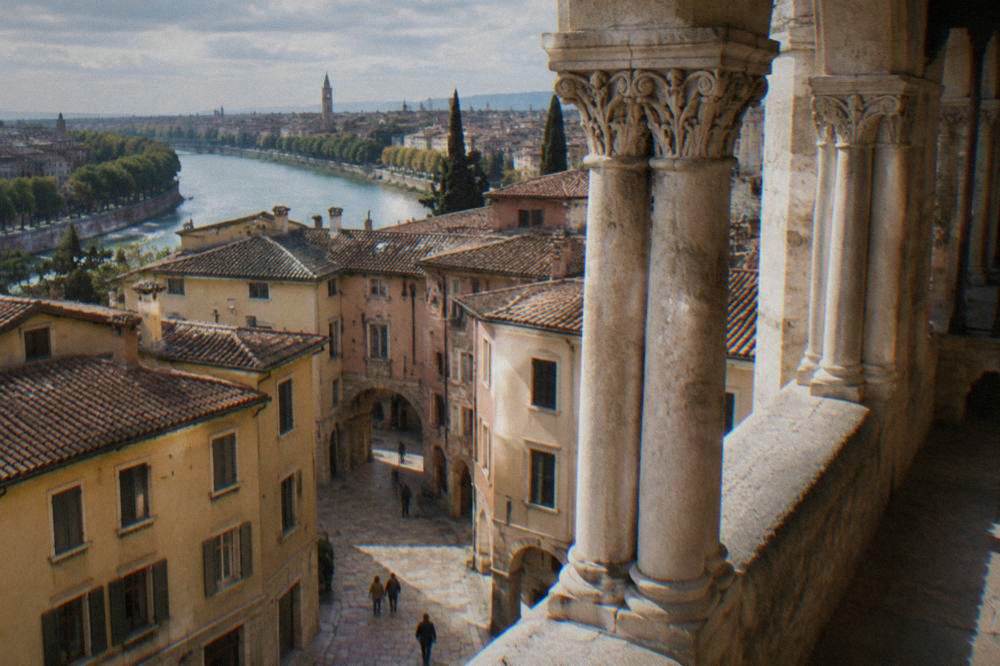
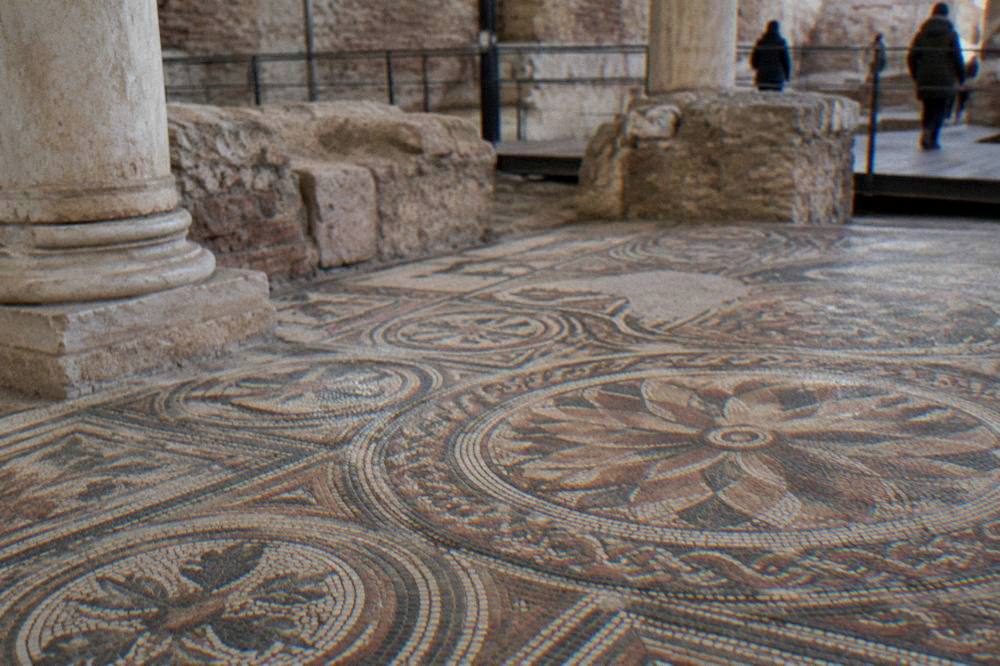
The cloister is the transition space between the church and the excavations. Its arcades run on paired columns, no two capitals alike, which is the standard description of Veronese Romanesque cloister design and matches what a visitor actually sees. From the cloister, a stairway leads down to the baptistery of Sant'Elena and the mosaic floors of the early Christian church beneath the present building. The mosaics are the oldest visible layer of the complex, and the excavated area around them exposes the plan of the earlier structure.
| Part of the complex | What a visitor sees | Reported in sources |
|---|---|---|
| Nave and high altar | Striped Romanesque interior, Titian's Assumption above the altar | Artwork named in captured sources |
| Main portal | Deep porched doorway with carved figures on the facade | Described in general coverage of the complex |
| Cloister | Arcades on paired columns with varied carved capitals | Consistently described in coverage |
| Baptistery of Sant'Elena | Early Christian floor mosaics and the base of the font | Named as part of the complex |
| Excavated lower level | Remains of earlier churches beneath the present building | Described as visible on site |
A practical note about expectations: the cathedral is a working church, not a museum, and its rhythm follows services rather than a fixed visitor timetable. No opening hours were captured from official sources for this page, and hours for Verona's churches are known to vary seasonally and around services. The honest planning advice is to treat any hour you read anywhere, including in printed guidebooks, as something to confirm on the day, either at the door or through the VeronaCard listing.
How Do Tickets Work For Verona Cathedral?
Tickets for Verona Cathedral are reported to be handled through the Chiese Vive circuit, with VeronaCard holders receiving free or reduced entry to the Duomo complex under the card's convention, per the Comune di Verona's VeronaCard notice. A standalone door price for the cathedral was not captured from official sources, so check the current price at the entrance or on the card's listing before you go.
This is where the 2026 changes matter. The VeronaCard became digital on 1 September 2026, delivered through the "Your Verona" web app, and the Comune's notice lists the new prices plainly: 33 euro for 24 hours and 38 euro for 48 hours with ATV urban transport included, or 29 and 32 euro without transport. The card's coverage includes the civic museums and the churches under the Chiese Vive convention, among them the Duomo complex, San Zeno, Sant'Anastasia and San Fermo. Old paper cards remained valid to 31 March 2027.
| VeronaCard option | Price with ATV transport | Price without transport |
|---|---|---|
| 24 hours | 33 euro | 29 euro |
| 48 hours | 38 euro | 32 euro |
The card is valid from first use, and the Comune's notice carries one caveat worth repeating for church visitors specifically: where a site requires booking, card holders book too. Juliet's House is the example the notice itself uses, since even card holders must reserve a slot online there, and the same discipline of checking whether a reservation is needed applies to the cathedral complex on busy days. The Aerobus airport line is not included in the card's transport component, a point the notice also makes.
For a visit built around several covered sights in one or two days, the arithmetic is a traveller's own to do, because the card's terms forbid computing a saving on this site and door prices for individual churches were not captured anyway. What can be said plainly is what the card covers and what it costs, both stated above from the Comune's notice.
If the plan is to pair the cathedral quarter with the Arena and the city's other headline sights in a single guided loop, the Arena priority-access tour below is the pairing that covers the other end of the historic centre, and it can be reserved with free cancellation:
Check availability
Where Is Verona Cathedral And How Do You Reach It?
Verona Cathedral stands in the cathedral quarter on the north-east side of Verona's historic centre, inside the UNESCO perimeter, roughly midway between Piazza delle Erbe and the Adige river at the Ponte Pietra end of the old city, and it is reached on foot in a few minutes from either landmark. The historic centre is a camera-policed ZTL, so drivers park outside and walk.
The walking logic of the old city makes the cathedral easy to fold into a loop. From Piazza delle Erbe the route climbs gently through the medieval streets of the Citta Antica, and from the cathedral it is a short continuation to Sant'Anastasia, the Scaliger tombs at Santa Maria Antica, and then down to the river at Ponte Pietra. The citta antica area guide on this site maps that sequence street by street, and the Piazza delle Erbe guide covers the market square where the walk naturally begins.
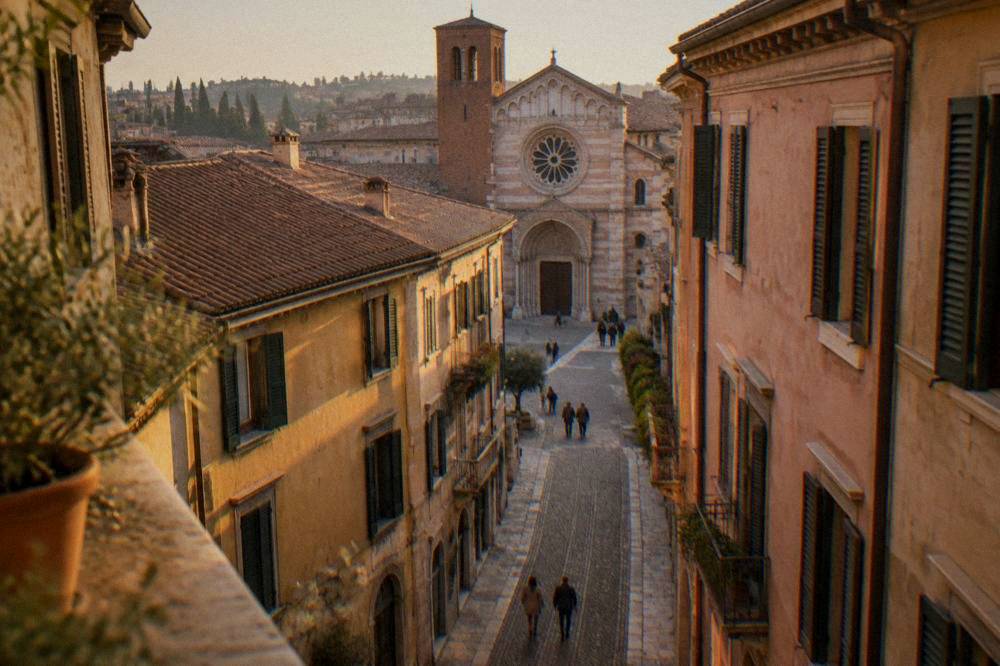
For drivers the constraint is the ZTL. The Comune di Verona's ZTL notice states that non-residents may enter the historic-centre zone at most four times a month on a booking, in windows reported as Monday to Friday 10:00 to 18:00 and 20:00 to 23:00, and from 10:00 to 13:30 on Saturdays, Sundays and holidays, with hotel guests exempted when the hotel registers the plate. The practical consequence for a cathedral visit is straightforward: arrive by train to Porta Nuova, walk or take an ATV urban bus, and leave the car in a car park outside the zone.
For orientation, the neighbouring sights worth naming in one table:
| Nearby sight | Direction from the cathedral | Notes from this site's guides |
|---|---|---|
| Piazza delle Erbe | Downhill, west | Market square, open access, free |
| Sant'Anastasia | Short walk south | VeronaCard coverage reported under Chiese Vive |
| Arche Scaligere | Short walk south-west | Free or tied to the civic ticket, VeronaCard free |
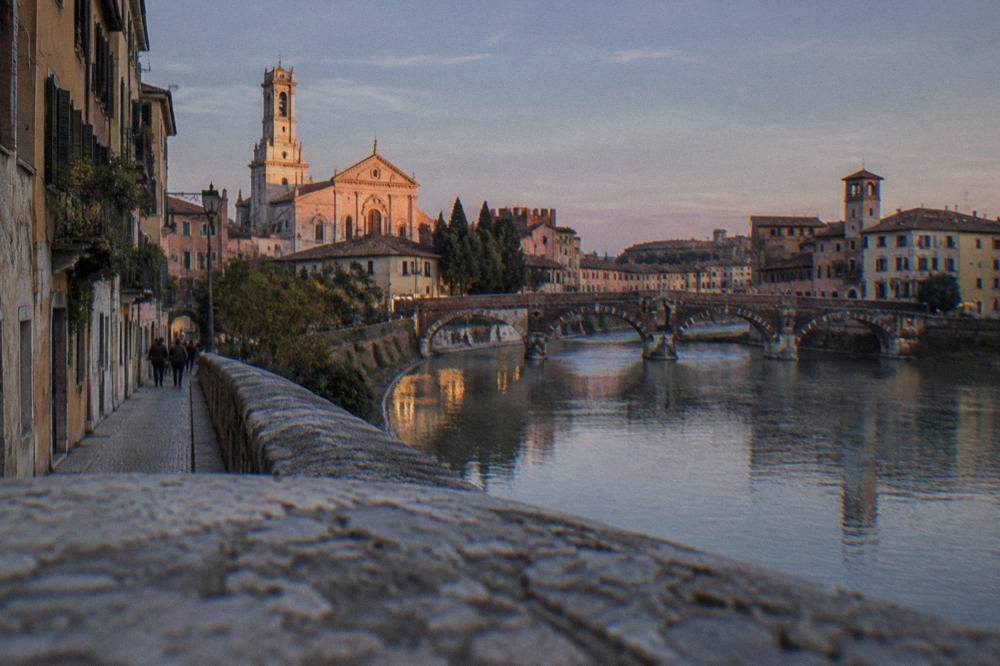
| Ponte Pietra | Downhill, north-east | Roman bridge, open access, free |
| Castelvecchio | Across the river loop, west | 9 euro full, 6 reduced, per the civic price list |
| Torre dei Lamberti | Near Piazza delle Erbe | Reported 6 euro, free with VeronaCard |
The cluster is compact enough that a half day covers the cathedral, Sant'Anastasia, the Scaliger tombs and the river at Ponte Pietra at a walking pace, with time left for the climb to Castel San Pietro if the funicular or stairs appeal. The things to do in Verona overview page places each of these in a suggested order.
How Does Verona Cathedral Compare With Verona's Other Great Churches?
Verona Cathedral is one of four major church complexes in Verona reported to be covered by the VeronaCard under the Chiese Vive convention, alongside the Basilica di San Zeno, Sant'Anastasia and San Fermo, and its distinguishing feature is the layered complex: church, Romanesque cloister and early Christian excavations in one site. The other churches offer single-building visits, per the general coverage of each.
Each of the four has a distinct character, and the differences are visible rather than hidden in art history. San Zeno, west of the centre, is famous for its bronze doors and its独立 west front; Sant'Anastasia, closest to the cathedral, is the city's large Gothic interior with its humped forecourt; San Fermo, near the river, keeps its two-level Romanesque and Gothic structure. The Duomo complex alone pairs a standing cathedral with an excavated earlier layer, which is the honest reason to give it time rather than a quick doorway look.
| Church in Verona | Character of the visit | VeronaCard status as reported |
|---|---|---|
| Duomo complex | Cathedral, cloister, Sant'Elena baptistery, excavations | Covered under Chiese Vive |
| Basilica di San Zeno | Romanesque basilica with bronze doors, west of centre | Covered under Chiese Vive |
| Sant'Anastasia | Large Gothic church near the cathedral quarter | Covered under Chiese Vive |
| San Fermo Maggiore | Two-level church by the river, Romanesque and Gothic | Covered under Chiese Vive |
No church ticket price and no church opening hours appear anywhere in that table, deliberately: those figures were not captured from official sources, and the sources that do speak, the Comune's VeronaCard notice and the card's listings, speak only about coverage. This site's guides to San Zeno, Sant'Anastasia and San Fermo treat each church on the same terms.
A dress observation belongs here in careful form. A rule of covered shoulders and knees is general practice in Italian churches, but it was not sourced for Verona specifically in the material behind this page, so it is not stated here as a Verona rule. The safe planning assumption for any working church, and the one repeated on the sites of major Italian basilicas, is modest coverage of shoulders and knees regardless.
When Is The Best Time To Visit Verona Cathedral?
The best time to visit Verona Cathedral is in the shoulder months of April to June and September to October, when the ERA5 reanalysis 1991-2020 shows Verona with mean daily highs of 17.8 to 26.6 degrees in that stretch and comfortable walking weather, and the opera-season crowds of July and August have not peaked. The cathedral itself is a year-round sight; the variable is the city around it.
The climate figures for Verona are modelled normals, ERA5 reanalysis for 1991-2020, and they describe a continental pattern: July's mean daily high is 29.3 degrees, January's mean daily low is minus 0.4, and November carries the heaviest monthly rainfall at 118.2 mm. May, October and November are the next wettest months, between 107 and 110 mm each. None of this closes a cathedral, but it shapes the walk to it, since the approach is on foot through narrow streets that offer little shade in high summer.
| Month | Mean high (C) | Mean low (C) | Rain (mm) |
|---|---|---|---|
| January | 7.3 | -0.4 | 52.3 |
| April | 17.8 | 7.6 | 93.5 |
| July | 29.3 | 19.1 | 79.4 |
| October | 18.1 | 10.5 | 107.2 |
| November | 12.3 | 5.3 | 118.2 |
Two calendar factors sit alongside the weather. The Arena opera season, which ran 5 June to 12 September in 2026 and is announced for 11 June to 11 September in 2027, draws the year's peak visitors to the city, and the streets around the cathedral are busier in those months. In winter, the Christmas markets have in past years run from late November to late December, but no official 2026 dates had been published at the time of this page's research; anyone planning a December visit around the markets should confirm the dates with the Comune before booking travel.
Can You Visit Verona Cathedral On A Guided Tour?
Yes, Verona Cathedral can be visited on a guided tour: the small-group walking tours of Verona's historic centre include the cathedral quarter among their stops, and the operator's listing describes the route and what is covered in each case. Product prices, ratings and durations render from the listings themselves and are never quoted here.
A guided walk suits the cathedral quarter specifically because the complex rewards explanation: the layers beneath the church, the post-1117 rebuilding of the city, and the Chiese Vive ticketing are all easier to absorb with a guide than from a printed panel. The food and walking options below are the two formats that pair well with a cathedral visit, one for the morning orientation and one for the evening.
The gourmet food tour above ends in the early evening with dinner, wine and gelato in the historic centre, a natural follow-on to an afternoon spent in the churches and the river loop. For travellers whose Verona stay is short, the pairing that works on paper is a highlights walk in the morning, the cathedral and Sant'Anastasia in the early afternoon when the streets empty at riposo, and the food tour from late afternoon.
For the wider decision, these three picks cover the three formats this site recommends for a first visit:
Common Questions About Verona Cathedral
Is Verona Cathedral free to enter?
A standalone door price for the cathedral was not captured from official sources, so this page prints none. The VeronaCard is reported to include free or reduced entry to the Duomo complex under the Chiese Vive convention, per the Comune di Verona's notice. Check the current price at the entrance or on the card's listing before you go.
Is Verona Cathedral included in the VeronaCard?
Yes, per the Comune di Verona's VeronaCard notice, which reports that the Duomo complex, San Zeno, Sant'Anastasia and San Fermo are covered under the Chiese Vive convention. The card has been digital since 1 September 2026 and costs 33 euro for 24 hours or 38 euro for 48 hours with ATV transport, 29 and 32 euro without.
What is the most famous artwork in Verona Cathedral?
Titian's Assumption of the Virgin, above the high altar, is the artwork named consistently in coverage of the cathedral's interior. Further attributions and dates inside the complex remain unconfirmed.
What are the opening hours of Verona Cathedral?
Opening hours for Verona Cathedral were not captured from official sources for this page, and church hours in Verona are known to vary seasonally and around services. Confirm at the door or through the VeronaCard listing on the day of a visit.
How far is Verona Cathedral from the Arena?
The cathedral stands on the north-east side of the historic centre and the Arena on its south-west edge at Piazza Bra, with the walk between them running through the pedestrian streets of the old city. Allow a relaxed city stroll through Piazza delle Erbe on the way.
Is there a dress code at Verona Cathedral?
A rule of covered shoulders and knees is general practice in Italian churches but was not sourced specifically for Verona in the material behind this page, so it is not stated here as a Verona rule. Modest coverage of shoulders and knees is the safe assumption for any working church.
The cathedral quarter rewards the slow approach: arrive on foot from Piazza delle Erbe, give the cloister and the excavations under Sant'Elena as much time as the nave, and carry the VeronaCard if the rest of your itinerary already includes the civic museums. More on the city around it is in the Verona highlights walking tour pages and in this site's guide to Verona in one day, and for everything the city offers beyond the churches, start with the Verona Italy Travel Guide homepage.
Before you go, the pick for this guide:
Small-Group Highlights Walk
★ 4.8 549 reviews · From $45
Check availability →