Ponte Pietra: The Roman Bridge Over The Adige
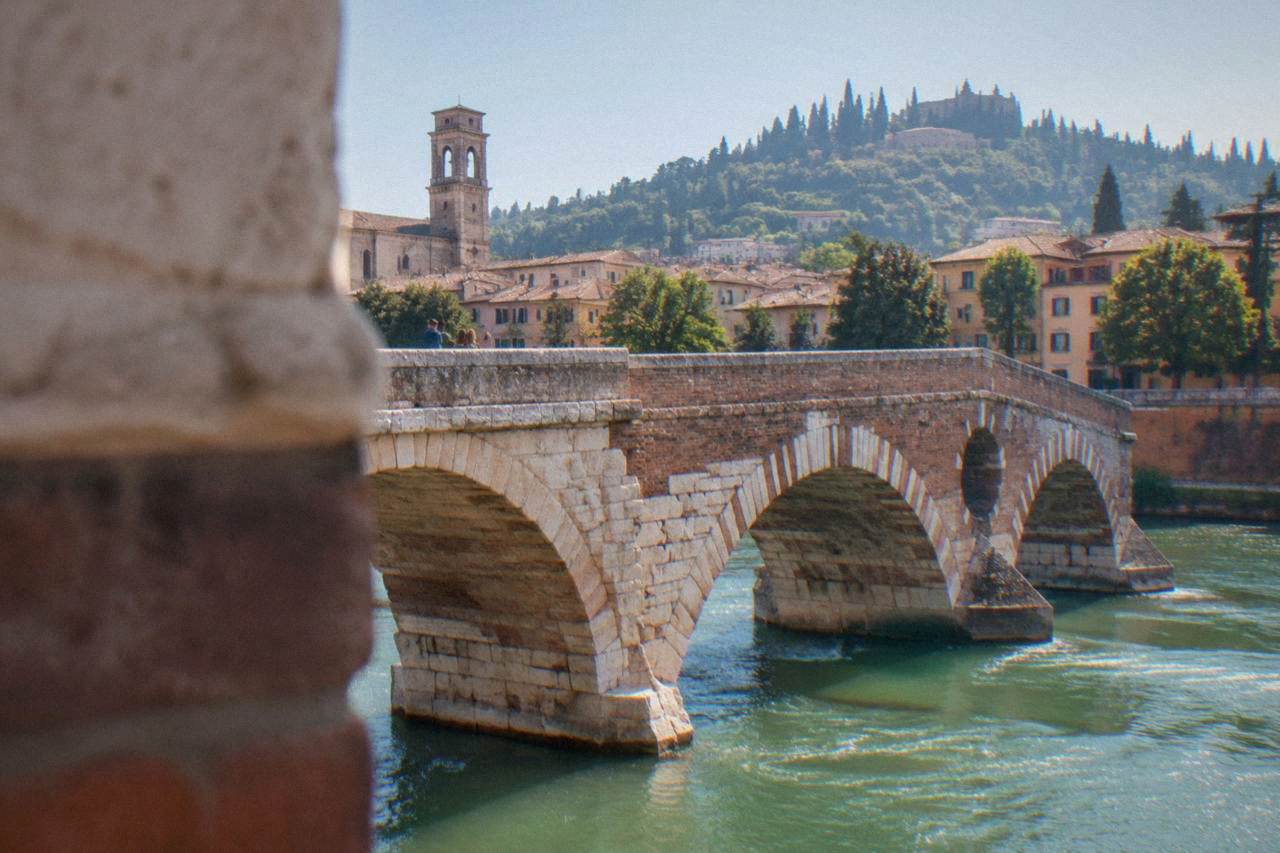
Ponte Pietra is the stone bridge that carries pedestrians across the Adige in Verona, in Veneto, northern Italy, connecting the edge of the historic centre to the Veronetta district and the Roman Theatre above the left bank. It is an open, free public crossing with no ticket, no gate and no closing hour.
Short answer
Ponte Pietra is a Roman stone bridge over the Adige river in Verona, Veneto, open free to pedestrians at any hour. It links the historic centre with the Veronetta district, and from its far side a path and stairs climb to Castel San Pietro for the classic view over the city.
Ponte Pietra is the stone bridge that crosses the Adige river in Verona, in Veneto, northern Italy, a city of rose-pink marble and brick listed by UNESCO in 2000. The bridge is a piece of working public space: no ticket, no queue, no gate, just a pedestrian crossing that happens to be one of the most photographed spots in the city. It joins the northern edge of the historic centre to the Veronetta district on the left bank, where the Roman Theatre and the climb to Castel San Pietro begin. This guide from the Verona Italy Travel Guide desk covers what the bridge is, what a visitor actually sees from it, how to fit it into a day, and what sits within a few minutes' walk on either bank.
What Is Ponte Pietra In Verona?
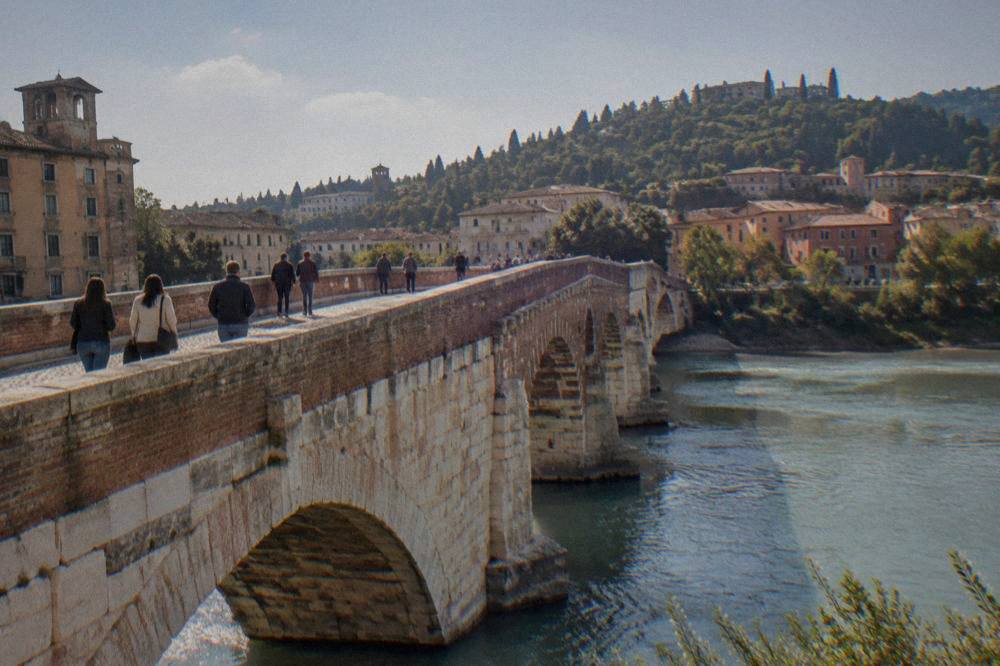
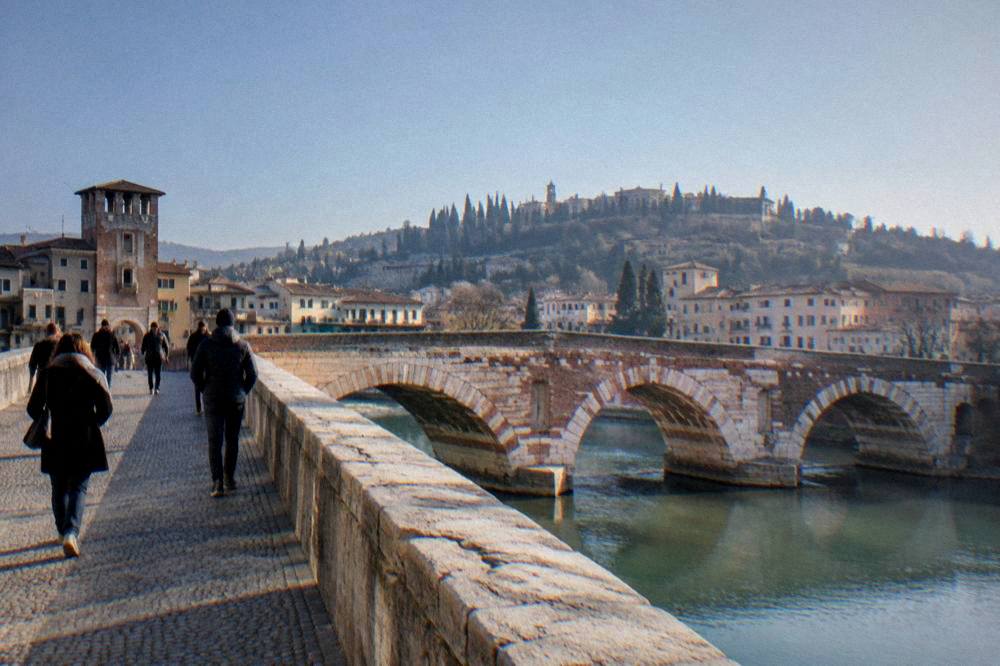
Ponte Pietra is a Roman stone bridge carrying a pedestrian walkway across the Adige river in Verona, Veneto, northern Italy, a short walk north of Piazza Bra along the river path. It is open access and free, with no admission, no ticket desk and no published closing time, because it is a public bridge rather than a museum. From its deck, pedestrians look upstream to the hills and downstream toward the city centre, with the Roman Theatre visible on the far bank.
The name simply means "stone bridge" in Italian, and that plainness fits the thing itself. The bridge carries foot traffic only: there are no cars, no bicycles racing across and no barriers, just stone, water and view. The Adige runs fast and green beneath the arches, and the river bend at this point is what makes the perspective work: standing at mid-deck you can see the water arrive from the hills to the north and leave toward the Arena district to the south.
Verona is an inland city on the Adige, and the river is the reason the city exists where it does. The historic centre wraps inside a tight loop of the river, and Ponte Pietra sits at the top of that loop, where the water comes around from the north. The site facts for this page record the bridge as an open, free public crossing, and that is the whole of the practical picture: walk on, walk across, walk off.
What the desk cannot responsibly add is a construction date, a named builder or a restoration history for the bridge. Those figures do not appear in the site's sources, and a page that invents them would be guessing. What a visitor sees is what can be described: an arched stone crossing, worn paving underfoot, and the two banks it connects.
Is Ponte Pietra Free To Visit In Verona?
Yes, Ponte Pietra costs nothing to cross and is open around the clock, because it is a public pedestrian bridge rather than a ticketed monument. The site's facts list it among Verona's free open-access sights alongside Piazza Bra, Piazza delle Erbe, Piazza dei Signori and Porta Borsari. No booking, no VeronaCard and no timed entry is involved, and the card is not needed to reach either end of the crossing.
This matters in 2026 more than it used to, because two of Verona's famous "free" sights are no longer free. Juliet's courtyard has required a ticket since 1 April 2026, five euro for the courtyard route or twelve euro with the house and balcony, booked online with entry via Teatro Nuovo. The Arena, similarly, is a paid daytime visit at twelve euro full price. Ponte Pietra belongs to the category that has not changed: open stone, open river, open access.
For trip budgeting, the free sights are the backbone of a Verona day. The table below groups the headline sights near the bridge by what a visitor pays, using only figures the site's sources carry.
| Sight | Admission | Notes from the site's sources |
|---|---|---|
| Ponte Pietra | Free | Open public bridge, no ticket |
| Piazza Bra | Free | Open square, Arena stands on it |
| Piazza delle Erbe | Free | Open market square |
| Piazza dei Signori | Free | Open square |
| Porta Borsari | Free | Open Roman gate |
| Arena di Verona | 12 euro full, 9 reduced, 3 for ages 18 to 25 from EU and reciprocity countries | 1 euro first Sunday of the month, November to March |
| Casa di Giulietta | 5 euro courtyard, 12 euro with house | Online booking, via Teatro Nuovo, since 1 April 2026 |
| Roman Theatre | Figures not confirmed in the site's sources | Confirm locally before visiting |
A reasonable plan pairs the free crossing with one or two paid entries. The Arena guide covers the amphitheatre visit in detail, and the walking route past the bridge is described in the site's Verona walking tour overview.
One further point of honesty about this bridge: because it is free and open, it appears in almost every photograph of Verona ever taken, and it gets busy in the middle of the day in high summer. Early morning and evening are the calmer crossings, and the light on the stone is better at both ends of the day anyway.
Where Does Ponte Pietra Lead On The Veronetta Side?
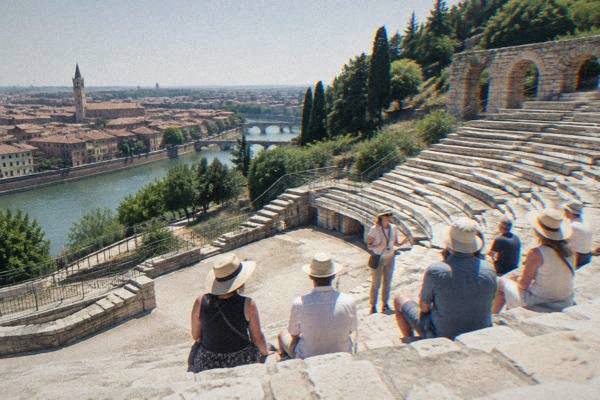
Crossing Ponte Pietra eastward puts you in Veronetta, the district on the Adige's left bank, where the Roman Theatre and its archaeological museum sit directly above the bridge and a stepped climb continues up to Castel San Pietro, the terrace viewpoint above the city. The whole chain, bridge to theatre to viewpoint, fits inside a short walk on steep ground, and the theatre and museum are the only paid elements. Veronetta itself is a quiet residential quarter of small streets.
The Roman Theatre is the reason many visitors cross the bridge in the first place. The tiered seating faces the river, and the site's sources describe it as a visitor sight with an attached archaeological museum; exact admission figures were not captured, so confirm locally or at the entrance before committing. The theatre's stone banks are visible in part from the paths around it, and the museum entrance sits higher up the slope.
From the theatre grounds, steps and a path climb further to Castel San Pietro. The climb is short but unrelenting, and the reward is the postcard panorama: the whole river loop of the historic centre, the brick Lamberti tower, the Arena's surviving outer ring and the sequence of bridges crossing the Adige, Ponte Pietra directly below. A funicular also serves the hill; the site's sources do not carry its fare, so check at the station if the steps do not appeal.
There is another way to see the bridge that avoids the climb entirely: from the water. A guided rafting trip on the Adige drifts under Ponte Pietra and past the city's other historic bridges, and it is the related tour for this page. Check availability on the operator's live listing if a river-level view of the arches appeals.
How Do You Fit Ponte Pietra Into A Day In Verona?
Ponte Pietra sits at the top of the river loop, about ten minutes on foot from Piazza Bra and five from Piazza delle Erbe, which makes it a natural late-morning or late-afternoon stop on a walking circuit through the historic centre. A workable order is Piazza Bra and the Arena, then Piazza delle Erbe and Piazza dei Signori, then the bridge, the Roman Theatre and the Castel San Pietro climb, finishing with the view at golden hour. The whole loop is walkable; Verona's centre is compact.
The bridge rewards timing. Midday in July, when the ERA5 reanalysis for Verona, 1991-2020, puts the mean daily high at 29.3 C, is the worst moment to be climbing to Castel San Pietro. Morning crossings are cooler; evening crossings catch the sun going down over the city, and the terrace above is a classic sunset stop.
The table below lays out a sample day built around the bridge, with the admission figures attached where the site's sources carry them.
| Time | Stop | Cost basis from the site's sources |
|---|---|---|
| Morning | Piazza Bra and the Arena | Arena 12 euro full, 9 reduced, 3 for 18 to 25 |
| Late morning | Piazza delle Erbe, Piazza dei Signori | Free open squares |
| Midday | Lunch in the centre | Cafe and restaurant prices vary; confirm on the spot |
| Afternoon | Ponte Pietra crossing | Free |
| Afternoon | Roman Theatre and museum | Confirm admission locally |
| Late afternoon | Climb to Castel San Pietro | Terrace is an open viewpoint |
| Evening | Dinner, or an opera night in season | Opera stone-step seats start in the 30-euro range, per the Arena's ticket pages |
Travellers with only one day should read the site's one-day itinerary, which slots the bridge into a tighter circuit, and the longer three-day version adds the Veronetta and the left bank properly rather than treating them as an afterthought.
What Do You See From Ponte Pietra And Where Are The Best Photos?
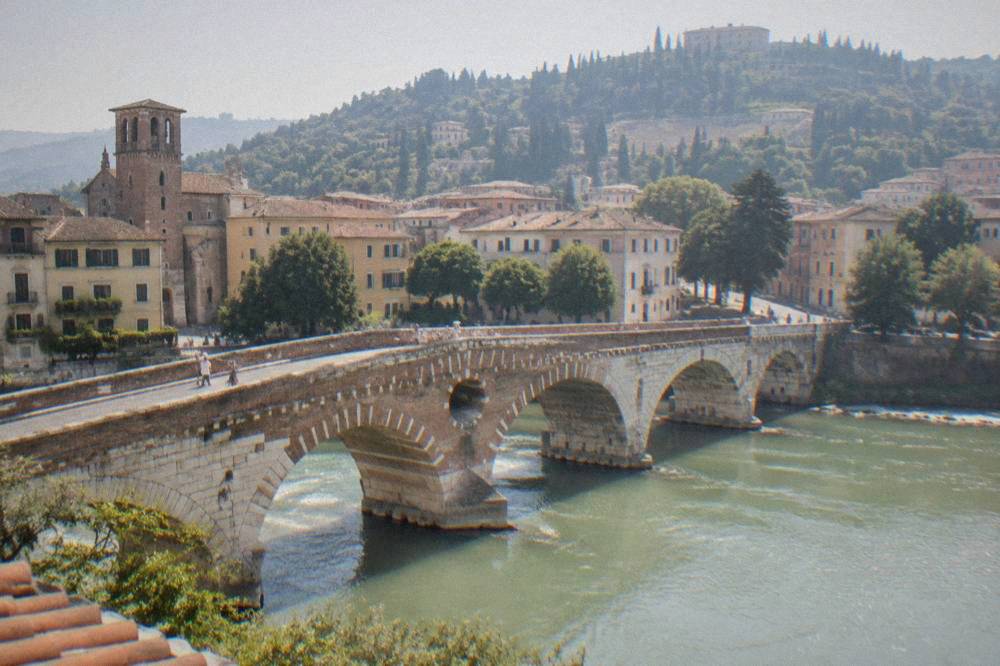
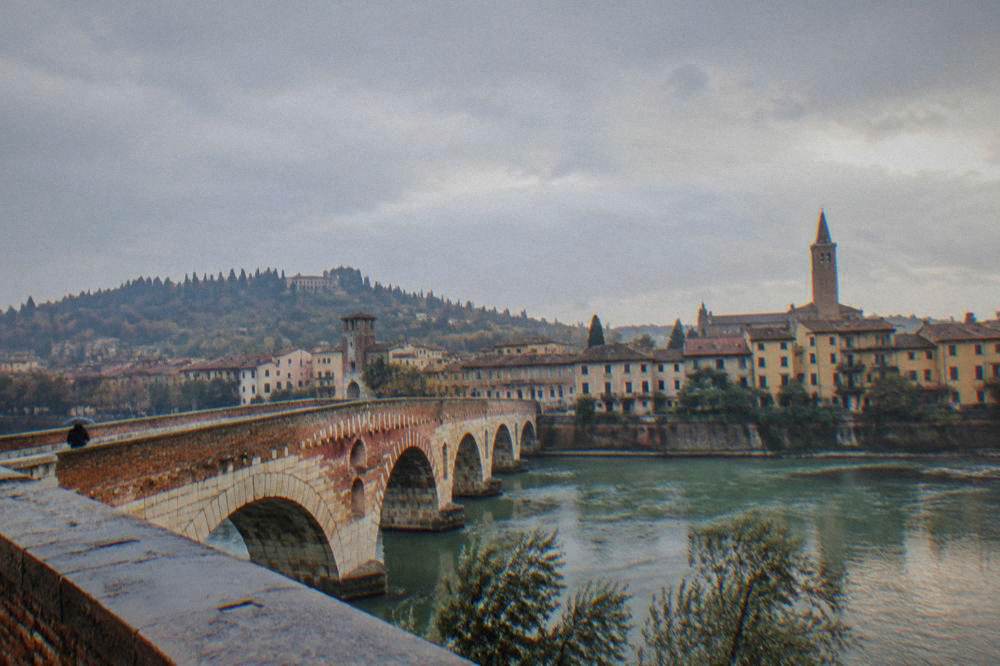
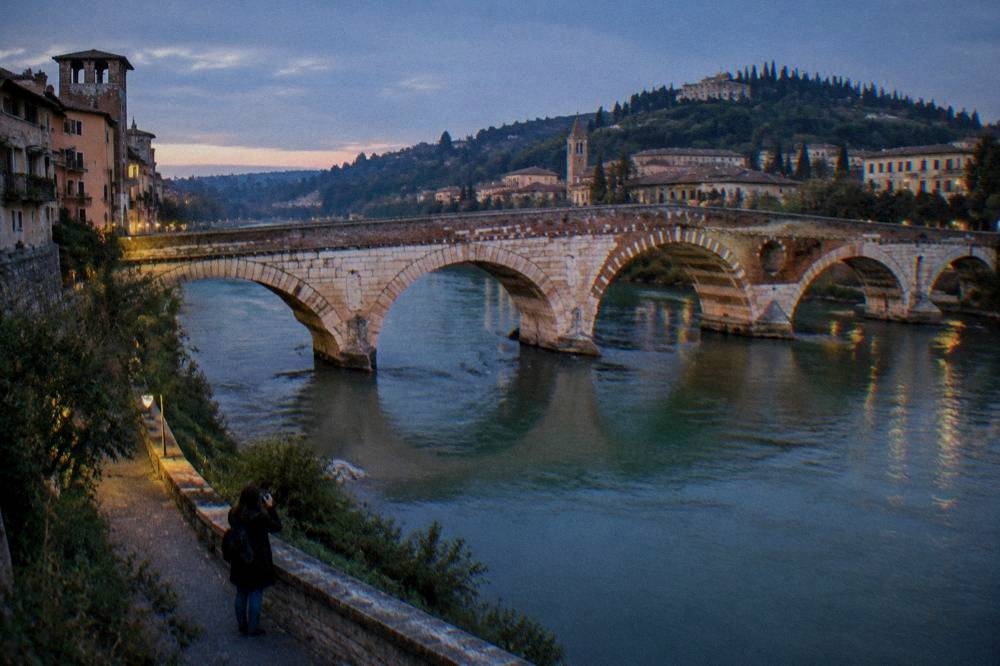
From the deck of Ponte Pietra you see the Adige flowing through its bend beneath you, the hills rising to the north, the Roman Theatre's stone tiers on the left bank and, downstream, the rooftops and towers of the historic centre. The classic photographs, though, are not taken from the bridge but of it: from the riverbank paths on either side, and from Castel San Pietro above, where the bridge appears mid-frame with the river loop wrapped around the centre.
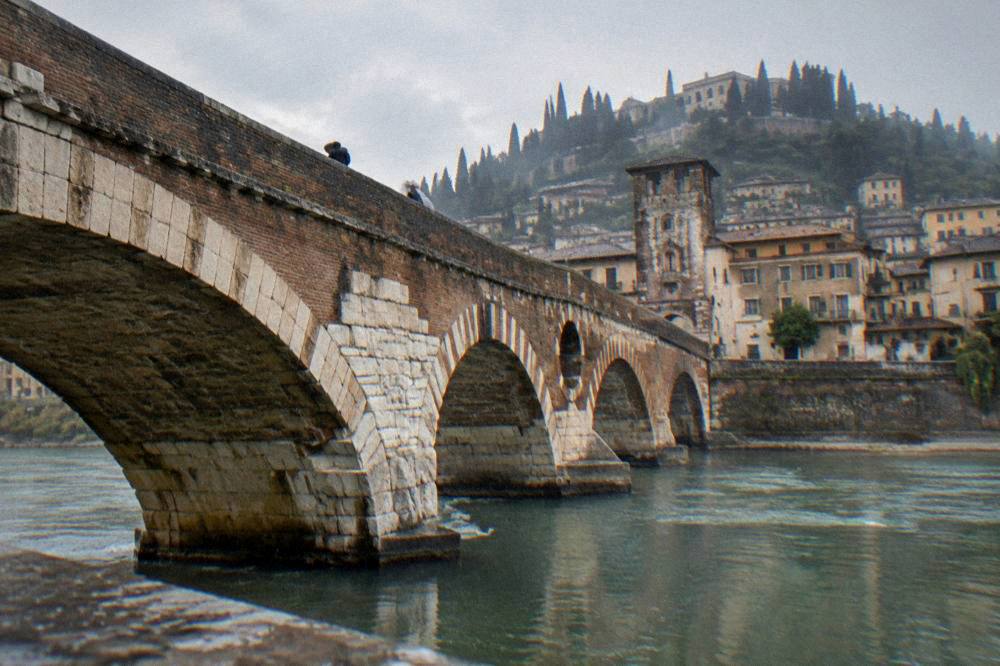
The shot many people want is the one from below. On the Veronetta side, the riverside path runs close to the water, and from there the arches stack against the theatre hill behind them. On the centre side, the bank downstream gives the bridge with the city behind it. Golden hour, when the stone goes warm, is the hour the photographers wait for.
The site's photography spots guide places the bridge in a full route around the city, for anyone planning a serious shoot rather than a phone snapshot. A few practical notes apply: the deck is cobbled and worn, the railings are low in places, and in the early morning the river often carries mist, which is either a photographic gift or a visibility problem depending on what you came for.
For a different angle entirely, the rafting trip already mentioned passes under the arches. Seeing the stones from water level, looking up, is the one perspective the riverbank paths cannot give.
What Sits Within A Short Walk Of Ponte Pietra?
Within ten minutes of Ponte Pietra stand the Roman Theatre and its museum, the Castel San Pietro terrace, the Duomo complex a little downstream on the centre side, Sant'Anastasia, Piazza delle Erbe and the Torre dei Lamberti, plus the quieter lanes of the Veronetta district itself. The bridge is a junction, not a destination: nearly everything worth reaching in eastern Verona funnels through or near it, and a visitor can build two full days around the two banks without repeating ground.
On the left bank, beyond the theatre, Veronetta is one of the city's calmer quarters, and the site's Veronetta area guide covers the wider old-city district that includes it. The streets climb away from the river into residential ground with fewer crowds than the centre.
On the centre side, walking downstream along the river path brings you toward the Duomo complex and Sant'Anastasia, both covered by the VeronaCard under the Chiese Vive convention, so confirm ticket prices at the door. Heading inland instead brings you to Piazza delle Erbe and the Torre dei Lamberti, the brick tower whose reported admission is six euro with the tower's own site carrying current hours.
| Sight | Bank | Walk from the bridge | Admission per the site's sources |
|---|---|---|---|
| Roman Theatre and museum | Left (Veronetta) | 2 to 5 minutes uphill | Confirm locally |
| Castel San Pietro terrace | Left (Veronetta) | 10 minutes uphill, steep | Open viewpoint |
| Duomo complex | Right (centre) | About 10 minutes downstream | VeronaCard coverage; price confirm at door |
| Sant'Anastasia | Right (centre) | About 8 minutes | VeronaCard coverage; price confirm at door |
| Piazza delle Erbe | Right (centre) | About 6 minutes | Free |
| Torre dei Lamberti | Right (centre) | About 8 minutes | Reported 6 euro; free with VeronaCard |
| Porta Borsari | Right (centre) | About 12 minutes | Free open gate |
The pattern to notice is that the bridge's neighbourhood mixes free open sights with a handful of paid ones, and the paid cluster, theatre, tower, churches, is exactly what the digital VeronaCard introduced on 1 September 2026 is designed to bundle. The card does not cover the bridge itself, because nothing about the bridge needs covering.
When Is The Best Time Of Year To Visit Ponte Pietra In Verona?
The shoulder months, April to June and September to October, give the most comfortable conditions for the bridge and the Castel San Pietro climb, with ERA5 reanalysis mean highs of 17.8 C in April, 22.3 C in May and 23.7 C in September. July and August, with mean highs of 29.3 and 29.1 C, are hot and crowded at midday, and November is the wettest month in the same 1991-2020 normals at 118.2 mm of rain. Winter crossings are cold but quiet.
The numbers behind that summary, from the ERA5 reanalysis, 1991-2020, for the grid cell near Verona:
| Month | Mean high C | Mean low C | Rain mm |
|---|---|---|---|
| January | 7.3 | -0.4 | 52.3 |
| April | 17.8 | 7.6 | 93.5 |
| July | 29.3 | 19.1 | 79.4 |
| September | 23.7 | 15.1 | 99.7 |
| November | 12.3 | 5.3 | 118.2 |
Rain matters more here than temperature does. The stone deck is worn and can be slippery when wet, and the Castel San Pietro steps are exposed. There is no shelter on the bridge, so in the wetter months, October through December in the table above, a rain layer earns its place in the bag. The site's Verona weather guide and the best time to visit guide carry the full monthly picture.
One seasonal note cuts the other way: summer is opera season, and the 2026 Arena season ran 5 June to 12 September, with the 104th edition announced for 11 June to 11 September 2027. On an opera evening the centre fills after dinner, which paradoxically leaves the bridge and the climb quieter in the early part of the night than a visitor might expect.
Is Ponte Pietra Accessible And Safe To Cross?
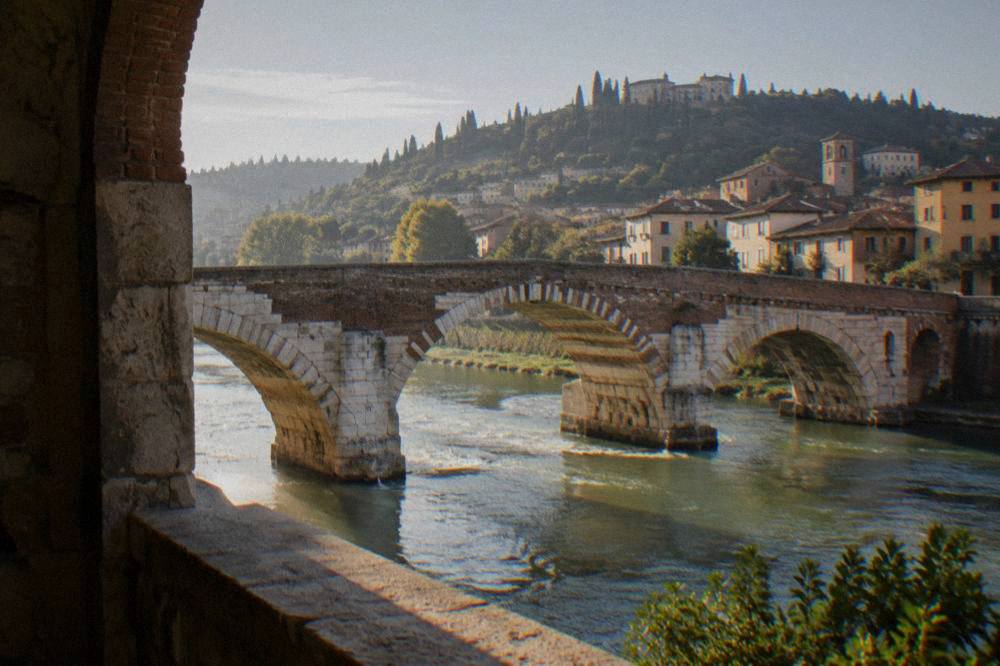
Ponte Pietra is a flat pedestrian crossing with no steps on the deck itself, but its surface is worn cobbling, the approaches from both banks involve sloped or stepped riverbank paths, and the site's sources carry no accessibility information for the bridge, so anyone with a mobility aid should scout the approach paths in advance or confirm locally. On safety, the bridge is a normal public street in a city where the ordinary precautions of any crowded tourist area apply: watch belongings, use the emergency number 112 if needed.
What can be said from description alone is that the deck itself is level and pedestrian-only, which removes traffic as a concern entirely, and that the surrounding streets rise steeply on the Veronetta side.
The climb to Castel San Pietro is the physically demanding part of this walk, and it is optional. The bridge, the riverbank paths and the theatre district can all be enjoyed without it, and the terrace is the only element of the standard circuit that demands the stairs.
For families, the bridge itself is an easy stop, and the site's Verona with kids guide places it on a family route. For anyone arriving by car, note that the historic centre is a camera-policed ZTL with access limited for non-residents; the site's ZTL and parking guide explains the rules, including the plate-registration option for hotel guests.
Common Questions About Ponte Pietra In Verona
Is Ponte Pietra free to cross?
Yes. The bridge is an open public pedestrian crossing with no ticket, no booking and no closing time, listed among Verona's free open-access sights alongside Piazza Bra, Piazza delle Erbe, Piazza dei Signori and Porta Borsari.
How far is Ponte Pietra from the Arena?
The bridge sits at the top of the river loop in the historic centre, about a ten-minute walk from Piazza Bra, where the Arena stands. The route runs through the centre past Piazza delle Erbe or along the riverbank.
What is on the other side of Ponte Pietra?
The Veronetta district, on the Adige's left bank. The Roman Theatre and its archaeological museum sit directly above the bridge, and steps continue up to the Castel San Pietro terrace, the classic panorama over the city.
Can you see Ponte Pietra from the river?
Yes. A guided rafting trip on the Adige passes under the bridge and the city's other historic bridges, giving a water-level view of the arches. Availability and conditions are on the operator's live listing.
When is the best time to photograph Ponte Pietra?
Early morning and golden hour. The classic shots are taken from the riverbank paths on either side, and from the Castel San Pietro terrace above, rather than from the deck itself.
Do you need the VeronaCard for Ponte Pietra?
No. The bridge is free and open, so the card plays no part in crossing it. The digital VeronaCard, introduced 1 September 2026, covers paid civic sights such as the Arena and the Torre dei Lamberti, not open bridges.
Ponte Pietra asks nothing of a visitor: no ticket, no schedule, no planning beyond comfortable shoes and a sense of where the light will be. Cross it once for the view, cross it again for the photograph, and save the climb for the hour before sunset.