Verona Walking Tour: Which Old Town Walk To Book
Verona's old town folds an Arena, two Roman gates, a Shakespeare balcony and a river loop into a compact UNESCO-listed centre, and a walking tour is the standard way to see it. Here is what guided walks cover, what the 2026 tickets cost, and how to walk the route without a guide.
Short answer
A Verona walking tour covers the compact old town inside the Adige river loop: Piazza Bra and the Arena, Via Mazzini, Piazza delle Erbe, the Torre dei Lamberti, Juliet's House and often Ponte Pietra and Castelvecchio. The Arena daytime visit costs 12 euro full price and Juliet's courtyard has cost 5 euro since 1 April 2026, so a guided walk that bundles skip-the-line entry saves queueing at the two busiest sights.
Verona, in Veneto in northern Italy, is an inland city on the Adige river whose entire historic centre sits on the UNESCO World Heritage List, inscribed in 2000. The old town wraps around a first-century Roman amphitheatre, and nearly everything a visitor comes to see sits inside one river loop small enough that walking is not just the usual way to see it, it is practically the only way. This guide, from the Verona Italy Travel Guide editorial desk, sets out what a Verona walking tour actually covers, what the 2026 admission prices are at each stop, and how to walk the same route independently if a guided walk does not fit your plans.
What Does A Verona Walking Tour Cover?
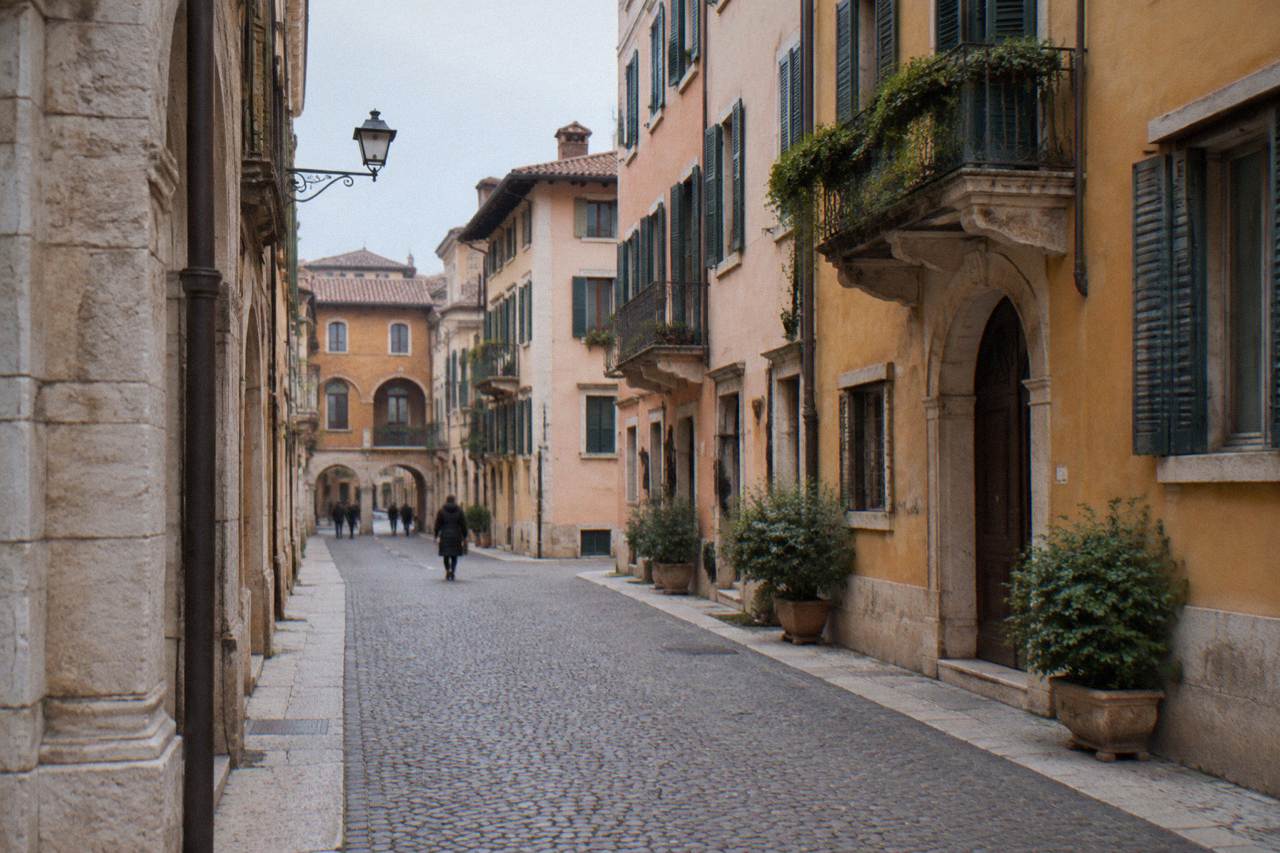
A typical guided Verona walking tour covers the compact old town inside the Adige loop: Piazza Bra and the exterior of the Arena, the shopping street Via Mazzini, Piazza delle Erbe and its market square, Piazza dei Signori, the Torre dei Lamberti, the Scaliger tombs and Juliet's House, with many walks continuing over Ponte Pietra or up toward Castel San Pietro. The whole route sits within the Citta Antica, the historic core, and every stop is public space or a ticketed landmark within easy reach of Piazza Bra.
The logic of the route is geographic rather than thematic. Verona's centre is a loop: the Adige curls around the old town, and the main sights string along a line from the Arena in the southwest, through the Roman and medieval core, to Ponte Pietra and the Roman Theatre in the northeast. A guided walk is essentially this line told with commentary, and the Citta Antica area guide on this site maps the same territory stop by stop.
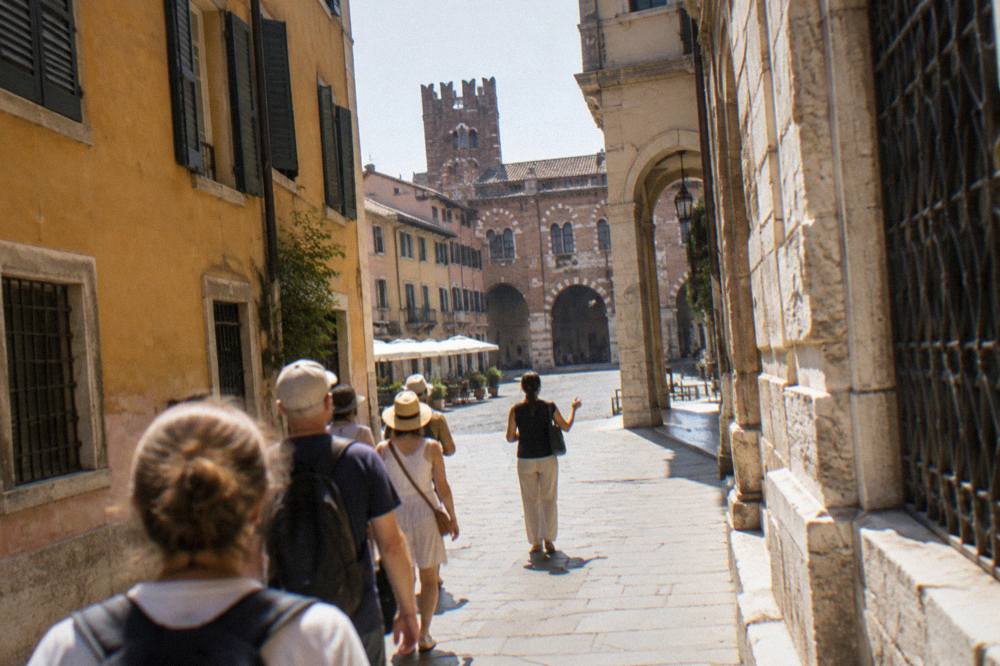
Guided options split into a few formats. Small-group historian-led walks focus on Verona under the Scala family and the Venetian Republic, tying Piazza dei Signori and the Arche Scaligere to the city's political story. Shorter highlights walks hit the headliners in a single loop. Themed evening walks, including moonlight and dark-history versions, cover the same lanes with a different narrative. What no walk can do is enter Juliet's House or the Arena freely: those are ticketed, which is why several products bundle a guided walk with priority entry.
One point worth knowing before booking anything: Verona is not on Lake Garda. The lake towns of Sirmione, Bardolino, Garda and Malcesine are 22 to 39 km west and are separate day trips. A walking tour booked in Verona stays in Verona, and if a product description promises lake views it is describing a day trip, not a city walk.
Which Verona Walking Tour Should You Book For The Old Town?
For a first visit, book a small-group history walk that covers Piazza Bra, the Arena exterior, Piazza delle Erbe, Piazza dei Signori and Juliet's House, and decide separately whether to bundle the two paid interiors. The Arena and Juliet's courtyard are the only major walking-route stops that charge admission, so the choice is really between a commentary-only walk, a walk with tickets, or a city card that carries the entries.
The featured option on this site is the Small-Group History Tour of Highlights and Hidden Gems, a guided walk built around exactly the route described above, with the stories of the Scala lords and the Roman city along the way. You can check dates and pricing on the operator's live listing: Check availability.
Two companion products suit walkers who want entries handled. A city card with Arena priority entrance wraps the amphitheatre visit into a pass, and a fast-track Juliet's House ticket with audio guide covers the balcony sight. Both pair naturally with a guided or self-guided walk, since neither landmark needs a guide inside.
If you prefer to walk alone but still want structure, a digital self-guided walk with audio commentary exists in the roster on this site's tours section, and the free-walking-tour option listed at free walking tours in Verona is covered on its own page. Beyond that, the sections below give you everything needed to build the route yourself.
How Much Does A Verona Walking Tour Cost With Tickets Included?
The sight costs on any Verona walk are fixed by the city: the Arena daytime visit is 12 euro full price, 9 euro reduced for groups of 15 or more, over-65s and other concessions, and 3 euro for visitors aged 18 to 25 from EU and reciprocity countries, per the Comune di Verona's own price list. Juliet's House has been ticketed since 1 April 2026: 5 euro for the courtyard route and 12 euro for the house and balcony, booked online. Guided walk prices are set by each operator and render on their listings.
Those two admissions are the only compulsory spend on the classic route. Everything else on a standard walk, Piazza Bra, Piazza delle Erbe, Piazza dei Signori, Porta Borsari and Ponte Pietra, is open public space with no ticket. Add-on stops have their own prices, and the table below collects the figures the city and operators publish.
| Stop on the walking route | Admission | Notes |
|---|---|---|
| Arena di Verona (daytime visit) | 12 euro full, 9 euro reduced, 3 euro aged 18 to 25 | Per the Comune di Verona price list; 1 euro first Sunday of the month November to March |
| Casa di Giulietta (courtyard route) | 5 euro | Ticketed since 1 April 2026, online booking, entry via Teatro Nuovo |
| Casa di Giulietta (house and balcony) | 12 euro | Includes the courtyard route |
| Piazza Bra, Piazza delle Erbe, Piazza dei Signori | Free | Open public squares |
| Ponte Pietra, Porta Borsari | Free | Open bridge and Roman gate |
| Torre dei Lamberti | 6 euro full, reported | Free with VeronaCard; check the tower's own site before you go |
A VeronaCard changes this arithmetic. Since 1 September 2026 the card has been digital, at 33 euro for 24 hours and 38 euro for 48 hours with ATV urban buses included, or 29 and 32 euro without transport, per the Comune di Verona's VeronaCard notice. The card covers Arena entry, Juliet's House (still requiring an online booking slot even for card holders), the Torre dei Lamberti and the civic museums, and details are on the site's VeronaCard guide's sibling coverage across the museum pages. Whether the card beats single tickets depends on how many interiors you visit, so count your stops before choosing. Never assume the card includes the airport Aerobus: the notice states it does not.
| VeronaCard option (from 1 Sept 2026) | Price | Includes ATV buses |
|---|---|---|
| 24 hours, base | 29 euro | No |
| 24 hours, with transport | 33 euro | Yes, urban ATV network |
| 48 hours, base | 32 euro | No |
| 48 hours, with transport | 38 euro | Yes, urban ATV network |
The walk-in tour products that bundle entries print their own prices from their listings, never from this page, and prices move with the season.
What Is The Best Self-Guided Walking Route Through Verona's Old Town?
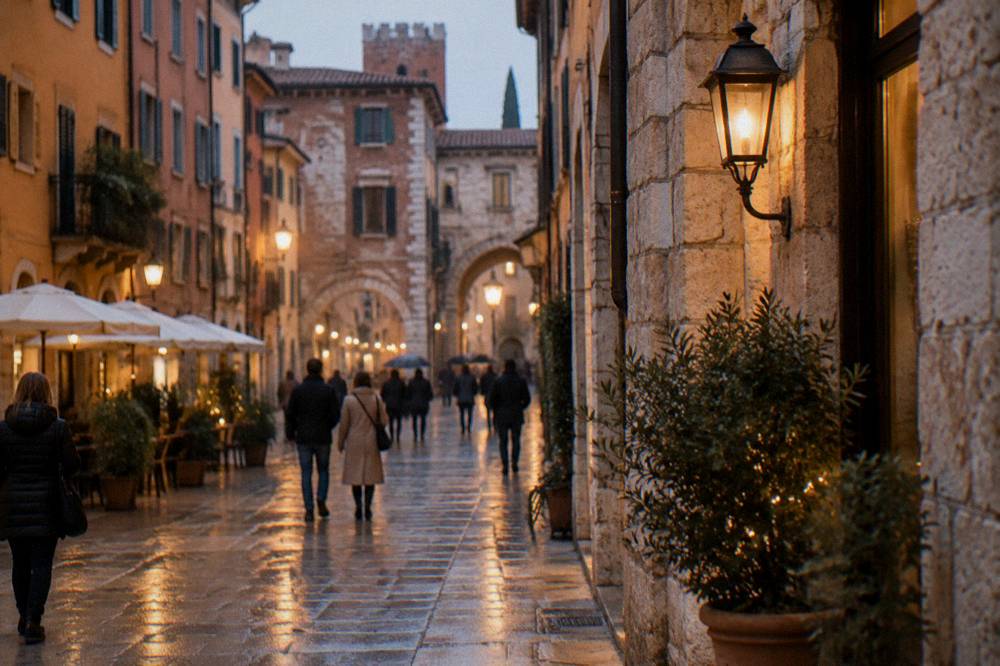
The best self-guided Verona route runs from Piazza Bra and the Arena, up Via Mazzini to Piazza delle Erbe, into Piazza dei Signori past the Scaliger tombs, down to Juliet's House, then east across Verona to Sant'Anastasia and Ponte Pietra, ending at the Roman Theatre or up at Castel San Pietro for the panorama. The whole line stays inside the river loop and every stop is either free public space or a single ticket.
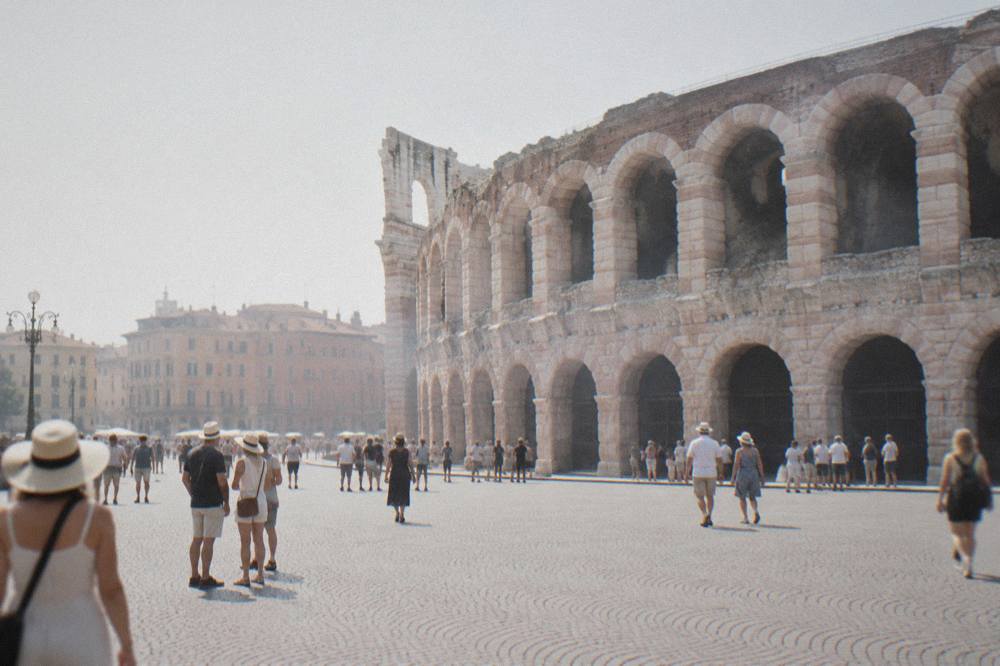
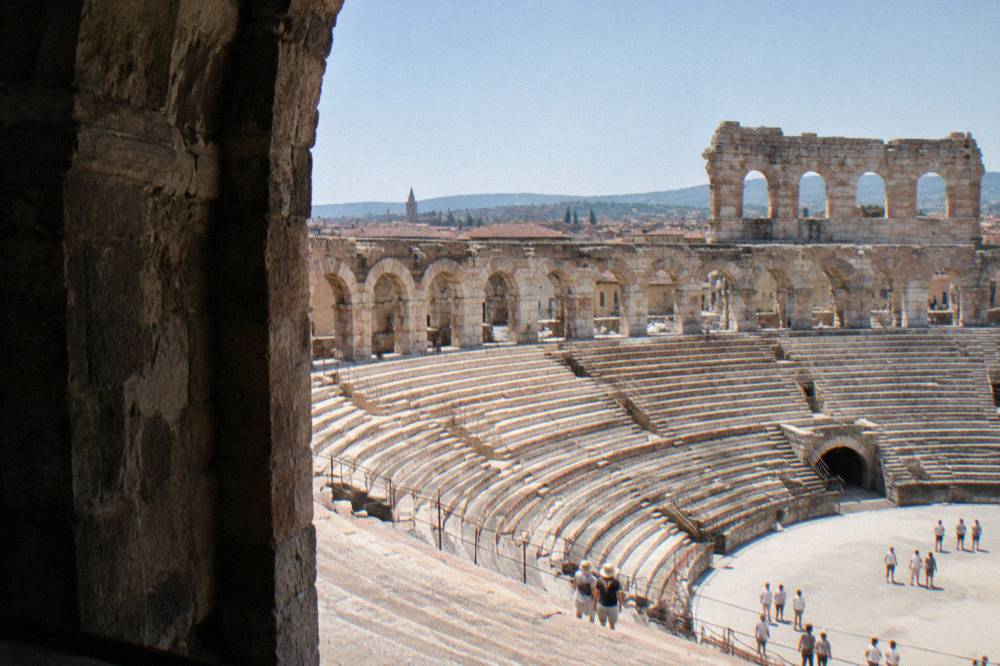
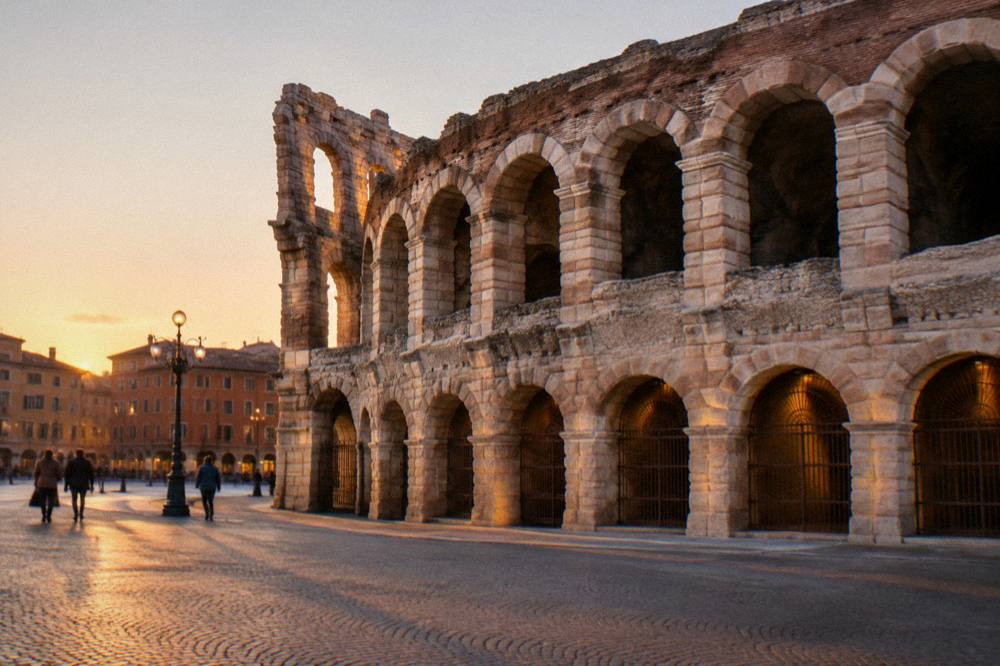
Start at Piazza Bra, the broad square facing the Arena's pink-white ring. The Arena's own site places its construction around 30 AD, making it, as reported, older than Rome's Colosseum and one of the largest Roman amphitheatres still standing; its outer ring was lost to the 1117 earthquake, which is why one flank looks sliced open. A daytime interior visit costs 12 euro full price and is bookable on the Arena's own ticket page, which also lists early closures on opera evenings.
From Piazza Bra, Via Mazzini, the city's polished shopping spine, leads northeast to Piazza delle Erbe, the old Roman forum, now a market square ringed by painted facades and the whale rib hung under one arch. The Piazza delle Erbe attraction guide covers the square's buildings in detail. One lane north is Piazza dei Signori, the Scaliger lords' government square, with the Arche Scaligere tombs fenced beside Santa Maria Antica. More on the city's story sits in the site's Verona history coverage.
Juliet's House is a few minutes south. Since 1 April 2026 the courtyard itself has cost 5 euro, with entry booked online and routed through the Teatro Nuovo, and the full house-and-balcony route costs 12 euro. The balcony is not original: the city's tourism office reports it was assembled onto the facade in 1940 from medieval material. The bronze Juliet, by Nereo Costantini, dates from 1969.
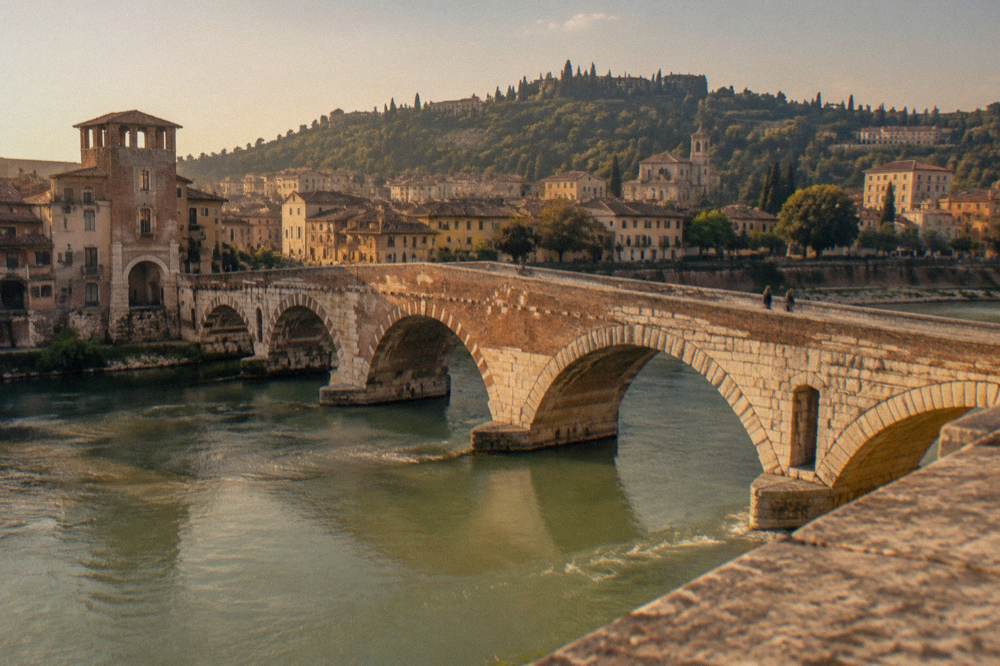
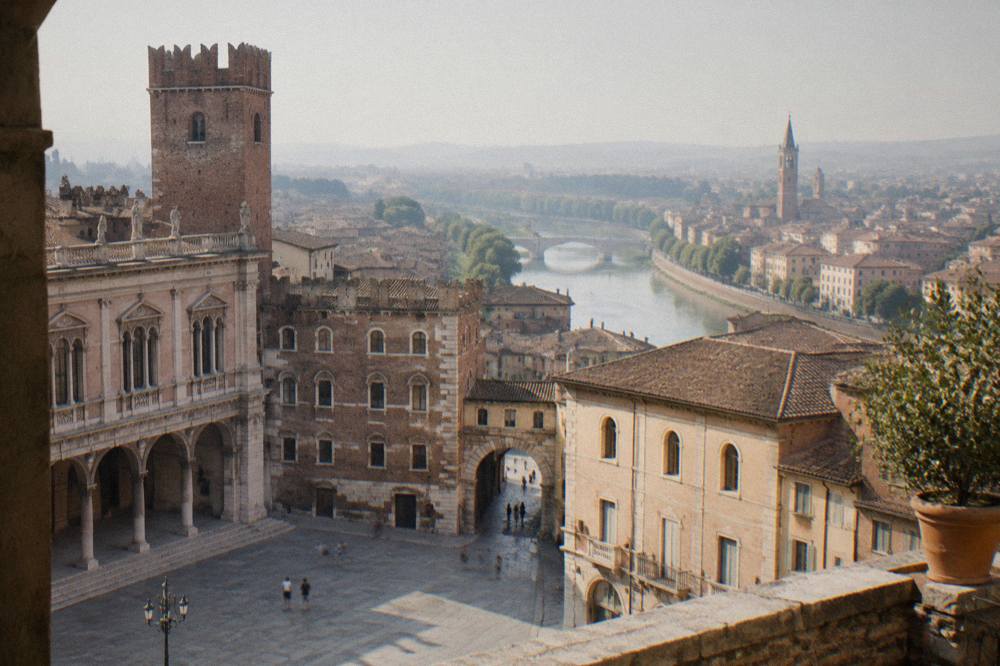
Head east along Via Sant'Anastasia to the great Dominican church of that name, then cross Ponte Pietra, the Roman-founded footbridge, for the view back over the city. The Roman Theatre and Museo Archeologico sit on the far bank, and above them the Castel San Pietro steps climb to the terrace that gives the definitive old-town panorama. Cross back and finish wherever Via Mazzini delivers you.
If two days are available rather than one, the site's two-day Verona itinerary splits this route across a fuller schedule, adding Castelvecchio, the Duomo and San Zeno.
Is Verona Easy To Walk Without A Tour Guide?
Yes, Verona is easy to walk without a guide: the old town inside the Adige loop is compact, flat in its core, signposted, and every major landmark sits within 5 km of the centre, per the site's computed mapping of the city's landmarks. The arguments for a guide are interpretation and queue handling at the two ticketed headliners, not navigation, because the route from the Arena to Ponte Pietra is effectively a single line.
Practically, the city rewards independence. The squares and bridge stops are free, the side lanes of the Citta Antica hold surprises a fixed commentary route skips, and the Verona map guide plus the getting around Verona guide cover orientation and transport in detail. The urban ATV bus single costs 1.50 euro and is valid 90 minutes, per ATV's own fare page, which covers the rare leg a walker wants to shortcut. Bags are the one planning item: luggage storage details at Porta Nuova could not be confirmed, so check the station services or the site's luggage storage guide discussion before arriving with cases.
What a guide adds is the layer Verona does not post on signs: why the Scala family's tombs sit in cages beside their parish church, how the 1117 earthquake reshaped the city, which facades in Piazza delle Erbe carry which frescoes. On the two paid interiors, guided and priority products handle the entry logistics; the fast-track Juliet ticket below is the standalone version of that.
For walkers who want the entries and the pass logic in one product, the city card carries Arena priority entrance and other civic museums.
Evening changes the calculus. Reported general advisories flag pickpocket risk around the Arena, Piazza Bra, Piazza delle Erbe, Via Mazzini and Juliet's House, the exact line of the walking route, with no Verona-specific official statistic; the site's page on walking Verona at night treats the question directly. Standard care applies, and 112 is the emergency number in Italy.
Which Verona Sights Need Tickets And Which Are Free To Walk Past?
On the standard walking route, the paid sights are the Arena daytime visit at 12 euro full price, Juliet's House at 5 euro for the courtyard or 12 euro with the house, the Torre dei Lamberti at a reported 6 euro, and the civic museums such as Castelvecchio at a reported 9 euro. The free sights are Piazza Bra, Piazza delle Erbe, Piazza dei Signori, the Arche Scaligere viewing area, Ponte Pietra and Porta Borsari, all open public space with no ticket.
This split matters for budgeting a walk. A visitor content with exteriors and squares spends nothing on the core route. A visitor entering both headliners spends at least 17 euro per person at 2026 prices. A visitor adding towers and museums multiplies that, which is where the digital VeronaCard's 33 and 38 euro transport-inclusive tiers earn their place.
| Sight | Paid or free | 2026 figure | Source basis |
|---|---|---|---|
| Arena di Verona | Paid | 12 euro full, 9 reduced, 3 for 18 to 25 | Comune di Verona price list |
| Casa di Giulietta | Paid | 5 euro courtyard, 12 euro house | Official VisitVerona notice |
| Torre dei Lamberti | Paid | 6 euro reported, free with VeronaCard | Operator site, confirm before you go |
| Castelvecchio Museum | Paid | 9 euro reported, 6 reduced | Civic museums, confirm before you go |
| Ponte Pietra | Free | No ticket | Open bridge |
| Porta Borsari | Free | No ticket | Open Roman gate |
| Piazza Bra, delle Erbe, dei Signori | Free | No ticket | Open squares |
Church admissions are the one grey zone. The Duomo complex, San Zeno, Sant'Anastasia and San Fermo fall under the Chiese Vive convention with VeronaCard free or reduced entry, but individual church prices and hours vary, so confirm at each door or on the VeronaCard notice before planning entries. Detailed pages on the Arena, Juliet's House, Torre dei Lamberti, Castelvecchio and Ponte Pietra cover each stop.
When Is The Best Time Of Day To Walk Verona's Centre?
The best time of day to walk Verona is early morning for empty squares and soft light on Piazza Bra and Piazza delle Erbe, or evening after the day-trip crowds thin, with two fixed caveats from the sources: the Arena's reported daytime hours are 9:00 to 19:00 Tuesday to Sunday, closed Monday with early closes on show days, and Juliet's House opens at 9:00 Tuesday to Sunday and 14:00 on Monday. Build the walk around those windows rather than around generalities.
Climate frames the choice. The ERA5 reanalysis for Verona, 1991 to 2020, puts the July mean daily high at 29.3 C and the January mean daily high at 7.3 C, with November the wettest month at 118.2 mm of rain and January the driest at 52.3 mm. Early starts in summer avoid the afternoon heat; in winter, midday is the comfortable window and the light on the pink stone is at its best.
| Month | Mean daily high (C) | Mean daily low (C) | Rain (mm) | Walking conditions |
|---|---|---|---|---|
| January | 7.3 | -0.4 | 52.3 | Cold, driest month, quiet streets |
| April | 17.8 | 7.6 | 93.5 | Mild, spring light |
| July | 29.3 | 19.1 | 79.4 | Hot, start early, opera season |
| October | 18.1 | 10.5 | 107.2 | Mild, wet spells |
| November | 12.3 | 5.3 | 118.2 | Wettest month, fewest crowds |
Opera evenings reshape the centre. The 2026 Arena festival ran 5 June to 12 September, and the 104th edition is announced for 11 June to 11 September 2027, so on summer performance nights the Arena closes early to visitors and the streets around Piazza Bra fill from late afternoon. Check the Arena's own calendar for show-day closures before locking a walking schedule. The site's Verona opera guide coverage and the opera-night page carry the season detail.
Can A Verona Walking Tour Extend Beyond The Old Town?
Yes, a Verona walking tour can extend across the Adige into Veronetta and the Roman Theatre hill, west to Castelvecchio and the San Zeno district, or north into Borgo Trento, all on foot inside the city, while Lake Garda, Valpolicella and the other classic excursions are separate day trips by bus, train or car rather than extensions of a city walk. The city districts sit on the site's area map, and each adds a different mood to the core route.
Across Ponte Pietra, Veronetta holds the Roman Theatre and the climb to Castel San Pietro, whose terrace view takes in the whole river loop at once; the Castel San Pietro page covers the funicular and steps. West of the Arena, Castelvecchio and its fortified Ponte Scaligero mark the start of the walk toward the Basilica di San Zeno, the Romanesque church of the city's western district. The Giardino Giusti garden, with its manicured terraces and hilltop viewing spot, sits east of the centre across the river and pairs well with a Veronetta extension.
For the excursions, computed free-flow drive times from the Arena put Sirmione at about 40 minutes, Bardolino at 37, the town of Garda at 42, Malcesine at 84, Valpolicella at 25 and Soave at 33. Sirmione, in Brescia province in Lombardy, is reached from Verona by the ATV line 164 bus, reported at about 55 minutes direct and hourly, with the fare unconfirmed, so check with ATV before travelling. The Sirmione guide coverage on this site and the Lake Garda pages carry the detail. Wine walkers should look at the site's Valpolicella wine tour and Verona food tour pages for the tasting-led alternatives to a city walk.
What Should You Know Before Booking Any Guided Walk In Verona?
Before booking a guided walk in Verona, know four things: the historic centre is a camera-enforced ZTL with at most four entries a month for non-resident cars, so the walk itself should be reached on foot or by bus; Juliet's House requires an online booking even with a VeronaCard; the Arena closes early on performance evenings; and a tourist tax capped at four nights per person per month is collected by your accommodation at a rate printed nowhere on this page.
Each one changes how a walking day is scheduled.
The ZTL is the one that catches drivers. The rules, per the Comune di Verona, limit non-residents to four entries a month by booking, in windows such as Monday to Friday 10:00 to 18:00 and 20:00 to 23:00, with hotel guests exempt if the hotel registers the plate. Short-term rental guests do not get that exemption. Park outside the loop and walk in; the urban bus single at 1.50 euro covers the connector. The site's Verona map and getting-around pages show where the centre begins.
Booking logistics are second. Juliet's House sells timed entry online, and card holders still need a slot. The Arena's own ticket page lists the calendar of early closures. Guided products wrap both, but their start times are fixed, so an independently walked morning followed by a guided afternoon is a common and workable pattern. Restaurant planning sits off the walking route itself; the site's Verona restaurants guide covers where the classic dishes are served, and the where to stay in Verona page positions each district for walkers.
Third, seasonality. The festival summer of mid-June to mid-September fills the centre every performance night; the Tocati street-games festival filled Veronetta from 18 to 20 September 2026, free, with 2027 dates unpublished; Vinitaly takes the fairground from 11 to 14 April 2027. None of these cancels a walk, but each reshapes the crowds on it.
Finally, the products themselves. Below is the trio this site compares for a Verona walking trip: the history walk, the city card with Arena entry, and the fast-track Juliet ticket.
And for readers who want the guided core experience alone, the featured small-group history walk covers the highlights and the hidden corners between them.
| Walking plan | What it costs at 2026 city prices | What it includes |
|---|---|---|
| Squares and exteriors only | 0 euro | Piazza Bra, delle Erbe, dei Signori, Ponte Pietra, Porta Borsari |
| Core route with both headliners | 17 euro per person | Arena visit plus Juliet's courtyard route |
| Core route with full Juliet House | 24 euro per person | Arena visit plus house and balcony route |
| VeronaCard 24h with transport | 33 euro | Civic sites plus ATV urban buses |
Common Questions About Verona Walking Tours
How long does a Verona walking tour take?
Product durations vary by operator and are printed on each listing, never estimated here. The route itself, Arena to Ponte Pietra, is walked at sightseeing pace across a morning or afternoon, with entries adding time at each ticketed stop.
Is Juliet's courtyard free on a walking tour?
No. Since 1 April 2026 the courtyard route costs 5 euro and the house and balcony route 12 euro, with online booking and entry via the Teatro Nuovo, per the official VisitVerona notice. VeronaCard holders enter free but still book a slot online.
Can you visit the Arena during the day, or is it only for opera?
The Arena is open to daytime visitors at 12 euro full price, 9 euro reduced and 3 euro for visitors aged 18 to 25 from EU and reciprocity countries, per the Comune di Verona's price list. Reported hours are 9:00 to 19:00 Tuesday to Sunday, closed Monday, with early closes on performance days, so check the Arena's own calendar before you go.
Does a Verona walking tour include Lake Garda?
No. Verona is inland on the Adige river. Sirmione, Bardolino, Garda town and Malcesine are 22 to 39 km west and are separate day trips, about 37 to 84 minutes by car from the Arena per computed routing.
Do you need to book a guided walk in advance?
Small-group walks and bundled ticket products sell by date and slot, so booking ahead secures the start time you want, and free cancellation before the start time is the norm on the operator's live listing. Independent walkers only need to pre-book Juliet's House, which sells timed entry online.
Is Verona walkable in one day?
Yes. The old town inside the Adige loop holds the Arena, Piazza delle Erbe, Piazza dei Signori, Juliet's House and Ponte Pietra on one walking line, and every city landmark sits within 5 km of the centre. Two days add Castelvecchio, San Zeno, Veronetta and the garden stops at an unhurried pace.
A Verona walking tour, guided or self-guided, is the one activity the city is genuinely built around: a first-century amphitheatre, a medieval market square, a Shakespeare balcony and a Roman bridge, all on one walkable line inside a river loop. Choose the format that matches whether you want commentary, tickets handled, or just the route and a map.