Why Did Shakespeare Choose Verona For Romeo And Juliet?
Shakespeare set Romeo and Juliet in Verona because he followed Luigi da Porto's 1531 novella, which named the city and its real feuding families. Here is the full chain of sources.
Verona, in Veneto, northern Italy, owes its fame as the city of love to a writer who never set foot in it. William Shakespeare never visited Verona, a point the city's own tourism materials make plainly, yet he made the Adige-river city the stage for the most famous love story in Western literature. The choice was not random and it was not his. Shakespeare inherited Verona from a chain of Italian storytellers, and the first of them, Luigi da Porto, had a specific literary reason for picking this city over any other in Italy. This site's editorial desk has traced the chain below from what the sources themselves say, and it ends in a courtyard on Via Cappello that now charges admission.
Why Did Shakespeare Choose Verona For Romeo And Juliet?
Shakespeare chose Verona because the story was already set there when he received it. His primary source, Arthur Brooke's 1562 poem, and behind it Matteo Bandello's 1554 novella and Luigi da Porto's 1531 original, all name Verona as the home of the doomed lovers, and da Porto himself pointed to Dante's mention of the Montecchi and Cappelletti families as his warrant. Shakespeare, who worked from written sources rather than travel, kept the setting his sources gave him.
That chain deserves a closer look, because each link explains a piece of the final play. Da Porto, a Vicentine nobleman whose novella was published in 1531, was the first to give the story the shape a modern reader recognizes: two feuding families, a ball, a secret marriage, a killing, a banishment, a sleeping potion and a double death in a tomb. He also made two naming decisions that stuck. He called the families Montecchi and Cappelletti, and he placed them in Verona.
His reason, as the literary historians behind the Verona guide tradition recount it, was Dante. In the Divine Comedy, Dante names the Montecchi among the factions torn by civil strife, and da Porto took that poetic reference as evidence that real, warring houses had existed in the region. A story about factional violence needed a city associated with factional violence, and Dante had already made the association for him. The Cappelletti were in fact a Ghibelline family of Cremona in the historical record, but the literary tradition fused them into a Veronese feud, and no later writer, including Shakespeare, undid the fusion.
Bandello broadened the story in 1554, adding texture and episode. Brooke turned it into English verse in 1562 as The Tragical History of Romeus and Juliet, and it is Brooke's poem, not an Italian text and certainly not a visit, that Shakespeare used as the skeleton of his play. The deeper background is covered in the site's guide to Romeo and Juliet in Verona.
| Step | Year | What it contributed |
|---|---|---|
| Luigi da Porto, novella | 1531 | First written version set in Verona; families named Montecchi and Cappelletti; the tomb ending |
| Matteo Bandello, novella | 1554 | Expanded retelling that circulated widely across Europe |
| Arthur Brooke, poem | 1562 | English verse version; Shakespeare's direct source |
| Shakespeare, play | no date given | The play, keeping Verona, the families and the plot Brooke gave him |
The table's last row is deliberately vague on the date, because the exact year of composition is a scholarly argument rather than a settled fact, and this page prints no year the sources do not give. What the sources do give is the direction of travel: Italy to England, Verona to London, da Porto to Shakespeare, with no evidence anywhere in the chain that the final author ever crossed the Alps. The separate question of the playwright's own travels is answered in full in Did Shakespeare Ever Visit Verona?.
What Did Dante Have To Do With Verona's Feuding Families?
Dante's mention of the Montecchi in the Divine Comedy is the oldest literary thread da Porto cited when he set his lovers' feud in Verona. Dante lists the Montecchi among the factions of northern Italy destroyed by internal conflict, and that reference gave a sixteenth-century storyteller a warrant for treating two real-sounding family names as a Veronese feud. Without Dante's line, da Porto may never have fixed on this city.
Dante also had a personal connection to Verona, which strengthens the association in the literary tradition, but the point that matters for Romeo and Juliet is narrower. A poet seeking authentic Italian names for feuding houses found them in Dante, and a city to hang them on: Verona, a genuine arena of Guelph and Ghibelline struggle in the medieval period. The historic centre that visitors walk today, the UNESCO World Heritage site inscribed in 2000, is dense with the physical residue of that violent politics, from the Scaliger tombs to the towers families built to hide in.
The fusion of history and invention has a practical consequence for visitors. People arrive looking for the house of a family that, as Veronese history records it, never existed in Verona in the form the play gives it. What they find instead is a medieval city that makes the fiction feel plausible, which is a fair part of why the fiction has held its grip for close to five centuries. For readers weighing whether the trip justifies itself on literary grounds alone, the site's assessment is at Is Verona Italy Worth Visiting?.
A guided walk is one way to absorb the layered history, and the site's featured option covers the Arena, the river city and a cable-car climb over the rooftops, with optional Juliet's House tickets. For travellers who prefer to move at their own pace, the same trio above includes a fast-track Juliet's House ticket with an audio guide and a Valpolicella vineyard visit for the afternoon.
Is Juliet's Balcony Real?
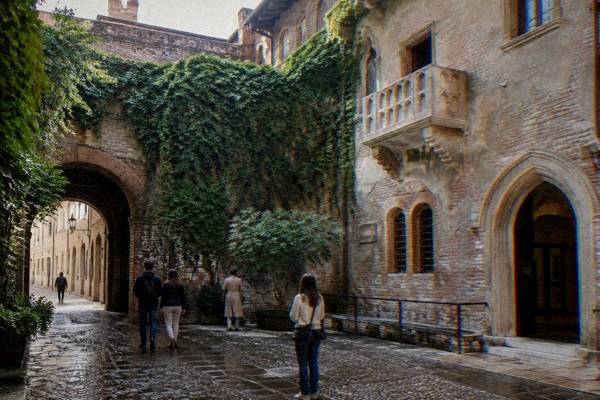
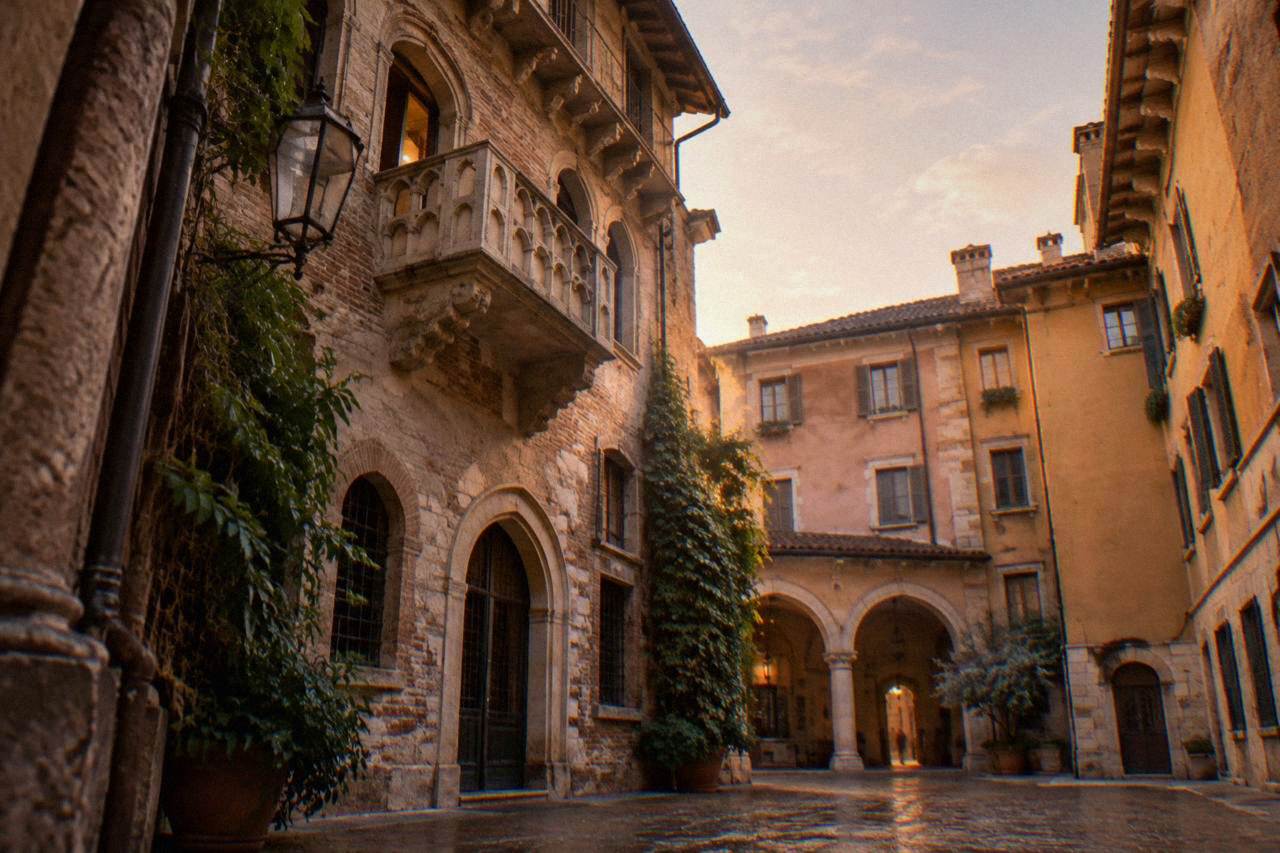
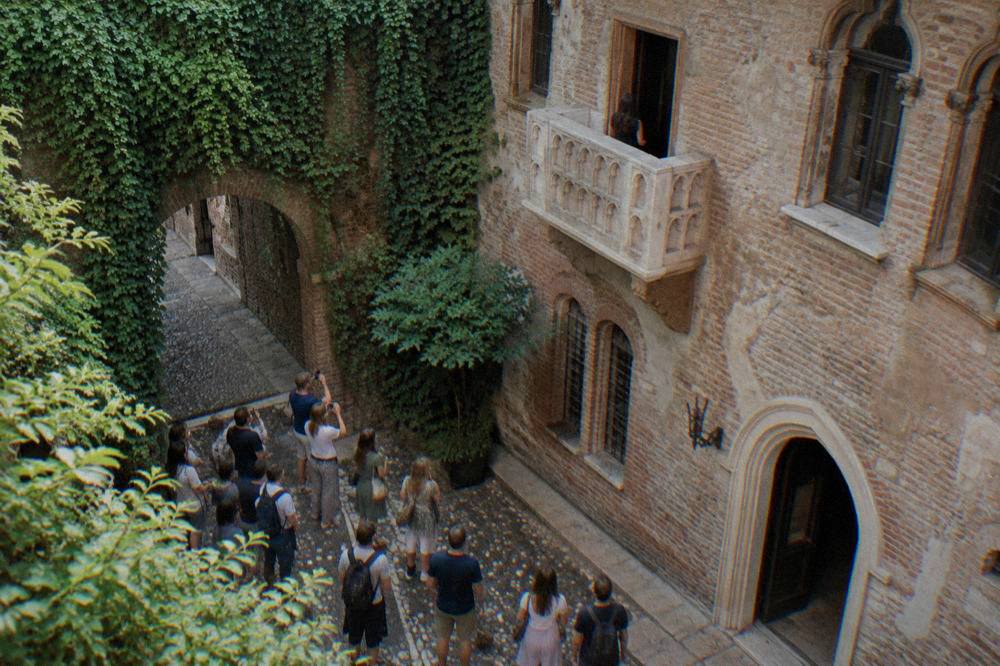
No, the balcony at Juliet's House is not original to any real Juliet, because there was no real Juliet. The city's own tourism office reports that the balcony was added to the medieval facade in 1940, assembled from a carved sarcophagus fragment, in a deliberate act of set-dressing for the legend. The bronze statue below it is by Nereo Costantini, dated 1969 and placed in the courtyard in 1972.
The Casa di Giulietta on Via Cappello is a genuine medieval house with a genuine history, but its connection to Shakespeare's heroine is a construction of modern mythmaking, built on top of a very old habit of linking the building to the Cappelletti name. The balcony question is examined in detail at Is Juliet's Balcony Real In Verona?, and the statue's own strange custom, the rubbing of its right breast for luck, is covered separately in Why Do People Touch Juliet's Statue In Verona?. The original statue, worn thin by decades of that custom, is now kept inside; the courtyard bronze is a 2014 copy.
None of this has dampened demand, and the city has responded with ticketing. Since 1 April 2026 the courtyard is no longer free: the courtyard route costs 5 euro, the full house and balcony route 12 euro, booking is online only, and access runs through the Teatro Nuovo. Reported hours are Monday 14:00 to 19:00 and Tuesday to Sunday 9:00 to 19:00, and visitors should confirm times before they go. A VeronaCard does not remove the need to book. The wider set of guides lives on Verona Italy Travel Guide.
Planning the visit around the legend works best as one morning: the courtyard early, then the short walk to the Arena and Piazza Bra. The tour above bundles the walk, the Arena entry and the funicular in a single booking, and free cancellation terms are shown on the operator's live listing.
Can You Still See The Places The Legend Attached Itself To?
Yes, and they cluster within a short walk of each other. Juliet's House on Via Cappello, Juliet's Tomb in a former monastery, the Arena, Piazza delle Erbe and the Scaliger tombs all sit inside the historic centre, and the whole circuit is walkable without transport. The city's tourist board ties each site to the legend's modern growth rather than to the play's composition, which is the honest framing.
| Site | Link to the legend | Access fact |
|---|---|---|
| Juliet's House, Via Cappello | Courtyard, balcony added 1940, statue 1969 | 5 euro courtyard, 12 euro with house, online booking, via Teatro Nuovo |
| Juliet's Tomb | Traditional site of the tomb scene | Hours and fee not published in the sources; confirm locally |
| Piazza delle Erbe | The market square of the medieval city the story evokes | Open access, free |
| Arena di Verona | First-century Roman amphitheatre, the city's other great stage | 12 euro full, 9 reduced, closed Mondays |
Juliet's Tomb sits in a former Capuchin monastery across the river, and because the sources used here do not publish its hours or any fee, this page prints none: check locally before making the trip. The Arena needs no legend to justify itself, though its own history, gladiators included, is a separate story told at Did Gladiators Fight In The Verona Arena?.
Why Does The Legend Still Sell Verona Today?
Because the city leaned in. Verona's tourism authority explicitly attributes its identity as the city of love to the Romeo and Juliet legend and the Shakespeare association, listing the balcony and the statue as the anchors of that identity. A UNESCO-listed medieval city with a first-century amphitheatre and the Valpolicella wine hills 25 minutes away had plenty to sell already; the love story gave it a single unforgettable image.
The commercial results are visible in the ticket queue on Via Cappello and in the annual February event Verona in Love, which ran 13 to 15 February in its 2026 edition. The Arena's opera festival, which ran 5 June to 12 September in 2026 and is announced for 11 June to 11 September 2027, completes the picture: a city that stages spectacle at Roman scale and romance at courtyard scale, in the same square kilometre.
For a fuller picture of what else the city offers beyond the legend, the site's overview is at Things To Do In Verona, and the question of trip length is settled, with times, at How Many Days In Verona Is Enough?. A final note for romantics weighing a pairing with Venice: the train from Porta Nuova is reported at 1 hour to 1 hour 15, and the comparison is worked through at Can You Do Verona And Venice In One Day?.
The featured walk above is the simplest way to see the legendary sites and the Roman ones in one guided loop, with the cable car over the river for the view Dante never had. Check availability on the operator's live listing before locking in dates.
Common Questions About Shakespeare And Verona
Why Did Shakespeare Choose Verona For Romeo And Juliet?
Because his sources did. Arthur Brooke's 1562 poem, Matteo Bandello's 1554 novella and Luigi da Porto's 1531 original all set the story in Verona, and da Porto justified the choice by citing Dante's reference to the feuding Montecchi. Shakespeare followed the written chain rather than first-hand knowledge.
Did Shakespeare ever visit Verona?
No. The city's own tourism tradition states plainly that Shakespeare never visited Verona, and everything he wrote about the city came to him through written sources, chiefly Brooke's 1562 poem.
Was Juliet a real person?
No historical Juliet is recorded, and the families as the play depicts them did not exist in Verona. Dante's Montecchi reference points to real factional strife in the region, but the lovers themselves are literary inventions, first given life by Luigi da Porto in 1531.
Is Juliet's balcony original?
No. The city's tourism office reports the balcony was added to the facade in 1940, built from a carved sarcophagus fragment, long after both the play and the poem. The bronze statue below it dates from 1969 and was placed in the courtyard in 1972.
Is Juliet's courtyard free to enter?
Not any more. Since 1 April 2026 the courtyard route costs 5 euro and the full house and balcony route 12 euro, booked online, with entry via the Teatro Nuovo. Check the official booking page before visiting.
The legend, in the end, is a relay: Dante gave Verona its feuding names, da Porto gave it the lovers, Bandello and Brooke carried the story across Europe, and Shakespeare gave it the language that made it immortal. Verona's part was simply to be the kind of city where the fiction could take root, and to keep the stage dressed ever since.